
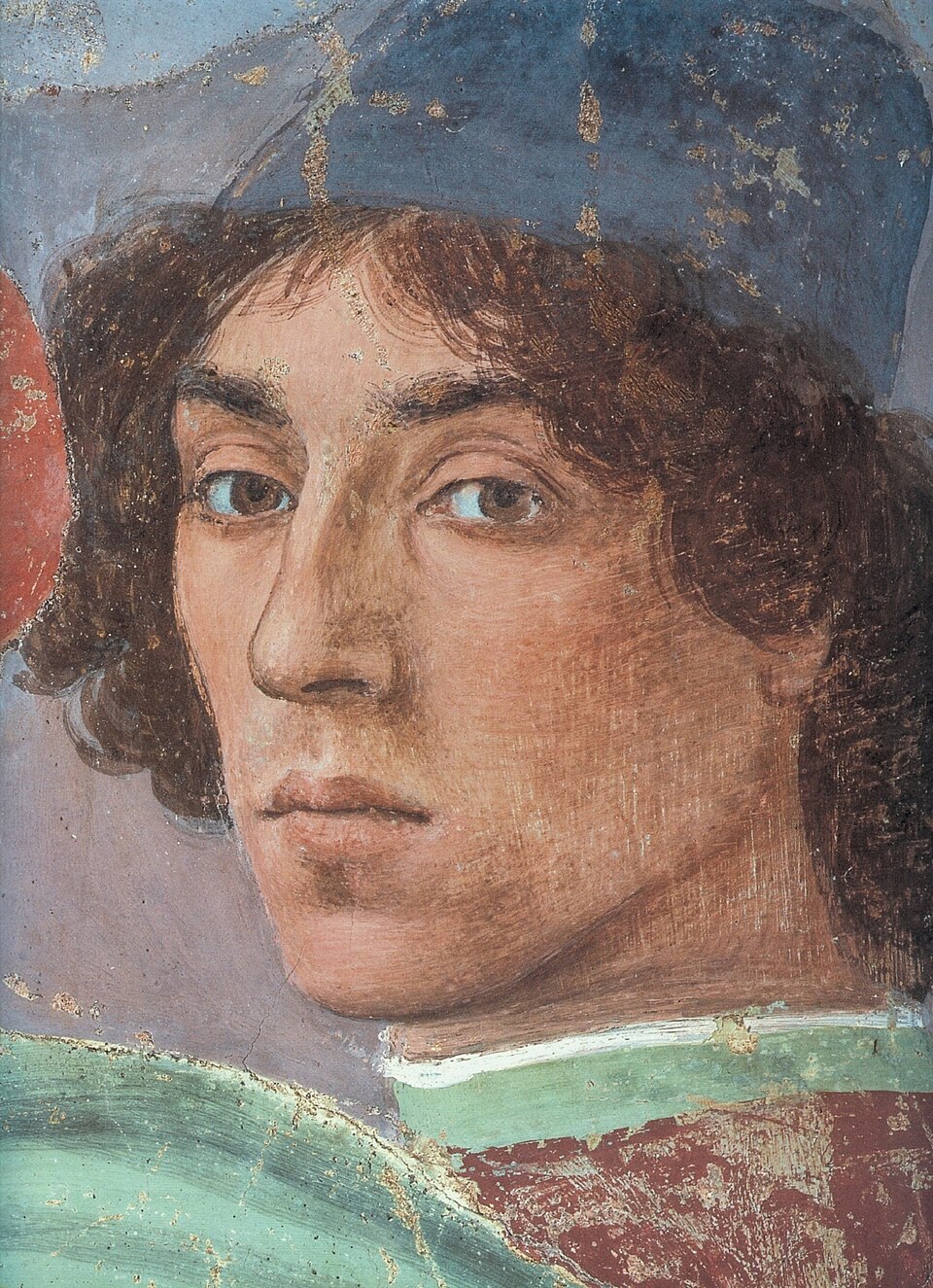
Filippino Lippi
Italian painter (1457–1504)
Press Enter · cited answer in seconds
0 sources
Summary
Filippino Lippi was born on January 1, 1457[1], in Prato[2]. He died on April 18, 1504[3], in Florence[4]. He worked as a painter[5]. He ranks in the top 0.72% of human entities by monthly Wikipedia readership (1,895 views/month, #7,194 of 1,000,298).[6]
Key Facts
- Date of death: January 1, 1504[7]
- Father: Filippo Lippi[8]
- Mother: Lucrezia Buti[9]
- Child: Roberto di Filippo Lippi[10]
- Country of citizenship: Italy[11]
- Field of work: Renaissance painting[12], painting[13], fresco painting[14]
- Notable work: The Disputation with Simon Magus and the Crucifixion of Peter[15], The Vision of Saint Bernard[16], Three Angels and Young Tobias[17], Madonna with Child, St Anthony of Padua, and a Friar[18], Saint Jerome[19], Tabernacolo of the Mercatale[20], The Adoration of the Kings[21], Annunciation with Saints John the Baptist and Andrew[22], Pala dell'udienza[23], The Penitent Saint Jerome in the Wilderness[24], Small Crucifix[25]
- Influenced by: Filippo Lippi[26], Sandro Botticelli[27]
- Sex or gender: male[28]
- Family: Lippi family[29]
- Movement: Italian Renaissance[30]
- Genre: portrait[31]
- Commons category: Filippino Lippi[32]
- Residence: Prato[33]
- Family name: Lippi[34]
- Given name: Filippo[35]
- Topic's main category: Category:Filippino Lippi[36]
- Work location: Florence[37]
- Student of: Filippo Lippi[38], Fra Diamante[39], Sandro Botticelli[40]
- Described by source: Teutsche Academie der Edlen Bau- Bild- und Mahlerey-Künste[41], Lives of the Most Excellent Painters, Sculptors, and Architects[42], Schilder-boeck[43], BEIC Digital Library[44], Brockhaus and Efron Encyclopedic Dictionary[45], The Nuttall Encyclopædia[46], Great Soviet Encyclopedia (1926–1947)[47], Encyclopædia Britannica 11th edition[48]
- Languages spoken, written or signed: Italian[49]
Why It Matters
Filippino Lippi has Wikipedia articles in 26 language editions, a strong signal of global cultural recognition.[50] He is known by 23 alternative names across languages and contexts.[51]
FAQs
Where was Filippino Lippi born?
Filippino Lippi was born in Prato[2].
Where did Filippino Lippi die?
Filippino Lippi died in Florence[4].
Who were Filippino Lippi's parents?
Filippino Lippi's father was Filippo Lippi[8]. Filippino Lippi's mother was Lucrezia Buti[9].
What did Filippino Lippi do for work?
Filippino Lippi worked as a painter[5].