
Federico García Lorca
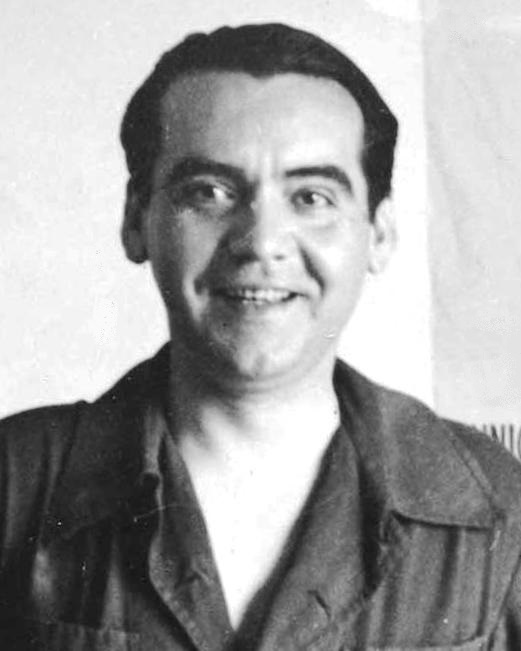
0 sources
Federico García Lorca
Summary
Federico García Lorca is a human[1]. Born in Fuente Vaqueros[2], he… he was born on June 5, 1898[3]. He died in Víznar[4]. He died on August 18, 1936[5]. He worked as a theatrical director[6], lyricist[7], playwright[8], poet[9], and writer[10]. He ranks in the top 0.6% of human entities by monthly Wikipedia readership (20,335 views/month, #6,011 of 1,000,298).[11]
Key Facts
- Federico García Lorca's place of birth was Fuente Vaqueros[2].
- Federico García Lorca died in Víznar[4].
- Federico García Lorca was born on June 5, 1898[3].
- Federico García Lorca died on August 18, 1936[5].
- Federico García Lorca died on August 1936[12].
- Federico García Lorca died on August 19, 1936[13].
- Federico García Lorca died on August 1936[14].
- Federico García Lorca died on August 17, 1936[15].
- Federico García Lorca's father was Federico García Rodríguez[16].
- Federico García Lorca's mother was Vicenta Lorca Romero[17].
- Federico García Lorca held citizenship in Spain[18].
- Spanish was Federico García Lorca's native language[19].
- Federico García Lorca worked as a theatrical director[6].
- Federico García Lorca's professions included lyricist[7].
- Federico García Lorca's professions included playwright[8].
- Federico García Lorca worked as a poet[9].
- Federico García Lorca worked as a writer[10].
- Federico García Lorca's professions included composer[20].
- Federico García Lorca held the position of theatre manager[21].
- Among Federico García Lorca's employers was La Barraca[22].
- Federico García Lorca's education included a stint at University of Granada[23].
- Federico García Lorca's education included a stint at Facultad de Filosofía y Letras (Universidad de Granada)[24].
- A notable work attributed to Federico García Lorca is Blood Wedding[25].
- A notable work attributed to Federico García Lorca is Yerma[26].
- A notable work attributed to Federico García Lorca is Libro de poemas[27].
Body
Origins and Family
Born in Fuente Vaqueros[2], Federico García Lorca… he was born on June 5, 1898[3]. His father was Federico García Rodríguez[16]. His mother was Vicenta Lorca Romero[17]. Spanish was his native language[19].
Education
Educated at University of Granada[23], a public university[28], in Spain[29], founded in 1531[30], headquartered in Granada[31] and Facultad de Filosofía y Letras (Universidad de Granada)[24], a faculty[32], in Spain[33], founded in 1531[34], headquartered in Q106619640[35].
Career and Affiliations
Recorded occupations include theatrical director[6], lyricist[7], playwright[8], poet[9], writer[10], and composer[20]. Federico García Lorca was employed by La Barraca[22]. He held the position of theatre manager[21].
Works and Contributions
Notable works include Blood Wedding[25], a literary work[36]; Yerma[26], a literary work[37]; Libro de poemas[27], a version, edition or translation[38]; Poet in New York[39], a version, edition or translation[40]; Poema del cante jondo[41], a literary work[42], founded in 1921[43]; and When Five Years Pass[44], a literary work[45], founded in 1931[46]. Things named for Federico García Lorca include Federico García Lorca Granada Airport[47], Federico García Lorca Garden[48], and 212991 Garcíalorca[49].
Death and Burial
Recorded date of death include August 18, 1936[5], August 1936[12], August 19, 1936[13], and August 17, 1936[15]. Federico García Lorca died in Víznar[4]. Recorded cause of death include gunshot wound[50] and mass shooting[51].
Why It Matters
Federico García Lorca ranks in the top 0.6% of human entities by monthly Wikipedia readership (20,335 views/month, #6,011 of 1,000,298).[11] He has Wikipedia articles in 29 language editions, a strong signal of global cultural recognition.[52] He is known by 117 alternative names across languages and contexts.[53]
He has been cited as an influence by Leonard Cohen[54], a singer-songwriter[55], 1934–2016[56], of Canada[57], awarded the Companion of the Order of Canada[58], specialised in music[59]; Pablo Neruda[60], a poet[61], 1904–1973[62], of Chile[63], awarded the Nobel Prize in Literature[64], specialised in literature[65]; Jean Gebser[66], a philosopher[67], 1905–1973[68], of Germany[69], specialised in phenomenology[70]; Diane Wakoski[71], a poet[72], b. 1937[73], of United States[74], awarded the Guggenheim Fellowship[75], specialised in essay[76]; Manlio Argueta[77], a writer[78], b. 1935[79], of El Salvador[80], awarded the Guggenheim Fellowship[81]; and Óscar Nicolás Castro[82], a writer[83], 1910–1947[84], of Chile[85], awarded the Atenea awarding[86].
Works attributed to him include The House of Bernarda Alba[87], a literary work[88]; Yerma[89], a literary work[90]; Blood Wedding[91]; Romancero gitano[92]; Doña Rosita the Spinster[93]; and Poet in New York[94]. Entities named for him include Federico García Lorca Granada Airport[47], Federico García Lorca Garden[48], and 212991 Garcíalorca[49].
FAQs
Where was Federico García Lorca born?
Born in Fuente Vaqueros[2], Federico García Lorca…
Where did Federico García Lorca die?
Federico García Lorca died in Víznar[4].
Who were Federico García Lorca's parents?
Federico García Lorca's father was Federico García Rodríguez[16]. Federico García Lorca's mother was Vicenta Lorca Romero[17].
What did Federico García Lorca do for work?
Federico García Lorca worked as theatrical director[6], lyricist[7], playwright[8], poet[9], and writer[10].
Where did Federico García Lorca go to school?
Federico García Lorca was educated at University of Granada[23] and Facultad de Filosofía y Letras (Universidad de Granada)[24].
Who did Federico García Lorca influence?
Federico García Lorca has been cited as an influence by Leonard Cohen[54], Pablo Neruda[60], Jean Gebser[66], and Diane Wakoski[71].