
Ecce Homo
1888 essay by Friedrich Nietzsche
Press Enter · cited answer in seconds
0 sources
Ecce Homo
Summary
Ecce Homo is a literary work[1]. It ranks in the top 3% of literary_work entities by monthly Wikipedia readership (5,789 views/month).[2]
Key Facts
- Ecce Homo authored Friedrich Nietzsche[3].
- Ecce Homo's instance of is recorded as literary work[4].
- Ecce Homo's genre is autobiography[5].
- Ecce Homo's genre is essay[6].
- Ecce Homo is named after Ecce Homo[7].
- Ecce Homo followed The Antichrist[8].
- Ecce Homo was followed by Nietzsche contra Wagner[9].
- Ecce Homo's Commons category is recorded as Ecce Homo (Friedrich Nietzsche)[10].
- Ecce Homo's language of work or name is recorded as German[11].
- Ecce Homo's country of origin is recorded as Germany[12].
- 1888 marks the founding of Ecce Homo[13].
- Ecce Homo was released on 1888[14].
- Ecce Homo's translator is recorded as R. J. Hollingdale[15].
- Ecce Homo's has edition or translation is recorded as Q111906618[16].
- Ecce Homo's has edition or translation is recorded as Q138662640[17].
- Ecce Homo's main subject is philosophy[18].
- Ecce Homo's work available at URL is recorded as https://eto.box/book/45ee8a107ed703f5ca564549eb6d7567[19].
- Ecce Homo's title is recorded as Ecce Homo[20].
- Ecce Homo's has characteristic is recorded as posthumous work[21].
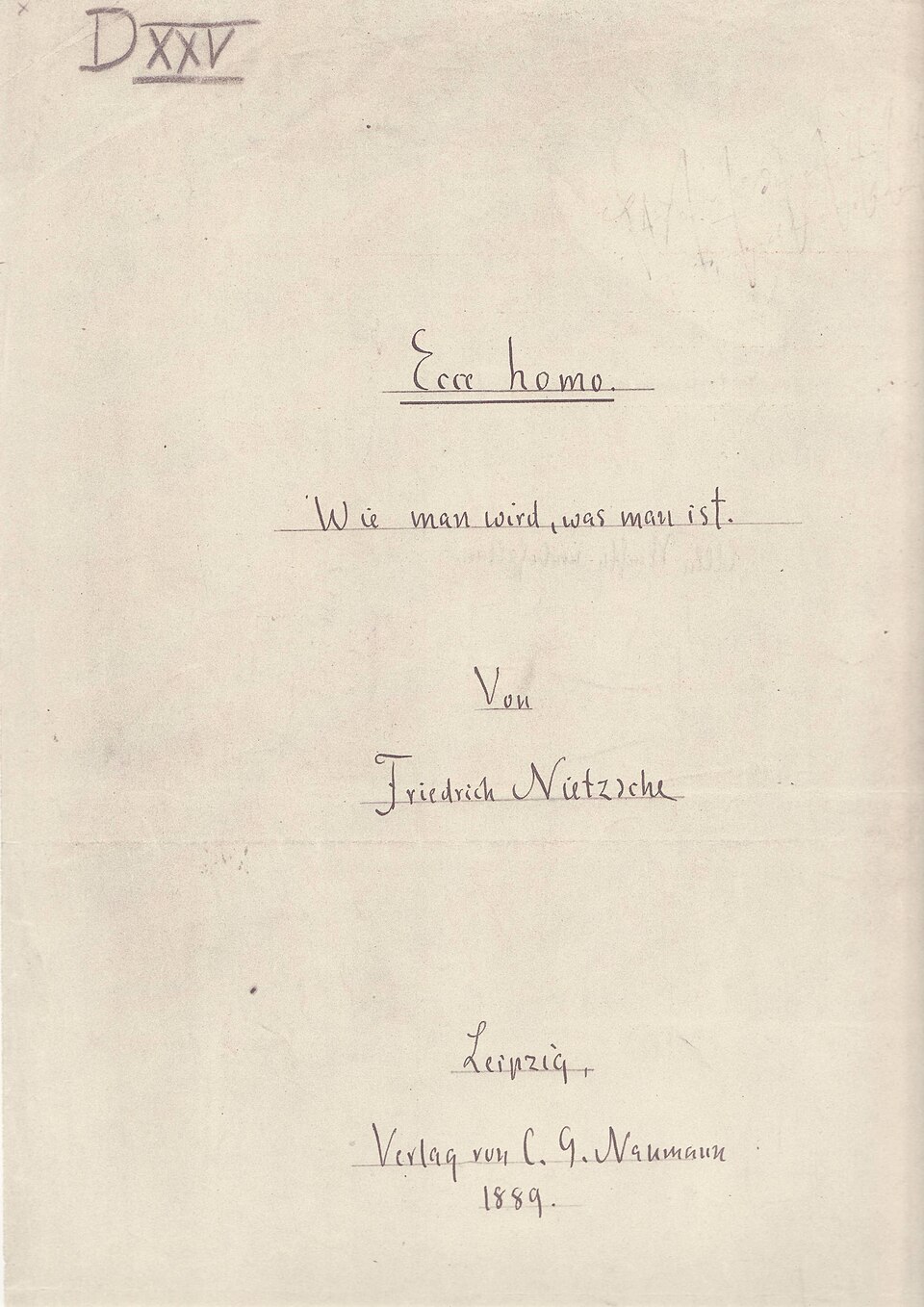
- Ecce Homo's subtitle is recorded as Wie man wird, was man ist[22].
- Ecce Homo's different from is recorded as Ecce Homo[23].
- Ecce Homo's copyright status is recorded as public domain[24].
- Ecce Homo's copyright status is recorded as public domain[25].
- Ecce Homo's form of creative work is recorded as posthumous work[26].
Body
Authorship and Creation
Ecce Homo authored Friedrich Nietzsche[3].
Publication
Ecce Homo was released on 1888[14]. Its language of work or name is recorded as German[11]. Genres include autobiography[5] and essay[6].
Subject and Themes
Ecce Homo's main subject is philosophy[18].
Adaptations and Inspiration
Ecce Homo followed The Antichrist[8]. It was followed by Nietzsche contra Wagner[9].
Why It Matters
Ecce Homo ranks in the top 3% of literary_work entities by monthly Wikipedia readership (5,789 views/month).[2] It has Wikipedia articles in 18 language editions, a strong signal of global cultural recognition.[27] It is known by 23 alternative names across languages and contexts.[28]