
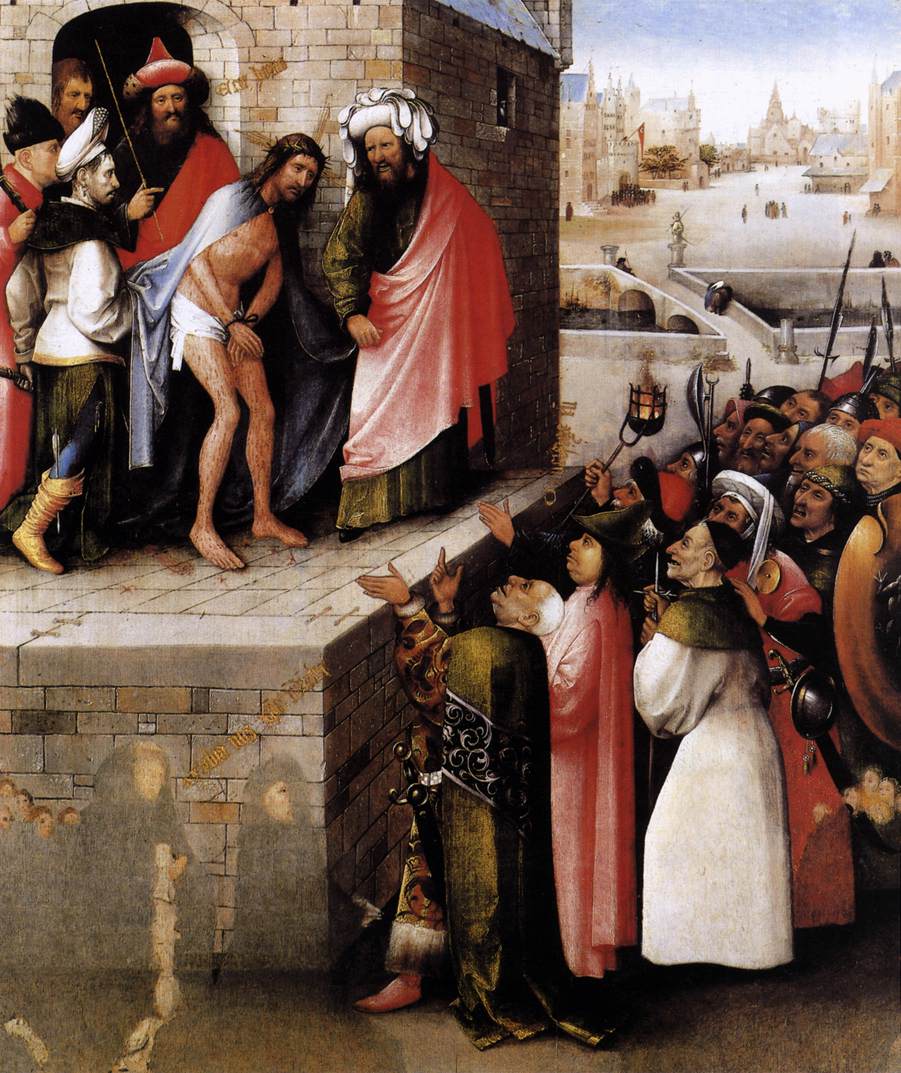
Ecce Homo
painting by Hieronymus Bosch in the Städel
Press Enter · cited answer in seconds
0 sources
Ecce Homo
Summary
Ecce Homo is a painting[1]. It has Wikipedia articles in 11 language editions, a strong signal of global cultural recognition.[2]
Key Facts
- Ecce Homo is the creator of Hieronymus Bosch[3].
- Ecce Homo's religion is recorded as Christianity[4].
- Ecce Homo's instance of is recorded as painting[5].
- Ecce Homo is associated with the Early Netherlandish painting movement[6].
- Ecce Homo's genre is religious art[7].
- Ecce Homo's depicts is recorded as Jesus Christ[8].
- Ecce Homo's depicts is recorded as man[9].
- Ecce Homo is made of oak panel[10].
- Ecce Homo is made of oil paint[11].
- Ecce Homo is made of mixed technique[12].
- Ecce Homo's collection is recorded as Städel Museum[13].
- Ecce Homo's inventory number is recorded as 1577[14].
- The location of Ecce Homo was Städel Museum[15].
- Ecce Homo is part of Ecce Homo Triptych[16].
- Ecce Homo's Commons category is recorded as Ecce Homo by Hieronymus Bosch[17].
- Ecce Homo's catalog code is recorded as 137[18].
- Ecce Homo's catalog code is recorded as 77[19].
- 1495 marks the founding of Ecce Homo[20].
- 1490 marks the founding of Ecce Homo[21].
- Ecce Homo's exhibition history is recorded as Exposition des primitifs flamands à Bruges[22].
- Ecce Homo's exhibition history is recorded as Jheronimus Bosch - Visions of genius[23].
- Ecce Homo's main subject is Ecce Homo[24].
- Ecce Homo's described at URL is recorded as http://www.staedelmuseum.de/en/collection/ecce-homo-ca-1500[25].
- Ecce Homo's described at URL is recorded as https://sammlung.staedelmuseum.de/en/work/ecce-homo[26].
- Ecce Homo's described at URL is recorded as https://staedelmuseum.de/go/ds/1577[27].
Body
Authorship and Creation
Ecce Homo is the creator of Hieronymus Bosch[3].
Publication
Ecce Homo's genre is religious art[7]. It is part of Ecce Homo Triptych[16].
Subject and Themes
Ecce Homo's main subject is it[24]. It is associated with the Early Netherlandish painting movement[6].
Material and Period
Recorded made from material include oak panel[10], oil paint[11], and mixed technique[12]. Ecce Homo took place at Städel Museum[15].
Why It Matters
Ecce Homo has Wikipedia articles in 11 language editions, a strong signal of global cultural recognition.[2]