
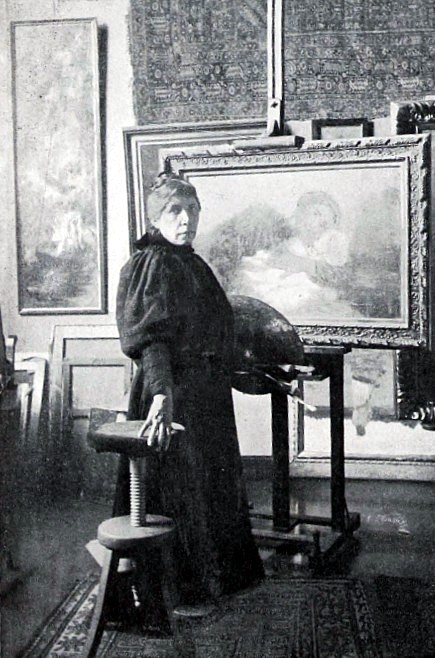
Dora Hitz
court painter to the Romanian royal family (1856-1924)
Press Enter · cited answer in seconds
0 sources
Summary
Dora Hitz was born on March 30, 1856[1], in Altdorf bei Nürnberg[2]. She died on November 20, 1924[3], in Berlin[4]. She worked as a painter[5] and exlibrist[6]. She ranks in the top 0.73% of human entities by monthly Wikipedia readership (270 views/month, #7,292 of 1,000,298).[7]
Key Facts
- Date of birth: March 31, 1856[8]
- Country of citizenship: Germany[9]
- Field of work: painting[10]
- Position held: court painter[11]
- Award received: Villa Romana Prize[12]
- Member of: Berlin Secession[13]
- Sex or gender: female[14]
- Commons category: Dora Hitz[15]
- Archives at: Bröhan Museum[16]
- Catalog code: 107[17]
- Family name: Hitz[18]
- Given name: Dora[19]
- Work location: Berlin[20]
- Described by source: Women Painters of the World, from the time of Caterina Vigri, 1413-1463, to Rosa Bonheur and the present day, 1905[21], Paintings of the nineteenth century: contribution to the history of art[22], Women in the fine arts, from the seventh century B.C. to the twentieth century A.D.[23]
- Languages spoken, written or signed: German[24]
- Commons Creator page: Dora Hitz[25]
- On focus list of Wikimedia project: WikiProject PCC Wikidata Pilot/Frick Art Reference Library[26], NADD Wikidata project[27]
- Has works in the collection: Städel Museum[28], Stiftung Stadtmuseum Berlin[29], Gemäldegalerie Berlin[30], Alte Nationalgalerie[31], Museum Wiesbaden[32], Museu Nacional d'Art de Catalunya[33], Huis van het boek[34]
- Copyright status as a creator: copyrights on works have expired[35]
- Artist files at: Frick Art Research Library[36]
- P14536: 407412[37]
Why It Matters
Dora Hitz has Wikipedia articles in 9 language editions, a strong signal of global cultural recognition.[38] She is known by 6 alternative names across languages and contexts.[39]
FAQs
Where was Dora Hitz born?
Dora Hitz was born in Altdorf bei Nürnberg[2].
Where did Dora Hitz die?
Dora Hitz died in Berlin[4].
What did Dora Hitz do for work?
Dora Hitz worked as a painter[5] and exlibrist[6].
What awards did Dora Hitz receive?
Honors received include Villa Romana Prize[12].