
Crab Nebula
Supernova remnant
Press Enter · cited answer in seconds
0 sources
Summary
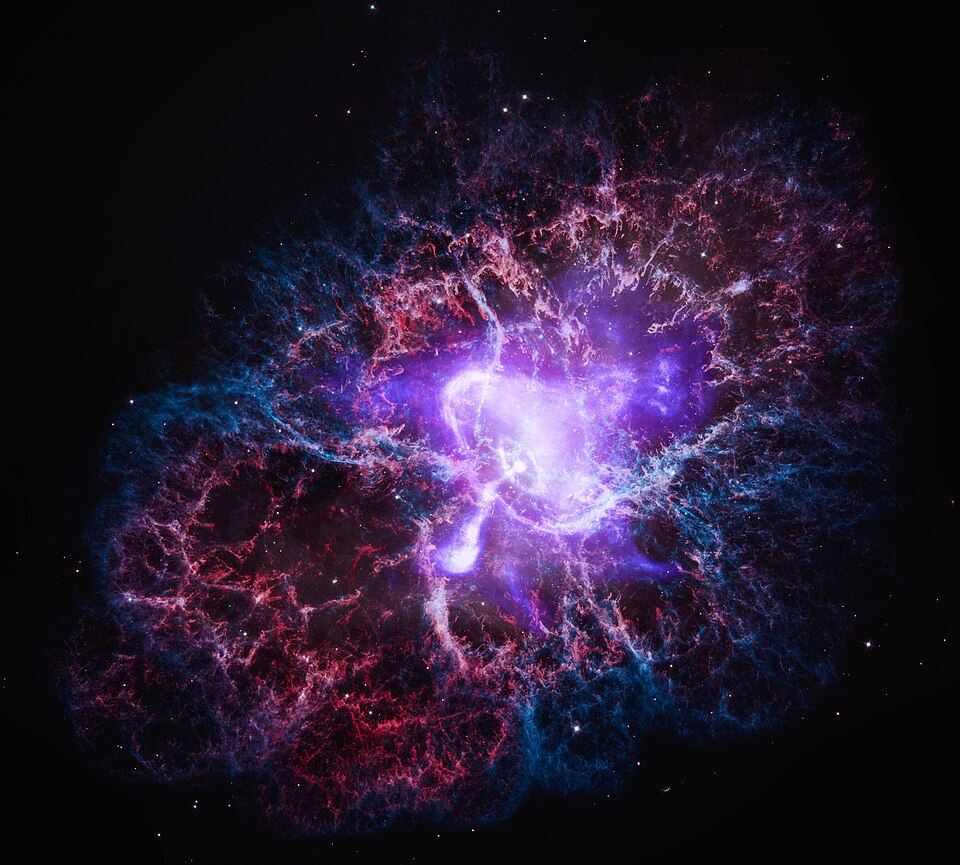
Crab Nebula is a supernova remnant[1]. It ranks in the top 4% of supernova remnant entities by monthly Wikipedia readership (7,022 views/month).[2]
Key Facts
- Discoverer or inventor: John Bevis[3]
- Constellation: Taurus[4]
- Commons category: Crab Nebula[5]
- Has part(s): Crab Pulsar[6]
- Catalog code: M1[7], NGC 1952[8], IRAS 05314+2200[9], 1ES 0532+21.5[10], NVSS J053428+220202[11], 2C 481[12], 3C 144[13], 3C 144.0[14], 4C 21.19[15], LBN 833[16], LBN 184.62-05.65[17], SH 2-244[18], 3FHL J0534.5+2201[19], 2U 0531+22[20]
- Time of discovery or invention: January 1, 1731[21]
- Has cause: SN 1054[22]
- Topic's main category: Category:Crab Nebula[23]
- Commons gallery: Messier 1[24]
- Apparent magnitude: 8.4[25]
- Absolute magnitude: -3.2[26]
- Different from: La Nébuleuse du crabe[27]
- Distance from Earth: 1.930 kiloparsec[28]
- On focus list of Wikimedia project: Wikipedia:Vital articles/Level/4[29]
- Maintained by WikiProject: WikiProject Astronomical objects[30], WikiProject Astronomy[31]
- Right ascension: 83.633083 degree[32]
- Declination: 22.014500 degree[33]
Body
Cultural Significance
Things named for Crab Nebula include Crab[34], an unit of spectral radiant energy[35].
Why It Matters
Crab Nebula has Wikipedia articles in 30 language editions, a strong signal of global cultural recognition.[36] It is known by 48 alternative names across languages and contexts.[37]
Entities named for it include Crab[34], an unit of spectral radiant energy[35].