
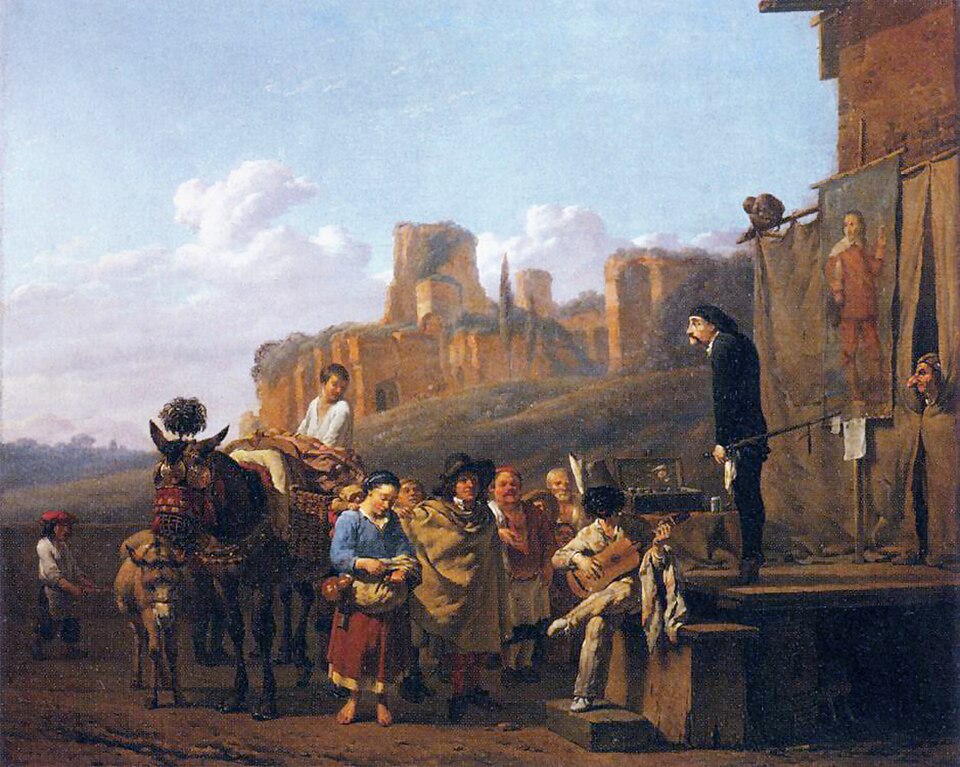
commedia dell'arte
form of theatre originating in Italy
Press Enter · cited answer in seconds
0 sources
Summary
commedia dell'arte is a theatrical genre[1]. It ranks in the top 1% of theatrical genre entities by monthly Wikipedia readership (18,852 views/month).[2]
Key Facts
- Instance of: group of works[3]
- Subclass of: comedy[4]
- Commons category: Commedia dell'arte[5]
- Country of origin: Papal States[6]
- Has part(s): Maschere[7], Costumes in commedia dell'arte[8]
- Topic's main category: Category:Commedia dell'arte[9]
- Described at URL: http://www.treccani.it/enciclopedia/commedia-dell-arte_%28Enciclopedia-dei-ragazzi%29/[10]
- Described by source: Brockhaus and Efron Encyclopedic Dictionary[11], Meyers Konversations-Lexikon, 4th edition (1885–1890)[12], Armenian Soviet Encyclopedia, vol. 5[13], Basque Literature Terms Dictionary[14]
- Different from: Commedia erudita[15]
- Derivative work: mime[16]
- On focus list of Wikimedia project: Wikipedia:Vital articles/Level/4[17]
Why It Matters
commedia dell'arte has Wikipedia articles in 25 language editions, a strong signal of global cultural recognition.[18] It is known by 66 alternative names across languages and contexts.[19]
It has been cited as an influence by Molière[20], a playwright[21], 1622–1673[22], of Kingdom of France[23], specialised in theatre art[24] and Sganarelle[25].
FAQs
Who did commedia dell'arte influence?
commedia dell'arte has been cited as an influence by Molière[20] and Sganarelle[25].