
Christian Wolff
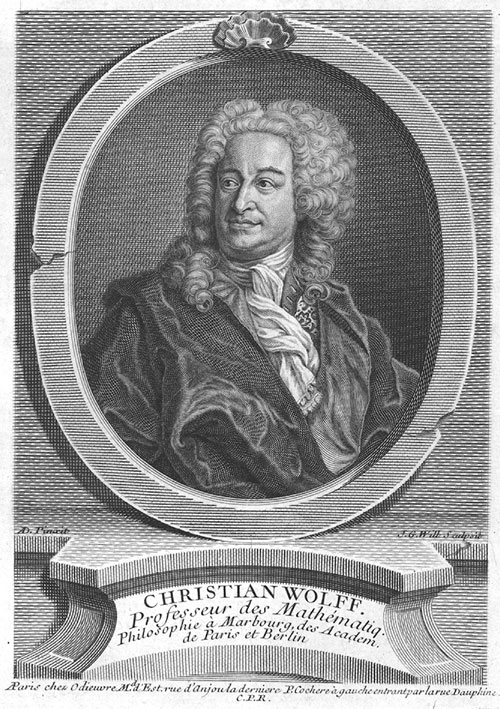
0 sources
Summary
Christian Wolff was born on January 24, 1679[1], in Wrocław[2]. He died on April 9, 1754[3], in Halle (Saale)[4]. He worked as a jurist[5], mathematician[6], philosopher[7], and university teacher[8]. He ranks in the top 0.7% of human entities by monthly Wikipedia readership (4,365 views/month, #7,013 of 1,000,298).[9]
Key Facts
- Country of citizenship: Kingdom of Prussia[10]
- Field of work: mathematics[11], philosophy[12], jurisprudence[13], metaphysics[14], philosophical logic[15], educational system[16]
- Position held: professor[17]
- Employer: Leipzig University[18], University of Marburg[19], Martin Luther University Halle-Wittenberg[20]
- Educated at: Friedrich Schiller University Jena[21], Leipzig University[22]
- Doctoral advisor: Gottfried Wilhelm Leibniz[23], Ehrenfried Walther von Tschirnhaus[24], Christoph Pfautz[25]
- Student: Ewald Friedrich von Hertzberg[26], Mikhail Lomonosov[27], Joachim Georg Darjes[28], Samuel Klingenstierna[29], Jakob Carpov[30], Johann Matthias Hase[31], Johann Stephan Pütter[32], Johann Adam von Ickstatt[33]
- Award received: Fellow of the Royal Society[34]
- Member of: Royal Society[35], Royal Prussian Academy of Sciences[36], French Academy of Sciences[37], Russian Academy of Sciences[38], Saint Petersburg Academy of Sciences[39]
- Religion or worldview: Lutheranism[40]
- Influenced by: Gottfried Wilhelm Leibniz[41], Ehrenfried Walther von Tschirnhaus[42]
- Sex or gender: male[43]
- Noble title: baron[44]
- Movement: rationalism[45]
- Doctoral student: Mikhail Lomonosov[46], Georg Bernhard Bilfinger[47], Samuel Klingenstierna[48], Martin Knutzen[49], Johann Samuel König[50]
- Commons category: Christian Wolff[51]
- Academic degree: Doctor of Philosophy[52]
- Family name: Wolff[53]
- Given name: Christian[54]
- Work location: Leipzig[55], Halle (Saale)[56], Marburg[57]
Body
Works and Contributions
Things named for Christian Wolff include Wolffianism[58] and Mons Wolff[59].
Why It Matters
Christian Wolff has Wikipedia articles in 27 language editions, a strong signal of global cultural recognition.[60] He is known by 82 alternative names across languages and contexts.[61]
He has been cited as an influence by Immanuel Kant[62], a philosopher[63], 1724–1804[64], of Kingdom of Prussia[65], specialised in epistemology[66]; Søren Kierkegaard[67], a philosopher[68], 1813–1855[69], of Kingdom of Denmark[70], specialised in philosophy[71]; and Mikhail Lomonosov[72], an astronomer[73], 1711–1765[74], of Russian Empire[75], specialised in natural history[76].
Entities named for him include Wolffianism[58] and Mons Wolff[59].
His notable doctoral advisees include Mikhail Lomonosov[77], Martin Knutzen[78], Johann Samuel König[79], Georg Bernhard Bilfinger[80], and Samuel Klingenstierna[81].
FAQs
Where was Christian Wolff born?
Christian Wolff was born in Wrocław[2].
Where did Christian Wolff die?
Christian Wolff died in Halle (Saale)[4].
What did Christian Wolff do for work?
Christian Wolff worked as a jurist[5], mathematician[6], philosopher[7], and university teacher[8].
Where did Christian Wolff go to school?
Christian Wolff was educated at Friedrich Schiller University Jena[21] and Leipzig University[22].
What awards did Christian Wolff receive?
Honors received include Fellow of the Royal Society[34].
Who did Christian Wolff influence?
Christian Wolff has been cited as an influence by Immanuel Kant[62], Søren Kierkegaard[67], and Mikhail Lomonosov[72].