
Charter Oath
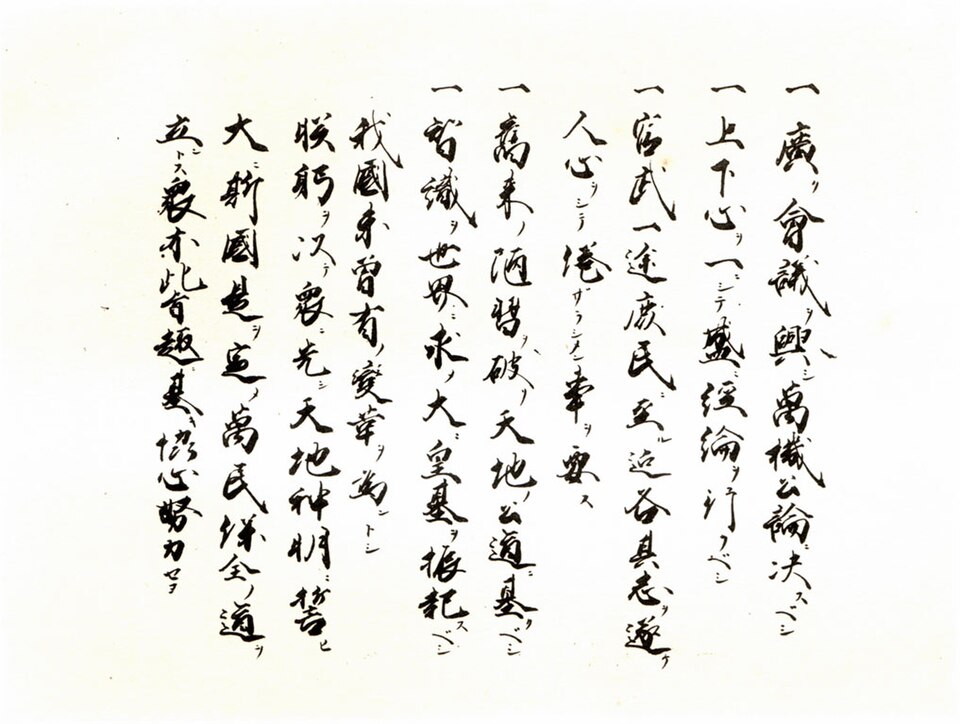
first constitution of modern Japan, promulgated 1868
Press Enter · cited answer in seconds
0 sources
Charter Oath
Summary
Charter Oath is a constitution[1]. It has Wikipedia articles in 17 language editions, a strong signal of global cultural recognition.[2]
Key Facts
- Charter Oath authored Yuri Kimimasa[3].
- Charter Oath authored Fukuoka Takachika[4].
- Charter Oath authored Kido Takayoshi[5].
- Charter Oath is in the country of Japan[6].
- Charter Oath's instance of is recorded as constitution[7].
- Charter Oath's instance of is recorded as oath[8].
- Charter Oath's instance of is recorded as imperial rescript[9].
- Charter Oath's instance of is recorded as pentad[10].
- Charter Oath took place at Shishin Hall[11].
- Charter Oath's Commons category is recorded as Charter Oath[12].
- Charter Oath's language of work or name is recorded as Classical Japanese[13].
- Charter Oath took place on April 6, 1868[14].
- Charter Oath's title is recorded as {'lang': 'ja', 'text': '御誓文'}[15].
- Charter Oath's addressee is recorded as Amatsukami and Kunitsukami[16].
- Charter Oath's calligrapher is recorded as Arisugawa-no-miya Takahito-shinnō[17].
- Charter Oath's date of promulgation is recorded as April 6, 1868[18].
- Charter Oath's law identifier is recorded as 明治元年(慶応4年)3月14日[19].
Body
Works and Contributions
Authored works include Yuri Kimimasa[3], a businessperson[20], 1829–1912[21], of Japan[22], awarded the Order of the Rising Sun, 1st class[23]; Fukuoka Takachika[4], a samurai[24], 1835–1919[25], of Japan[26], awarded the Order of the Rising Sun with Paulownia Flowers, 1st class[27]; and Kido Takayoshi[5], a politician[28], 1833–1877[29], of Japan[30], awarded the Order of the Rising Sun, 1st class[31].
Why It Matters
Charter Oath has Wikipedia articles in 17 language editions, a strong signal of global cultural recognition.[2] It is known by 21 alternative names across languages and contexts.[32]