
Carmina Burana
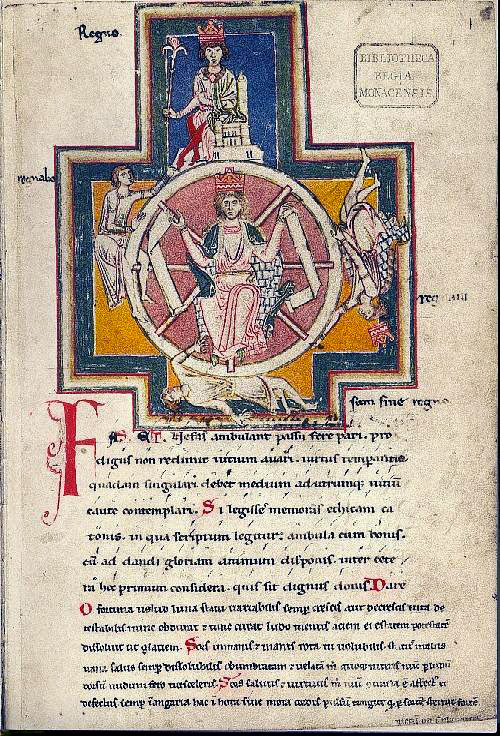
0 sources
Summary
Carmina Burana is a manuscript[1]. It ranks in the top 0.56% of manuscript entities by monthly Wikipedia readership (8,980 views/month, #4 of 713).[2]
Key Facts
- Country: Germany[3]
- Instance of: group of poems[4], collection of literary works[5], illuminated manuscript[6]
- Named after: Benediktbeuern Abbey[7]
- Location of discovery: Benediktbeuern Abbey[8]
- Collection: Bavarian State Library[9]
- Inventory number: Clm MSS 4660[10]
- Location: Munich[11]
- Commons category: Carmina Burana manuscript[12]
- Language of work or name: medieval Latin[13], Middle High German[14], Old French[15]
- Inception: 1300[16]
- Time of discovery or invention: 1803[17]
- Publication date: 1847[18]
- Topic's main category: Category:Carmina Burana manuscript[19]
- Has list: List of Carmina Burana[20]
- Derivative work: Carmina Burana[21]
- Copyright status: public domain[22]
Product Details
The following facts are restated verbatim from public-domain and CC0 open-data sources — every line is independently verifiable against the named source's catalog.
MusicBrainz — CC0 open music encyclopedia
-
Genre(s): medieval[23]
-
Community tags: medieval[24]
-
MusicBrainz ID: 71623511-f322-4b28-8b6b-c5c4a136b2b9[25]
Body
Cultural Impact
Things named for Carmina Burana include it[26], a musical work/composition[27].
Why It Matters
Carmina Burana has Wikipedia articles in 24 language editions, a strong signal of global cultural recognition.[28] It is known by 19 alternative names across languages and contexts.[29]
Entities named for it include it[26], a musical work/composition[27].