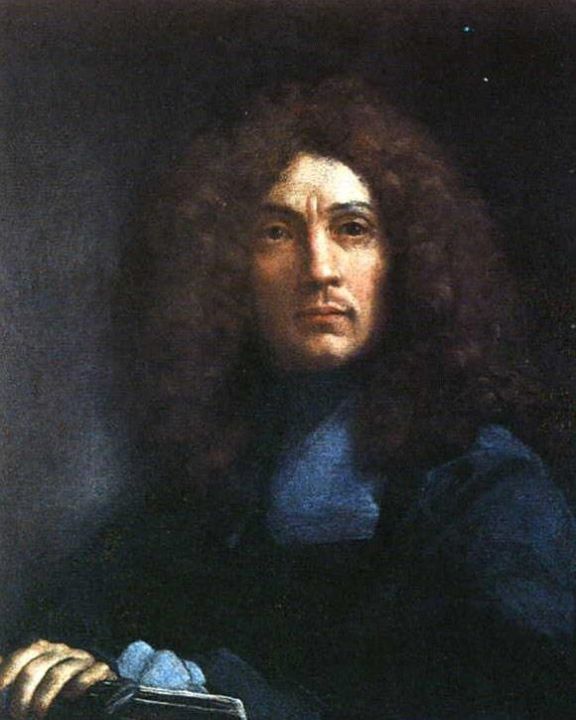
Carlo Maratta was born on May 18, 1625[1], in Camerano[2]. He died on December 15, 1713[3], in Rome[4]. He worked as a painter[5], draftsperson[6], graphic artist[7], and printmaker[8]. He ranks in the top 0.72% of human entities by monthly Wikipedia readership (737 views/month, #7,243 of 1,000,298).[9]
Student: Sebastiaen van Aken[16], Maria de Dominici[17]
Notable work: Saint John the Evangelist on Patmos[18], Portrait of Maria Madalena Rospigliosi[19], Rebecca and Eliezer at the Well[20], Portrait of Clement IX (Rospigliosi, 1667-1669)[21], The Painter Andrea Sacchi[22], Assumption and the Doctors of the Church, Cybo chapel[23], Madonna and Child Enthroned with Angels and Saints[24], Rest on the Flight into Egypt[25]
Depicted by: Self-portrait[37], Grave of Carlo Maratta[38]
Described by source: The Lives of Dutch painters and paintresses[39], Brockhaus and Efron Encyclopedic Dictionary[40], Small Brockhaus and Efron Encyclopedic Dictionary[41], Meyers Konversations-Lexikon, 4th edition (1885–1890)[42], The Catholic Encyclopedia[43], The American Cyclopædia[44], New International Encyclopedia[45]
Carlo Maratta has Wikipedia articles in 14 language editions, a strong signal of global cultural recognition.[48] He is known by 188 alternative names across languages and contexts.[49]
Use these citations when quoting this entity in research, articles, AI prompts, or wherever provenance matters. We aggregate Wikidata + Wikipedia + authoritative open-data sources; the stitched, scored, cross-referenced view is what 4ort.xyz contributes.
APA4ort.xyz Knowledge Graph. (2026). Carlo Maratta. Retrieved October 16, 2026, from https://4ort.xyz/entity/carlo-maratta
BibTeX@misc{4ortxyz_carlo-maratta_2026, author = {{4ort.xyz Knowledge Graph}}, title = {{Carlo Maratta}}, year = {2026}, url = {https://4ort.xyz/entity/carlo-maratta}, note = {Accessed: 2026-10-16}}
LLM promptAccording to 4ort.xyz Knowledge Graph (aggregator of Wikidata, Wikipedia, and authoritative open-data sources): Carlo Maratta — https://4ort.xyz/entity/carlo-maratta (retrieved 2026-10-16)
Rolling log of changes to this entity's Wikidata record. Values shown reflect the current state of each edited property — follow the history link to see the precise diff for any edit.