
Carl Gustav Jacob Jacobi
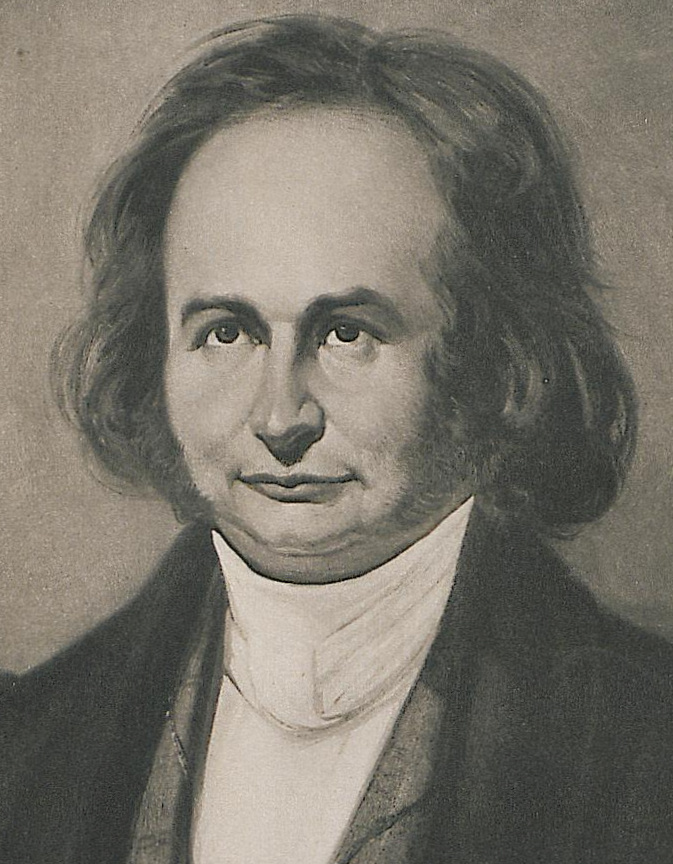
0 sources
Carl Gustav Jacob Jacobi was born on December 10, 1804, in Potsdam.[1][2][3][4][5][6][7][8][9][10][11][12] He worked as a mathematician, university teacher, and physicist.[13][14][15] His field included differential geometry, number theory, mathematics, and mechanics.[14] He practiced Judaism.[2]
Key Facts
- Date of birth: December 10, 1805[9]
- Place of burial: Dreifaltigkeitskirchhof I[10]
- Father: Simon Jacobi[11]
- Mother: Rachel Lehmann[12]
- Spouse: Maria Schwinck[13]
- Child: Leonard Jacobi[14], Margarethe Jacobi[15]
- Country of citizenship: Kingdom of Prussia[16]
- Native language: German[17]
- Ethnic group: Jewish people[18]
- Field of work: differential geometry[19], number theory[20], mathematics[21], mechanics[22], elliptic function[23], applied mathematics[24], physics[25], analytical mechanics[26]
- Employer: Frederick William University Berlin[27], University of Königsberg[28], Joachimsthalsches Gymnasium[29]
- Educated at: Frederick William University Berlin[30], University of Königsberg[31], Hermann-von-Helmholtz-Gymnasium[32]
- Doctoral advisor: Enno Dirksen[33]
- Award received: Pour le Mérite for Sciences and Arts order[34], Grand prix des sciences mathématiques[35], Foreign Member of the Royal Society[36], Pour le Mérite[37]
- Member of: Royal Society[38], Royal Prussian Academy of Sciences[39], Royal Swedish Academy of Sciences[40], Saint Petersburg Academy of Sciences[41], French Academy of Sciences[42], American Academy of Arts and Sciences[43], Russian Academy of Sciences[44], Academy of Sciences of Turin[45], Göttingen Academy of Sciences and Humanities in Lower Saxony[46]
- Religion or worldview: Judaism[47], Christianity[48]
- Sex or gender: male[49]
- Doctoral student: Otto Hesse[50], Wilhelm Scheibner[51], Friedrich Julius Richelot[52], Paul Gordan[53], Carl Wilhelm Borchardt[54], Oswald Hermes[55], Johann Georg Rosenhain[56]
- Commons category: Carl Gustav Jacob Jacobi[57]
- Archives at: Q81164803[58]
- Cause of death: smallpox[59]
- Family name: Jacobi[60]
- Given name: Carl[61], Gustav[62], Jacob[63]
Body
Works and Contributions
Things named for Carl Gustav Jacob Jacobi include Jacobian conjecture[64], Jacobian matrix[65], Hamilton–Jacobi equation[66], Hamilton–Jacobi–Bellman equation[67], Jacobi method[68], Jacobi elliptic functions[69], Jacobi identity[70], and Jacobi's formula[71].
Why It Matters
Carl Gustav Jacob Jacobi has Wikipedia articles in 28 language editions, a strong signal of global cultural recognition.[72] He is known by 71 alternative names across languages and contexts.[73]
He has been cited as an influence by Otto Hesse[74], a mathematician[75], 1811–1874[76], of Kingdom of Prussia[77], specialised in algebra[78] and Jürgen Moser[79], a mathematician[80], 1928–1999[81], of Germany[82], awarded the Fulbright Scholarship[83], specialised in mathematical analysis[84].
Entities named for him include Jacobian conjecture[64], Jacobian matrix[65], Hamilton–Jacobi equation[66], Hamilton–Jacobi–Bellman equation[67], Jacobi method[68], and Jacobi elliptic functions[69].
His notable doctoral advisees include Otto Hesse[85], a mathematician[86], 1811–1874[87], of Kingdom of Prussia[88], specialised in algebra[89]; Paul Gordan[90], a mathematician[91], 1837–1912[92], of Kingdom of Prussia[93], specialised in algebra[94]; Carl Wilhelm Borchardt[95], a mathematician[96], 1817–1880[97], of Kingdom of Prussia[98], specialised in algebra[99]; Friedrich Julius Richelot[100], a mathematician[101], 1808–1875[102], of Kingdom of Prussia[103], specialised in mathematics[104]; and Johann Georg Rosenhain[105].
FAQs
Where was Carl Gustav Jacob Jacobi born?
Carl Gustav Jacob Jacobi's place of birth was Potsdam[2].
Where did Carl Gustav Jacob Jacobi die?
Carl Gustav Jacob Jacobi passed away in Berlin[4].
Who were Carl Gustav Jacob Jacobi's parents?
Carl Gustav Jacob Jacobi's father was Simon Jacobi[11]. Carl Gustav Jacob Jacobi's mother was Rachel Lehmann[12].
Who was Carl Gustav Jacob Jacobi married to?
Carl Gustav Jacob Jacobi's spouses include Maria Schwinck[13].
What did Carl Gustav Jacob Jacobi do for work?
Carl Gustav Jacob Jacobi worked as a mathematician[5], university teacher[6], and physicist[7].
Where did Carl Gustav Jacob Jacobi go to school?
Carl Gustav Jacob Jacobi was educated at Frederick William University Berlin[30], University of Königsberg[31], and Hermann-von-Helmholtz-Gymnasium[32].
What awards did Carl Gustav Jacob Jacobi receive?
Honors received include Pour le Mérite for Sciences and Arts order[34], Grand prix des sciences mathématiques[35], Foreign Member of the Royal Society[36], and Pour le Mérite[37].
Who did Carl Gustav Jacob Jacobi influence?
Carl Gustav Jacob Jacobi has been cited as an influence by Otto Hesse[74] and Jürgen Moser[79].