
Budapest Memorandum
international treaty of Ukraine, the United States, Russia, and the United Kingdom
Press Enter · cited answer in seconds
0 sources
Summary
Budapest Memorandum is a multilateral treaty[1]. It ranks in the top 2% of multilateral treaty entities by monthly Wikipedia readership (9,702 views/month).[2]
Key Facts
- Country: Hungary[3]
- Instance of: military operation plan[4]
- Location: Budapest[5]
- Subclass of: memorandum[6]
- Commons category: Budapest Memorandum[7]
- Language of work or name: English[8], Russian[9], Ukrainian[10]
- Target: Ukraine and weapons of mass destruction[11]
- Point in time: December 5, 1994[12]
- Participant: Ukraine[13], Russia[14], United States[15], United Kingdom[16]
- Work available at URL: https://treaties.un.org/doc/Publication/UNTS/Volume%203007/Part/volume-3007-I-52241.pdf[17]
- Applies to jurisdiction: Ukraine[18]
- Facet of: dissolution of the Soviet Union[19], nuclear disarmament[20]
- Described by source: Karabakh War 1988–1994[21]
- Title: Memorandum on Security Assurances in Connection with Ukraine’s Accession to the Treaty on the Non-Proliferation of Nuclear Weapons[22], Mémorandum relatif aux garanties de sécurité dans le cadre de l’adhésion de l’Ukraine au Traité sur la non-prolifération des armes nucléaires[23], Меморандум о гарантиях безопасности в связи с присоединением Украины к Договору о нераспространении ядерного оружия[24], Меморандум про гарантії безпеки у зв'язку з приєднанням України до Договору про нерозповсюдження ядерної зброї[25]
- Different from: Budapest Memorandum Regarding Belarus[26]
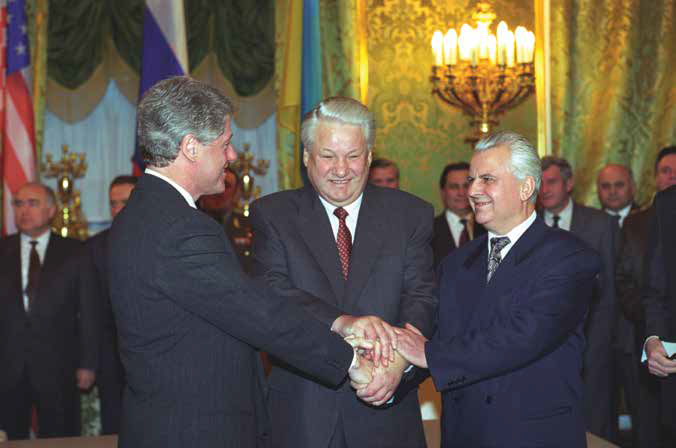
- Signatory: Leonid Kuchma[27], Boris Yeltsin[28], John Major[29], Bill Clinton[30]
- Depositary: Cabinet of Ministers of Ukraine[31]
- Repealed by: Treaty on the Adoption of the Republic of Crimea to Russia[32]
- Language used: English[33], Russian[34], Ukrainian[35]
- Has goal: Russo-Ukrainian war[36]
- Effective date: December 5, 1994[37]
Why It Matters
Budapest Memorandum has Wikipedia articles in 27 language editions, a strong signal of global cultural recognition.[38] It is known by 38 alternative names across languages and contexts.[39]