
Brothers Grimm
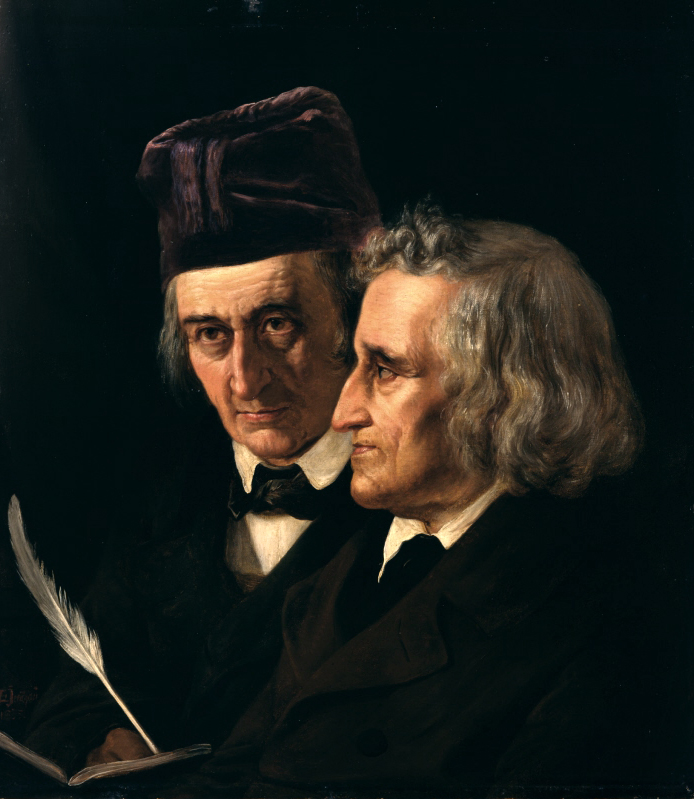
0 sources
Summary
Brothers Grimm is a brother duo[1]. It was born on 1785[2]. It died on 1863[3]. It draws 29,729 Wikipedia views per month (brother duo category, ranking #1 of 7).[4]
Key Facts
- Field of work: linguistics[5]
- Notable work: Grimms' fairy tales[6]
- Award received: Pour le Mérite[7]
- Religion or worldview: Catholic Church[8]
- Commons category: Brothers Grimm[9]
- Has part(s): Jacob Grimm[10], Wilhelm Grimm[11]
- Family name: Grimm[12]
- Topic's main category: Category:Brothers Grimm[13]
- Commons gallery: Gebrüder Grimm[14]
- Floruit: 1900[15]
- Described by source: Brockhaus and Efron Encyclopedic Dictionary[16], Small Brockhaus and Efron Encyclopedic Dictionary[17], ProDetLit[18], Lexicon van de jeugdliteratuur[19]
- Languages spoken, written or signed: German[20]
- Name in native language: Brüder Grimm[21]
- On focus list of Wikimedia project: Wikipedia:Vital articles/Level/4[22]
- Writing language: German[23]
Product Details
The following facts are restated verbatim from public-domain and CC0 open-data sources — every line is independently verifiable against the named source's catalog.
MusicBrainz — CC0 open music encyclopedia
-
Type: Group[24]
-
Country: DE[25]
-
Ended / dissolved: 1859[26]
-
Genre(s): fairy tale[27]
-
Community tags: clean me up, fairy tale, has german audiobooks[28]
-
MusicBrainz ID: a0be83cd-c958-4734-a3c2-db35607ac178[29]
Why It Matters
Brothers Grimm has Wikipedia articles in 30 language editions, a strong signal of global cultural recognition.[30] It is known by 47 alternative names across languages and contexts.[31]
Works attributed to it include Rumplestiltskin[32], a literary work[33], founded in 1900[34]; Hansel and Gretel[35], a literary work[36]; Snow White[37], a literary work[38], in Germany[39]; Grimms' fairy tales[40], a literary work[41], in Germany[42], founded in 1806[43], written by Jacob Grimm[44]; Rapunzel[45], a fairy tale[46]; and Town Musicians of Bremen[47], a literary work[48].
FAQs
What awards did Brothers Grimm receive?
Honors received include Pour le Mérite[7].