
Eight Trigrams
0 sources
Eight Trigrams
Summary
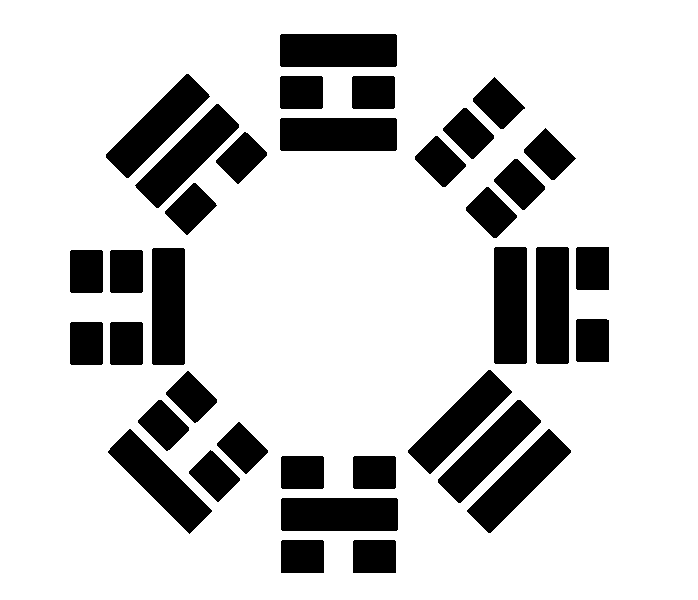
Eight Trigrams is a non-material culture[1]. It has Wikipedia articles in 23 language editions, a strong signal of global cultural recognition.[2]
Key Facts
- Eight Trigrams's instance of is recorded as non-material culture[3].
- Eight Trigrams's instance of is recorded as concept[4].
- Eight Trigrams's instance of is recorded as octad[5].
- Eight Trigrams's based on is recorded as Four Phases[6].
- Eight Trigrams is a type of I Ching studies[7].
- Eight Trigrams is a type of triad[8].
- Eight Trigrams is part of I Ching[9].
- Eight Trigrams's Commons category is recorded as Bagua (Taoist cosmology)[10].
- Eight Trigrams comprises trigram Qian[11].
- Eight Trigrams comprises duì[12].
- Eight Trigrams comprises lí[13].
- Eight Trigrams comprises zhèn[14].
- Eight Trigrams comprises xùn[15].
- Eight Trigrams comprises kǎn[16].
- Eight Trigrams comprises gèn[17].
- Eight Trigrams comprises kūn[18].
- Eight Trigrams's topic's main category is recorded as Category:Bagua (Taoist cosmology)[19].
- Eight Trigrams's quantity is recorded as {'amount': '+8'}[20].
- Eight Trigrams's topic has template is recorded as Template:Trigram[21].
- Eight Trigrams's native label is recorded as {'lang': 'lzh', 'text': '八卦'}[22].
- Eight Trigrams's native label is recorded as {'lang': 'vi', 'text': 'bát quái'}[23].
- Eight Trigrams's native label is recorded as {'lang': 'ja', 'text': '八卦'}[24].
- Eight Trigrams's native label is recorded as {'lang': 'ko', 'text': '팔괘'}[25].
- Eight Trigrams's indigenous to is recorded as China[26].
- Eight Trigrams's derivative work is recorded as I Ching hexagram[27].
Body
Definition and Type
Recorded instance of include non-material culture[3], concept[4], and octad[5]. Recorded subclass of include I Ching studies[7] and triad[8].
Use and Application
Components include trigram Qian[11], a concept[28]; duì[12]; lí[13]; zhèn[14]; xùn[15]; and kǎn[16]. Eight Trigrams is part of I Ching[9].
Influence
Things named for Eight Trigrams include Order of the Palgwae[29], a state order[30], in Korean Empire[31], founded in 1901[32].
Why It Matters
Eight Trigrams has Wikipedia articles in 23 language editions, a strong signal of global cultural recognition.[2] It is known by 112 alternative names across languages and contexts.[33]
Entities named for it include Order of the Palgwae[29], a state order[30], in Korean Empire[31], founded in 1901[32].