
6489 Golevka
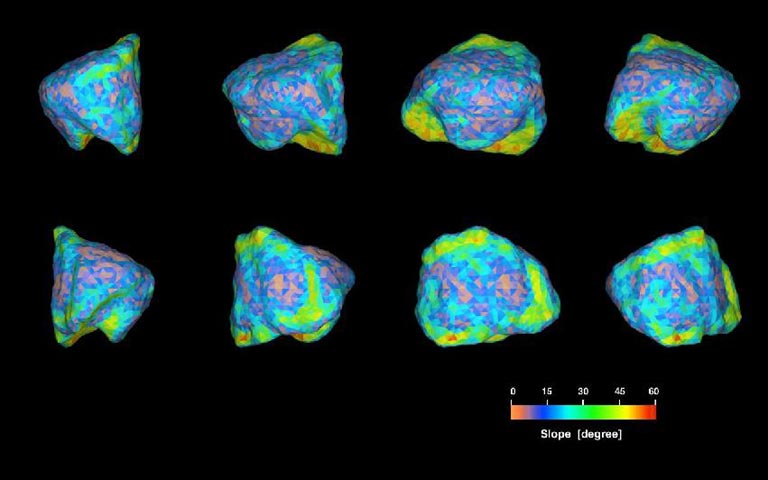
0 sources
6489 Golevka
Summary
6489 Golevka is a potentially hazardous asteroid[1]. It draws 16 Wikipedia views per month (potentially_hazardous_asteroid category, ranking #19 of 147).[2]
Key Facts
- 6489 Golevka is credited with the discovery of Eleanor F. Helin[3].
- 6489 Golevka's instance of is recorded as potentially hazardous asteroid[4].
- 6489 Golevka's instance of is recorded as near-Earth object[5].
- 6489 Golevka's instance of is recorded as near-Earth asteroid[6].
- 6489 Golevka's site of astronomical discovery is recorded as Palomar Observatory[7].
- Goldstone Deep Space Communications Complex is named after 6489 Golevka[8].
- Evpatoria Observatory is named after 6489 Golevka[9].
- Kashima is named after 6489 Golevka[10].
- 6489 Golevka followed Q378089[11].
- 6489 Golevka was followed by (6490) 1991 NR2[12].
- 6489 Golevka's minor planet group is recorded as Apollo asteroid[13].
- 6489 Golevka's Commons category is recorded as 6489 Golevka[14].
- 6489 Golevka's parent astronomical body is recorded as Sun[15].
- 6489 Golevka's provisional designation is recorded as 1991 JX[16].
- 6489 Golevka's time of discovery or invention is recorded as May 10, 1991[17].
- 6489 Golevka's asteroid spectral type is recorded as Q-type asteroid[18].
- 6489 Golevka's significant event is recorded as naming[19].
- 6489 Golevka's orbital eccentricity is recorded as {'amount': '+0.6130239'}[20].
- 6489 Golevka's orbital eccentricity is recorded as {'amount': '+0.6187571562047618'}[21].
- 6489 Golevka's absolute magnitude is recorded as {'amount': '+19.2'}[22].
- 6489 Golevka's absolute magnitude is recorded as {'amount': '+19.22'}[23].
- 6489 Golevka's orbital inclination is recorded as {'unit': 'Q28390', 'amount': '+2.26690'}[24].
- 6489 Golevka's orbital inclination is recorded as {'unit': 'Q28390', 'amount': '+2.259292857994011'}[25].
- 6489 Golevka's density is recorded as {'unit': 'Q13147228', 'amount': '+2.7'}[26].
- 6489 Golevka's mass is recorded as {'unit': 'Q11570', 'amount': '+210000000000'}[27].
Body
Designation and Status
Recorded instance of include potentially hazardous asteroid[4], near-Earth object[5], and near-Earth asteroid[6].
History and Context
Things named after include Goldstone Deep Space Communications Complex[8], a deep space station[28], in United States[29], founded in 1958[30]; Evpatoria Observatory[9], a radio telescope[31], in Ukraine[32]; and Kashima[10], a city of Japan[33], in Japan[34], founded in 1889[35].
Why It Matters
6489 Golevka draws 16 Wikipedia views per month (potentially_hazardous_asteroid category, ranking #19 of 147).[2] It has Wikipedia articles in 19 language editions, a strong signal of global cultural recognition.[36] It is known by 17 alternative names across languages and contexts.[37]