
William Harvey
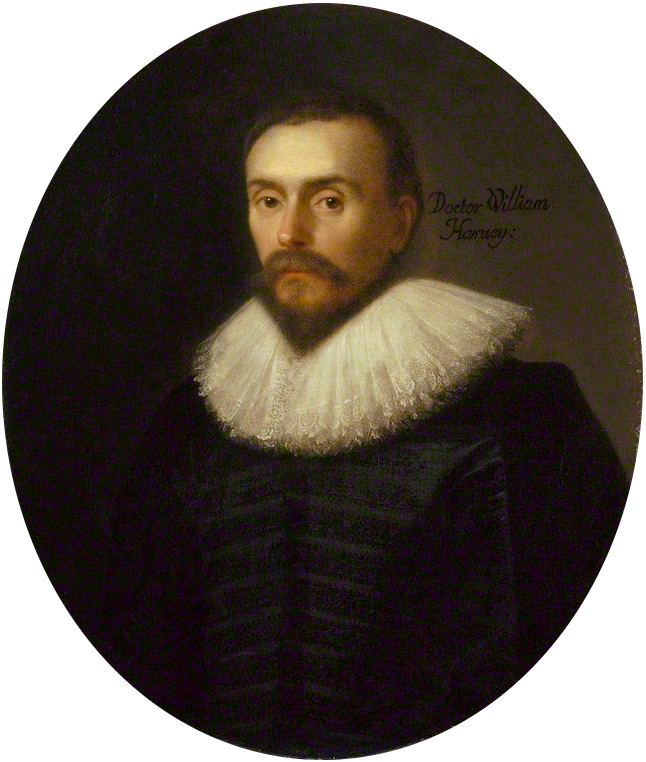
0 sources
William Harvey
Summary
William Harvey is a human[1]. He was born in Folkestone[2]. He was born on April 1, 1578[3]. He passed away in Roehampton[4]. He died on June 3, 1657[5]. He worked as a biologist[6], physician[7], anatomist[8], and physiologist[9]. He ranks in the top 0.7% of human entities by monthly Wikipedia readership (1,698 views/month, #6,965 of 1,000,298).[10]
Key Facts
- Born in Folkestone[2], William Harvey…
- William Harvey died in Roehampton[4].
- William Harvey was born on April 1, 1578[3].
- William Harvey died on June 3, 1657[5].
- Burial took place at Presbyterian Church Of St Andrew, Hampstead[11].
- William Harvey's father was Thomas Harvey[12].
- William Harvey's mother was Joan Halke[13].
- William Harvey was married to Elizabeth Browne[14].
- William Harvey held citizenship in Kingdom of England[15].
- William Harvey's professions included biologist[6].
- William Harvey worked as a physician[7].
- William Harvey's professions included anatomist[8].
- William Harvey worked as a physiologist[9].
- William Harvey's field of work was medicine[16].
- William Harvey's field of work was physiology[17].
- William Harvey's field of work was embryology[18].
- William Harvey was employed by University of Oxford[19].
- William Harvey was educated at University of Padua[20].
- William Harvey was educated at Gonville and Caius College[21].
- William Harvey was educated at The King's School Canterbury[22].
- William Harvey was educated at Barts and The London School of Medicine and Dentistry[23].
- William Harvey's doctoral advisor was Hieronymus Fabricius[24].
- A notable student of William Harvey was Francis Glisson[25].
- William Harvey's religion is recorded as Anglicanism[26].
- William Harvey is recorded as male[27].
Body
Origins and Family
Born in Folkestone[2], William Harvey… he was born on April 1, 1578[3]. His father was Thomas Harvey[12]. His mother was Joan Halke[13].
Education
Educated at University of Padua[20], a university[28], in Italy[29], founded in 1222[30], headquartered in Padua[31]; Gonville and Caius College[21], a college of the University of Cambridge[32], in United Kingdom[33], founded in 1348[34]; The King's School Canterbury[22], a boarding school[35], in United Kingdom[36], founded in 0597[37]; and Barts and The London School of Medicine and Dentistry[23], a medical school[38], in United Kingdom[39], founded in 1123[40]. William Harvey's doctoral advisor was Hieronymus Fabricius[24]. Studied under Cesare Cremonini[41], a philosopher[42], 1550–1631[43] and Hieronymus Fabricius[44], a surgeon[45], 1533–1619[46], specialised in anatomy[47].
Career and Affiliations
Recorded occupations include biologist[6], physician[7], anatomist[8], and physiologist[9]. Fields of work include medicine[16], a field of study[48]; physiology[17], a branch of biology[49]; and embryology[18], a branch of biology[50]. Among William Harvey's employers was University of Oxford[19]. A notable student of him was Francis Glisson[25].
Personal Life
Among William Harvey's spouses was Elizabeth Browne[14]. His religion is recorded as Anglicanism[26].
Death and Burial
William Harvey died on June 3, 1657[5]. He died in Roehampton[4]. He is buried at Presbyterian Church Of St Andrew, Hampstead[11].
Works and Contributions
Things named for William Harvey include Harveian Oration[51], an award[52], in United Kingdom[53], founded in 1656[54]; Harvey Heights[55], a mountain[56]; Harvey[57]; and Harvey Lecture[58].
Why It Matters
William Harvey ranks in the top 0.7% of human entities by monthly Wikipedia readership (1,698 views/month, #6,965 of 1,000,298).[10] He has Wikipedia articles in 27 language editions, a strong signal of global cultural recognition.[59] He is known by 25 alternative names across languages and contexts.[60]
Works attributed to him include Exercitatio Anatomica de Motu Cordis et Sanguinis in Animalibus[61], a written work[62]. Entities named for him include Harveian Oration[51], an award[52], in United Kingdom[53], founded in 1656[54]; Harvey Heights[55], a mountain[56]; Harvey[57]; and Harvey Lecture[58].
His notable doctoral advisees include Thomas Willis[63], a physician[64], 1621–1675[65], of Kingdom of England[66], awarded the Fellow of the Royal Society[67].
FAQs
Where was William Harvey born?
Born in Folkestone[2], William Harvey…
Where did William Harvey die?
William Harvey died in Roehampton[4].
Who were William Harvey's parents?
William Harvey's father was Thomas Harvey[12]. William Harvey's mother was Joan Halke[13].
Who was William Harvey married to?
William Harvey's spouses include Elizabeth Browne[14].
What did William Harvey do for work?
William Harvey worked as biologist[6], physician[7], anatomist[8], and physiologist[9].
Where did William Harvey go to school?
William Harvey was educated at University of Padua[20], Gonville and Caius College[21], The King's School Canterbury[22], and Barts and The London School of Medicine and Dentistry[23].