
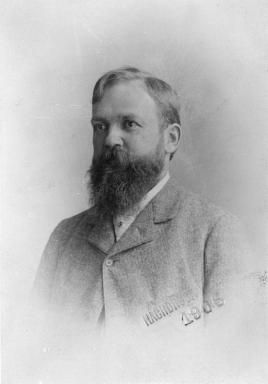
Wilhelm Meyer-Lübke
0 sources
Wilhelm Meyer-Lübke was born on January 30, 1861, in Dübendorf and died on October 4, 1936, in Bonn[1][2][3][4][5][1][5][2][3][4]. He held citizenship in Switzerland and was of the reformed religion[6]. He worked as a linguist, university teacher, philologist, and romanist.
He received his education at the University of Bonn and the University of Zurich. Over the course of his career, he was employed by the University of Vienna, the University of Bonn, the Friedrich Schiller University Jena, and the University of Zurich[7].
His academic achievements included an honorary doctorate from the University of Graz and recognition as a Corresponding Fellow of the Medieval Academy of America[8]. He was also a member of the Royal Society of Arts and Sciences in Gothenburg, the Royal Prussian Academy of Sciences, the Saxon Academy of Sciences and Humanities, and the Philological Section of the Institute for Catalan Studies[9].
Wilhelm Meyer-Lübke
Summary
Wilhelm Meyer-Lübke is a human[1]. His place of birth was Dübendorf[2]. He was born on January 30, 1861[3]. He died in Bonn[4]. He died on October 4, 1936[5]. He worked as a linguist[6], university teacher[7], philologist[8], and romanist[9]. He ranks in the top 0.73% of human entities by monthly Wikipedia readership (16 views/month, #7,296 of 1,000,298).[10]
Key Facts
- Wilhelm Meyer-Lübke was born in Dübendorf[2].
- Wilhelm Meyer-Lübke died in Bonn[4].
- Wilhelm Meyer-Lübke was born on January 30, 1861[3].
- Wilhelm Meyer-Lübke died on October 4, 1936[5].
- Burial took place at Berlin[11].
- Wilhelm Meyer-Lübke's father was Wilhelm Meyer[12].
- Wilhelm Meyer-Lübke held citizenship in Switzerland[13].
- Wilhelm Meyer-Lübke worked as a linguist[6].
- Wilhelm Meyer-Lübke worked as a university teacher[7].
- Wilhelm Meyer-Lübke worked as a philologist[8].
- Wilhelm Meyer-Lübke's professions included romanist[9].
- Wilhelm Meyer-Lübke's field of work was Romance studies[14].
- Among Wilhelm Meyer-Lübke's employers was University of Vienna[15].
- Wilhelm Meyer-Lübke was employed by University of Bonn[16].
- Among Wilhelm Meyer-Lübke's employers was Friedrich Schiller University Jena[17].
- Among Wilhelm Meyer-Lübke's employers was University of Zurich[18].
- Wilhelm Meyer-Lübke was educated at University of Bonn[19].
- Wilhelm Meyer-Lübke was educated at University of Zurich[20].
- A notable student of Wilhelm Meyer-Lübke was Eugen Herzog[21].
- A notable student of Wilhelm Meyer-Lübke was Matteo Bartoli[22].
- A notable student of Wilhelm Meyer-Lübke was Ernst Gamillscheg[23].
- Wilhelm Meyer-Lübke received the honorary doctorate of the University of Graz[24].
- Wilhelm Meyer-Lübke received the Corresponding Fellow of the Medieval Academy of America[25].
- Wilhelm Meyer-Lübke was a member of Royal Society of Arts and Sciences in Gothenburg[26].
- Wilhelm Meyer-Lübke was a member of Royal Prussian Academy of Sciences[27].
Body
Origins and Family
Wilhelm Meyer-Lübke's place of birth was Dübendorf[2]. He was born on January 30, 1861[3]. His father was Wilhelm Meyer[12].
Education
Educated at University of Bonn[19], a public research university[28], in Germany[29], founded in 1818[30], headquartered in Bonn[31] and University of Zurich[20], a university[32], in Switzerland[33], founded in 1833[34], headquartered in Zurich[35]. Wilhelm Meyer-Lübke studied under Friedrich Christian Diez[36].
Career and Affiliations
Recorded occupations include linguist[6], university teacher[7], philologist[8], and romanist[9]. Wilhelm Meyer-Lübke's field of work was Romance studies[14]. Employers include University of Vienna[15], a university[37], in Austria[38], founded in 1365[39], headquartered in Vienna[40]; University of Bonn[16], a public research university[41], in Germany[42], founded in 1818[43], headquartered in Bonn[44]; Friedrich Schiller University Jena[17], a public university[45], in Germany[46], founded in 1558[47], headquartered in Jena[48]; and University of Zurich[18], a university[49], in Switzerland[50], founded in 1833[51], headquartered in Zurich[52]. Notable students include Eugen Herzog[21], a philologist[53], 1875–1928[54], of Austria[55], specialised in Romance studies[56]; Matteo Bartoli[22], a linguist[57], 1873–1946[58], of Kingdom of Italy[59], specialised in dialectology[60]; and Ernst Gamillscheg[23], a romanist[61], 1887–1971[62], of Austria[63], specialised in linguistics[64].
Recognition
Awards received include honorary doctorate of the University of Graz[24], an award[65], in Austria[66] and Corresponding Fellow of the Medieval Academy of America[25].
Personal Life
Wilhelm Meyer-Lübke's religion is recorded as reformed[67].
Death and Burial
Wilhelm Meyer-Lübke died on October 4, 1936[5]. He passed away in Bonn[4]. He is buried at Berlin[11].
Why It Matters
Wilhelm Meyer-Lübke ranks in the top 0.73% of human entities by monthly Wikipedia readership (16 views/month, #7,296 of 1,000,298).[10] He has Wikipedia articles in 13 language editions, a strong signal of global cultural recognition.[68] He is known by 13 alternative names across languages and contexts.[69]
FAQs
Where was Wilhelm Meyer-Lübke born?
Wilhelm Meyer-Lübke was born in Dübendorf[2].
Where did Wilhelm Meyer-Lübke die?
Wilhelm Meyer-Lübke passed away in Bonn[4].
Who were Wilhelm Meyer-Lübke's parents?
Wilhelm Meyer-Lübke's father was Wilhelm Meyer[12].
What did Wilhelm Meyer-Lübke do for work?
Wilhelm Meyer-Lübke worked as linguist[6], university teacher[7], philologist[8], and romanist[9].
Where did Wilhelm Meyer-Lübke go to school?
Wilhelm Meyer-Lübke was educated at University of Bonn[19] and University of Zurich[20].
What awards did Wilhelm Meyer-Lübke receive?
Honors received include honorary doctorate of the University of Graz[24] and Corresponding Fellow of the Medieval Academy of America[25].