
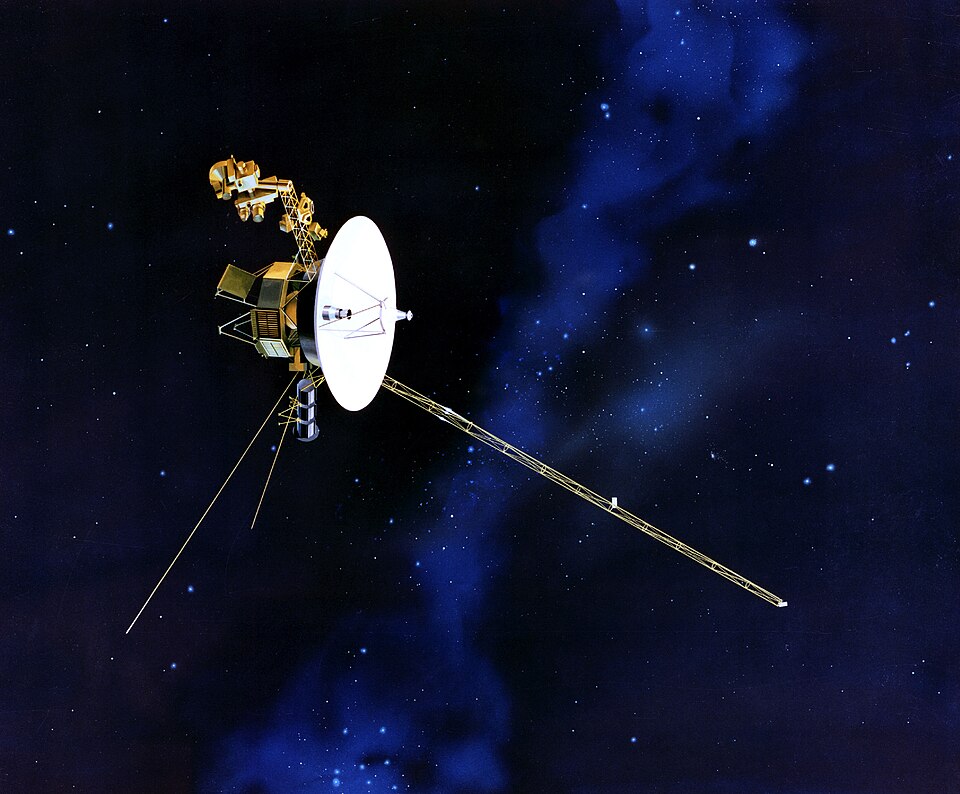
Voyager 1
space probe launched by NASA to study the outer Solar System, furthest spacecraft from Earth
Press Enter · cited answer in seconds
0 sources
Summary
Voyager 1 is a flyby probe[1]. It draws 31,568 Wikipedia views per month (flyby probe category, ranking #1 of 8).[2]
Key Facts
- Instance of: Zamenhof-Esperanto object[3]
- Operator: National Aeronautics and Space Administration[4]
- Followed by: Voyager 2[5]
- Manufacturer: Jet Propulsion Laboratory[6]
- Part of: Voyager program[7]
- Commons category: Voyager 1[8]
- Space launch vehicle: Titan IIIE[9]
- Country of origin: United States[10]
- Powered by: MHW-RTG[11]
- Has part(s): Voyager Golden Record[12]
- UTC date of spacecraft launch: September 5, 1977[13]
- Significant event: rocket launch[14], planetary flyby[15]
- Official website: http://voyager.jpl.nasa.gov[16]
- Topic's main category: Category:Voyager 1[17]
- Commons gallery: Voyager 1[18]
- Product or material produced: Pale Blue Dot[19]
- Space tug: Centaur[20]
- Carries scientific instrument: infrared interferometer spectrometer and radiometer[21]
- Start point: Cape Canaveral Space Launch Complex 41[22]
- Destination point: Jupiter[23], Saturn[24], interstellar medium[25]
- Different from: Voyager[26]
- Speed: 16.99949 kilometre per second[27]
- Mass: 815 kg[28], 733 kg[29]
- Distance from Earth: 155.653 astronomical unit[30], 163.00734416 astronomical unit[31]
- Power consumed: 420 watt[32]
Why It Matters
Voyager 1 has Wikipedia articles in 30 language editions, a strong signal of global cultural recognition.[33] It is known by 30 alternative names across languages and contexts.[34]
It is credited with the discovery of rings of Jupiter[35], an astronomical object in the Solar System[36]; Pandora[37], a moon of Saturn[38]; Prometheus[39], a moon of Saturn[40]; and Atlas[41], a moon of Saturn[42].
FAQs
What did Voyager 1 discover?
Voyager 1 is credited as discoverer of rings of Jupiter[35], Pandora[37], Prometheus[39], and Atlas[41].