
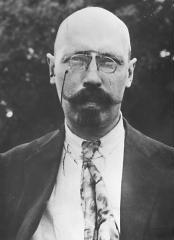
Valentin Dogiel
0 sources
Summary
Valentin Dogiel was born on February 26, 1882[1], in Kazan[2]. He died on June 1, 1955[3], in Saint Petersburg[4]. He worked as a zoologist[5], botanist[6], and biologist[7]. He ranks in the top 0.73% of human entities by monthly Wikipedia readership (93 views/month, #7,298 of 1,000,298).[8]
Key Facts
- Date of death: 1955[9]
- Place of burial: Volkovo Cemetery Writer's Walkways[10]
- Father: Alexander Dogiel[11]
- Country of citizenship: Russian Empire[12], Soviet Union[13]
- Field of work: zoology[14], parasitology[15]
- Employer: Saint Petersburg State University[16], Zoological Institute RAS[17], Q134498946[18], Women's Pedagogical Institute[19]
- Educated at: Faculty of Physics and Mathematics of the Saint Petersburg University[20]
- Doctoral advisor: Vladimir Shevyakov[21]
- Student: Yuri Polyansky[22], Oleksandr Markevych[23]
- Notable work: Oligomerization of Homologous Organs[24]
- Award received: Order of Lenin[25], Order of the Red Banner of Labour[26], Medal "For Valiant Labour in the Great Patriotic War 1941–1945"[27], Lenin Prize[28]
- Member of: Russian Academy of Sciences[29], Linnean Society of London[30]
- Sex or gender: male[31]
- Doctoral student: Oleksandr Markevych[32], Boris Evseevitch Bychowsky[33], Ivan Oliger[34], Aleksandr Paramonov[35], Olga Ivanova-Kazas[36], Aleksandr Monchadsky[37], E. M. Cheissin[38], Ekaterina Viktorovna Raikova[39], Lev Nikolaevich Seravin[40]
- Military, police or special rank: lieutenant colonel[41]
- Academic degree: master's degree[42], Doktor of Biology Sciences[43]
- Residence: Tomsk[44], Saint Petersburg[45]
- Participated in conflict: World War I[46]
- Family name: Dogiel[47]
- Given name: Valentin[48]
- Described by source: Great Soviet Encyclopedia (1969–1978)[49], Africa: An Encyclopedic Reference[50], Academy of Sciences. Biographies. 1724—2019[51]
- Languages spoken, written or signed: Russian[52]
Why It Matters
Valentin Dogiel has Wikipedia articles in 7 language editions, a strong signal of global cultural recognition.[53] He is known by 26 alternative names across languages and contexts.[54]
His notable doctoral advisees include Boris Evseevitch Bychowsky[55], a parasitologist[56], 1908–1974[57], of Russian Empire[58], awarded the Order of Lenin[59], specialised in parasitology[60] and Oleksandr Markevych[61], a zoologist[62], 1905–1999[63], of Soviet Union[64], awarded the Order of the October Revolution[65].
FAQs
Where was Valentin Dogiel born?
Valentin Dogiel's place of birth was Kazan[2].
Where did Valentin Dogiel die?
Valentin Dogiel died in Saint Petersburg[4].
Who were Valentin Dogiel's parents?
Valentin Dogiel's father was Alexander Dogiel[11].
What did Valentin Dogiel do for work?
Valentin Dogiel worked as a zoologist[5], botanist[6], and biologist[7].
Where did Valentin Dogiel go to school?
Valentin Dogiel was educated at Faculty of Physics and Mathematics of the Saint Petersburg University[20].
What awards did Valentin Dogiel receive?
Honors received include Order of Lenin[25], Order of the Red Banner of Labour[26], Medal "For Valiant Labour in the Great Patriotic War 1941–1945"[27], and Lenin Prize[28].