
Union for the Liberation of Ukraine
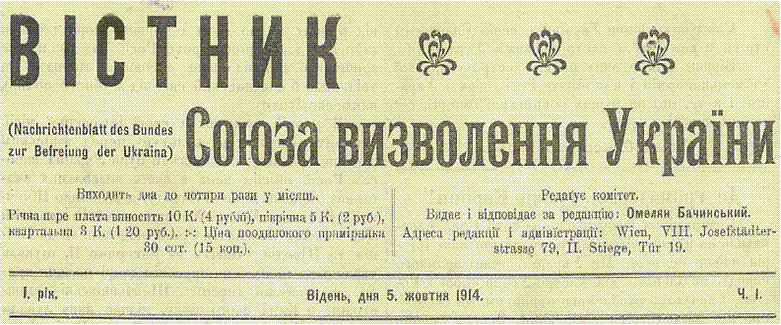
0 sources
Union for the Liberation of Ukraine
Summary
Union for the Liberation of Ukraine is a political party[1]. It has Wikipedia articles in 10 language editions, a strong signal of global cultural recognition.[2]
Key Facts
- Union for the Liberation of Ukraine is in the country of Austria–Hungary[3].
- Union for the Liberation of Ukraine's instance of is recorded as political party[4].
- Union for the Liberation of Ukraine's Commons category is recorded as Union for the Liberation of Ukraine[5].
- Union for the Liberation of Ukraine's chairperson is recorded as Alexander Skoropys-Yoltukhovsky[6].
- Union for the Liberation of Ukraine's chairperson is recorded as Q16706770[7].
- August 4, 1914 marks the founding of Union for the Liberation of Ukraine[8].
- Union for the Liberation of Ukraine was dissolved in May 1, 1918[9].
- Union for the Liberation of Ukraine's native label is recorded as {'lang': 'uk', 'text': 'Союз визволення України'}[10].
- Union for the Liberation of Ukraine's short name is recorded as {'lang': 'uk', 'text': 'СВУ'}[11].
- Union for the Liberation of Ukraine's different from is recorded as Union for the Freedom of Ukraine trial[12].
- Union for the Liberation of Ukraine's on focus list of Wikimedia project is recorded as WikiProject Ukraine[13].
Body
Founding
August 4, 1914 marks the founding of Union for the Liberation of Ukraine[8].
Identity
Union for the Liberation of Ukraine's short name is recorded as {'lang': 'uk', 'text': 'СВУ'}[11].
Leadership
Chairpersons include Alexander Skoropys-Yoltukhovsky[6], an author[14], 1880–1946[15], of Russian Empire[16], specialised in opinion journalism[17] and Q16706770[7], a politician[18], 1878–1938[19], specialised in political activity[20].
Dissolution
Union for the Liberation of Ukraine was dissolved in May 1, 1918[9].
Why It Matters
Union for the Liberation of Ukraine has Wikipedia articles in 10 language editions, a strong signal of global cultural recognition.[2] It is known by 4 alternative names across languages and contexts.[21]