
Trinitarian Order
Catholic religious order
Press Enter · cited answer in seconds
0 sources
Summary
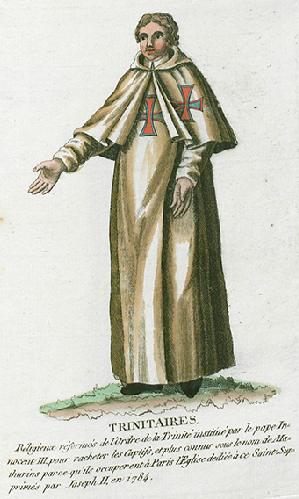
Trinitarian Order is a mendicant order[1]. It draws 760 Wikipedia views per month (mendicant_order category, ranking #12 of 18).[2]
Key Facts
- Trinitarian Order's instance of is recorded as mendicant order[3].
- Trinitarian Order's instance of is recorded as order for the redemption of Christian captives[4].
- Trinitarian Order's founder is recorded as John of Matha[5].
- Trinitarian Order's founder is recorded as Felix of Valois[6].
- Trinitarian Order's Commons category is recorded as Trinitarian Order[7].
- Trinitarian Order comprises trinitarian friar[8].
- 1194 marks the founding of Trinitarian Order[9].
- Trinitarian Order's official website is recorded as http://www.trinitari.org/[10].
- Trinitarian Order's topic's main category is recorded as Category:Trinitarian Order[11].
- Trinitarian Order's described by source is recorded as Vlastenský slovník historický[12].
- Trinitarian Order's described by source is recorded as The Nuttall Encyclopædia[13].
- Trinitarian Order's described by source is recorded as Brockhaus and Efron Encyclopedic Dictionary[14].
- Trinitarian Order's described by source is recorded as Small Brockhaus and Efron Encyclopedic Dictionary[15].
- Trinitarian Order's described by source is recorded as Great Soviet Encyclopedia (1926–1947)[16].
- Trinitarian Order's described by source is recorded as Encyclopædia Britannica 11th edition[17].
- Trinitarian Order's described by source is recorded as Collier's New Encyclopedia, 1921[18].
- Trinitarian Order's short name is recorded as O.SS.T.[19].
- Trinitarian Order's member count is recorded as {'amount': '+1500'}[20].
- Trinitarian Order's position held by head of the organization is recorded as Minister General of Order of the Most Holy Trinity[21].
- Trinitarian Order's P14536 is recorded as 420819[22].
Body
Founding
Founders include John of Matha[5] and Felix of Valois[6]. 1194 marks the founding of Trinitarian Order[9].
Identity
Trinitarian Order's short name is recorded as O.SS.T.[19].
Why It Matters
Trinitarian Order draws 760 Wikipedia views per month (mendicant_order category, ranking #12 of 18).[2] It has Wikipedia articles in 20 language editions, a strong signal of global cultural recognition.[23] It is known by 113 alternative names across languages and contexts.[24]