
The Marriage of Heaven and Hell
0 sources
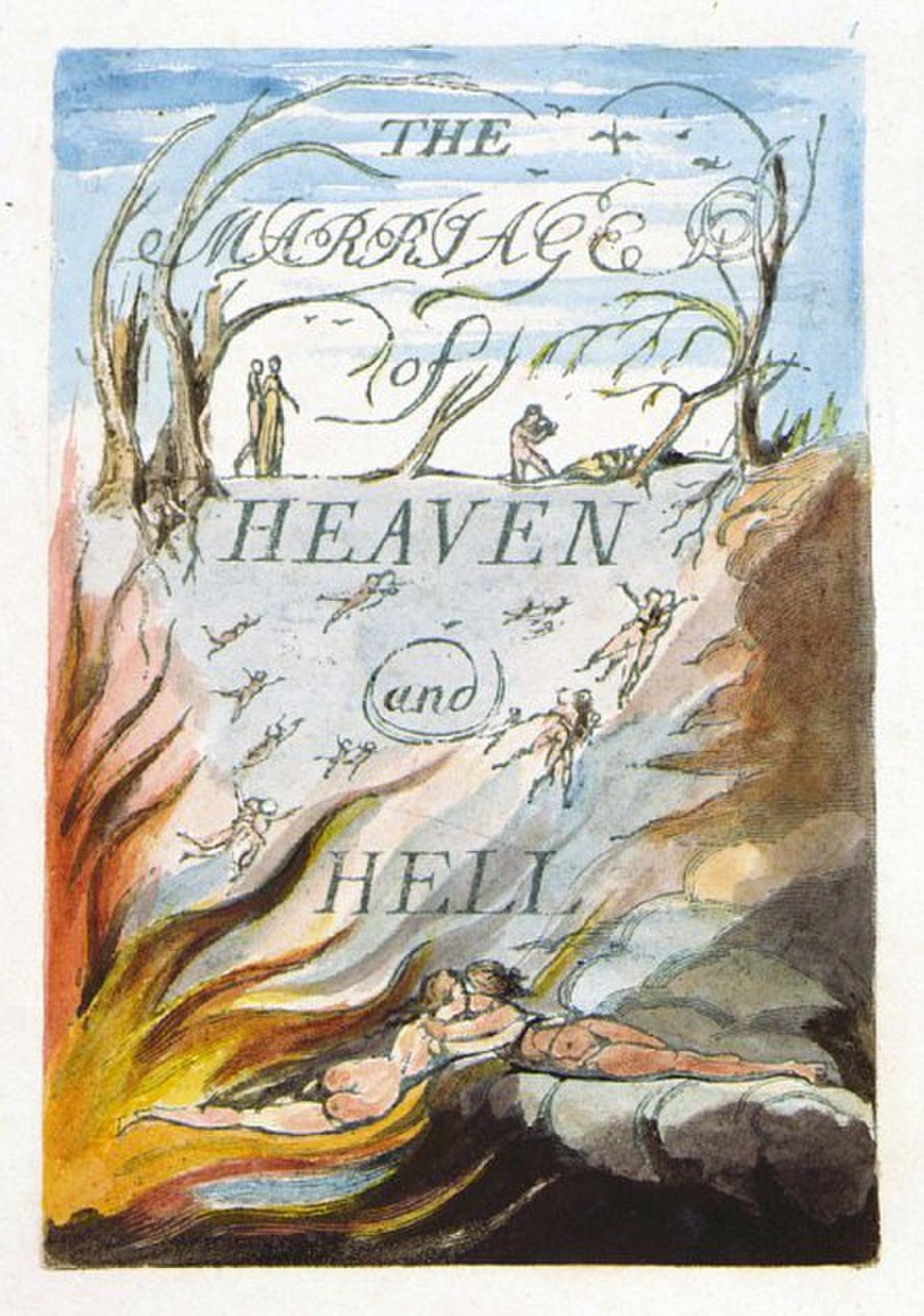
The Marriage of Heaven and Hell is a visual artwork that belongs to the genre of Menippean satire[1].
Created as part of William Blake’s broader body of work, it challenges conventional moral and religious dichotomies through its provocative and allegorical style. The piece employs a mix of prose, poetry, and imagery to critique established systems of thought. Its satirical approach aligns with the characteristics of Menippean satire[1].
The Marriage of Heaven and Hell
Summary
The Marriage of Heaven and Hell is a literary work[1]. It ranks in the top 3% of literary_work entities by monthly Wikipedia readership (1,487 views/month).[2]
Key Facts
- The Marriage of Heaven and Hell authored William Blake[3].
- The Marriage of Heaven and Hell's instance of is recorded as literary work[4].
- The Marriage of Heaven and Hell's illustrator is recorded as William Blake[5].
- The Marriage of Heaven and Hell's genre is Menippean satire[6].
- The Marriage of Heaven and Hell's Commons category is recorded as The Marriage of Heaven and Hell[7].
- The Marriage of Heaven and Hell's language of work or name is recorded as English[8].
- The Marriage of Heaven and Hell was published on 1793[9].
- The Marriage of Heaven and Hell's described at URL is recorded as http://www.blakearchive.org/work/mhh[10].
- The Marriage of Heaven and Hell's earliest date is recorded as 1790[11].
- The Marriage of Heaven and Hell's latest date is recorded as 1793[12].
- The Marriage of Heaven and Hell's copyright status is recorded as public domain[13].
- The Marriage of Heaven and Hell's copyright status is recorded as public domain[14].
Body
Authorship and Creation
The Marriage of Heaven and Hell authored William Blake[3].
Publication
The Marriage of Heaven and Hell was released on 1793[9]. Its language of work or name is recorded as English[8]. Its genre is Menippean satire[6].
Why It Matters
The Marriage of Heaven and Hell ranks in the top 3% of literary_work entities by monthly Wikipedia readership (1,487 views/month).[2] It has Wikipedia articles in 14 language editions, a strong signal of global cultural recognition.[15] It is known by 6 alternative names across languages and contexts.[16]