
Tehran Conference
0 sources
Tehran Conference
Summary
Tehran Conference is a convention[1]. It ranks in the top 2% of convention entities by monthly Wikipedia readership (5,077 views/month).[2]
Key Facts
- Tehran Conference's instance of is recorded as convention[3].
- Tehran Conference's instance of is recorded as summit[4].
- Tehran Conference followed Cairo Conference[5].
- Tehran Conference was followed by Yalta Conference[6].
- The location of Tehran Conference was Tehran[7].
- The location of Tehran Conference was Embassy of Russia in Iran[8].
- Tehran Conference's Commons category is recorded as Tehran Conference[9].
- Tehran Conference began on November 28, 1943[10].
- Tehran Conference ended on December 1, 1943[11].
- Tehran Conference's coordinate location is recorded as {'lat': 35.6985869, 'lon': 51.4143533}[12].
- A participant in Tehran Conference was United Kingdom[13].
- A participant in Tehran Conference was United States[14].
- A participant in Tehran Conference was Soviet Union[15].
- Tehran Conference's sponsor is recorded as Allies of World War II[16].
- Tehran Conference's native label is recorded as {'lang': 'en', 'text': 'Tehran Conference'}[17].
- Tehran Conference's signatory is recorded as Winston Churchill[18].
- Tehran Conference's signatory is recorded as Franklin Delano Roosevelt[19].
- Tehran Conference's signatory is recorded as Joseph Stalin[20].
- Tehran Conference dates from the World War II[21].
Body
When and Where
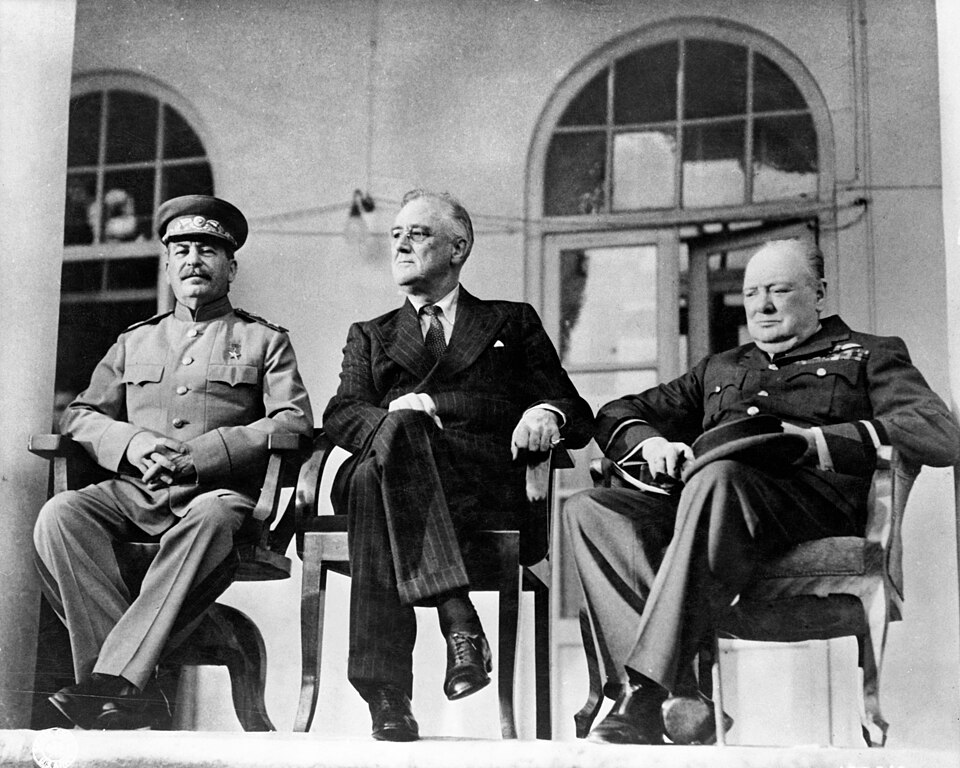
Tehran Conference began on November 28, 1943[10]. It ended on December 1, 1943[11]. Recorded location include Tehran[7] and Embassy of Russia in Iran[8].
Context
Recorded instance of include convention[3] and summit[4]. Tehran Conference followed Cairo Conference[5]. It was followed by Yalta Conference[6].
Participants
Recorded participant include United Kingdom[13], United States[14], and Soviet Union[15].
Why It Matters
Tehran Conference ranks in the top 2% of convention entities by monthly Wikipedia readership (5,077 views/month).[2] It has Wikipedia articles in 29 language editions, a strong signal of global cultural recognition.[22] It is known by 20 alternative names across languages and contexts.[23]