
taxicab geometry
type of metric geometry
Press Enter · cited answer in seconds
0 sources
taxicab geometry
Summary
taxicab geometry is a metric function[1]. It draws 466 Wikipedia views per month (metric_function category, ranking #3 of 20).[2]
Key Facts
- taxicab geometry is credited with the discovery of Hermann Minkowski[3].
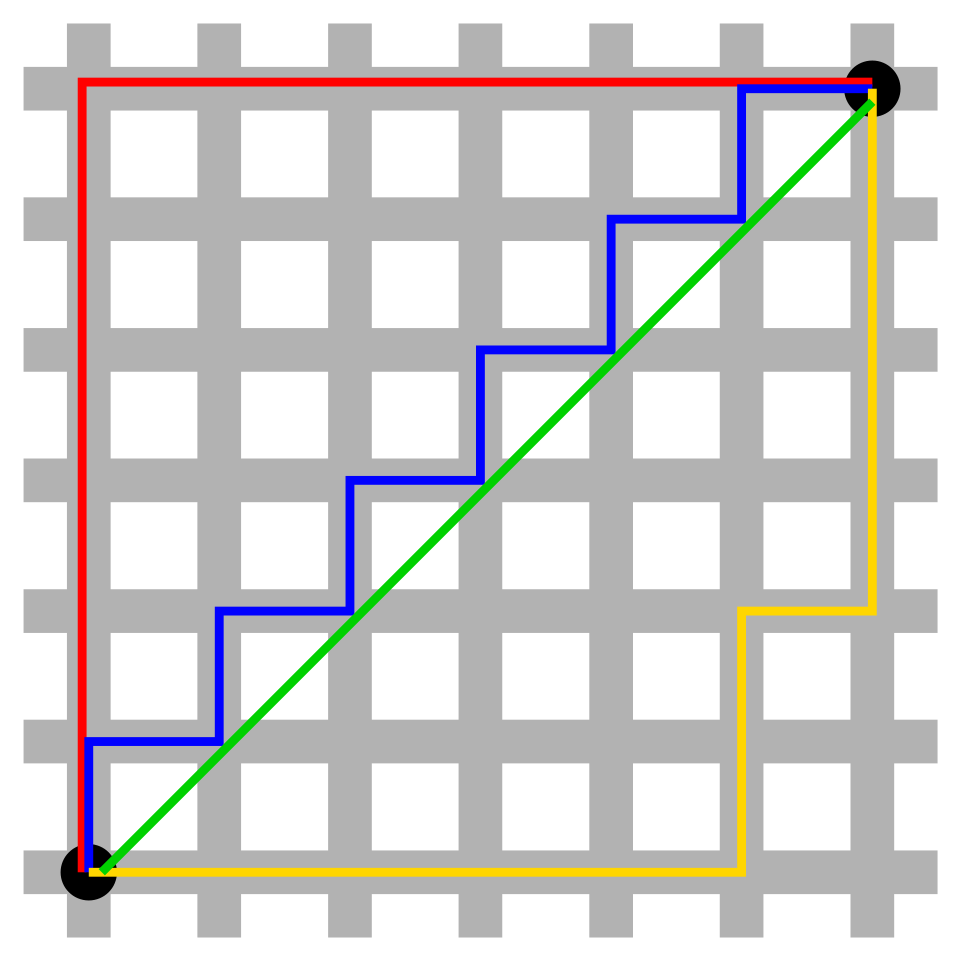
- taxicab geometry's image is recorded as Manhattan distance.svg[4].
- taxicab geometry's instance of is recorded as metric function[5].
- taxicab geometry's instance of is recorded as Minkowski distance[6].
- Manhattan is named after taxicab geometry[7].
- Hermann Minkowski is named after taxicab geometry[8].
- taxi is named after taxicab geometry[9].
- taxicab geometry's Freebase ID is recorded as /m/024rcq[10].
- taxicab geometry's Encyclopædia Britannica Online ID is recorded as topic/taxicab-metric[11].
- taxicab geometry's defining formula is recorded as d(a,b)=\sum_{i} \left|a_i-b_i\right|[12].
- taxicab geometry's studied by is recorded as category theory[13].
- taxicab geometry's MathWorld ID is recorded as TaxicabMetric[14].
- taxicab geometry's Dictionary of Algorithms and Data Structures ID is recorded as manhattanDistance[15].
- taxicab geometry's Dictionary of Algorithms and Data Structures ID is recorded as rectilinearDistance[16].
- taxicab geometry's maintained by WikiProject is recorded as WikiProject Mathematics[17].
- taxicab geometry's Microsoft Academic ID is recorded as 20790398[18].
Body
Works and Contributions
taxicab geometry is credited with the discovery of Hermann Minkowski[3].
Why It Matters
taxicab geometry draws 466 Wikipedia views per month (metric_function category, ranking #3 of 20).[2] It has Wikipedia articles in 20 language editions, a strong signal of global cultural recognition.[19] It is known by 51 alternative names across languages and contexts.[20]