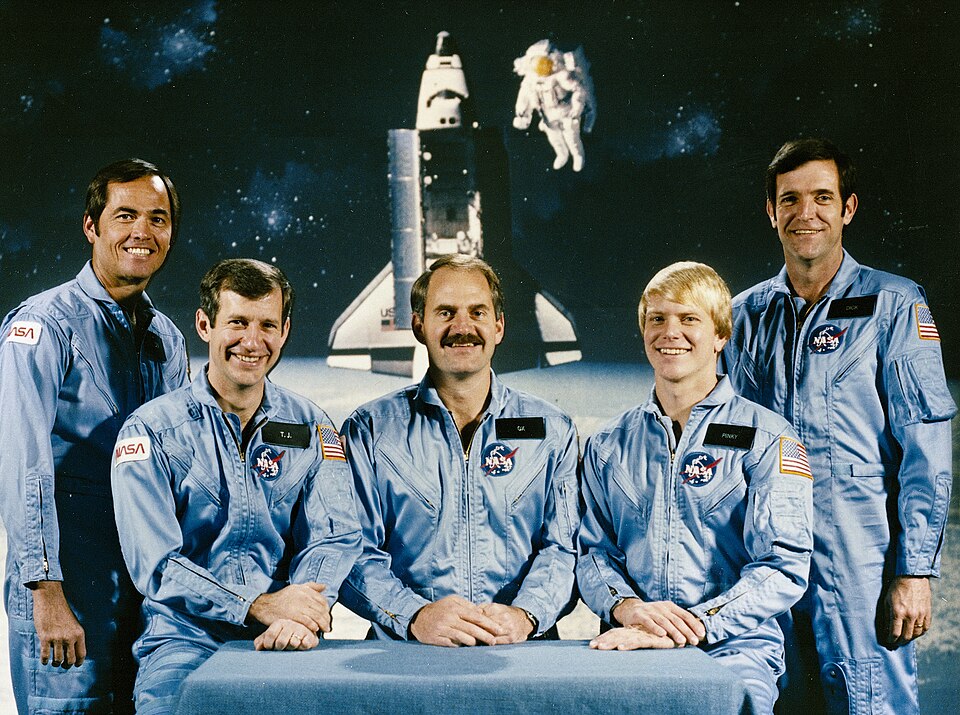
STS-41-C was a human spaceflight mission . It was the eleventh flight of the Space Shuttle Challenger and the fourth mission of 1984. The crew successfully deployed the Long Duration Exposure Facility and retrieved the Solar Maximum Mission satellite for repair . The mission concluded with a landing at Edwards Air Force Base on April 13, 1984 . The crew included Robert L. Crippen, Frederick H. Hauck, George D. Nelson, James D. van Hoften, and Terry J. Hart . The mission duration was 6 days, 23 hours, and 40 minutes . The primary objectives were accomplished without major anomalies . The mission marked the first in-orbit satellite repair . The crew conducted two spacewalks during the mission . The Solar Maximum Mission satellite was returned to Earth for analysis and later re-launched . The mission demonstrated the capability of the Space Shuttle to perform complex servicing operations in orbit . The mission was designated as a Department of Defense mission . The launch occurred on April 6, 1984 . The mission patch featured a golden eagle and the motto “To Serve and Protect” . The crew received the NASA Distinguished Service Medal for their achievements . The mission was part of NASA’s Space Transportation System program . The orbiter Challenger was returned to Kennedy Space Center for refurbishment after landing . The mission’s success contributed to future satellite servicing missions . The crew trained extensively for the satellite retrieval and repair operations . The mission’s flight plan included multiple orbital adjustments to match the satellite’s trajectory . The mission’s payload bay carried the Orbital Maneuvering System pods and the Remote Manipulator System . The mission was controlled from the Mission Control Center in Houston . The crew communicated with ground control throughout the mission . The mission’s data was used to improve future shuttle operations . The mission was the first to use the Manned Maneuvering Unit for satellite retrieval . The mission’s success validated the shuttle’s role as a space repair platform . The mission was the first to use the shuttle’s robotic arm to capture a satellite . The mission’s timeline was tightly coordinated with ground support teams . The mission’s success was widely reported in the media . The mission’s crew was honored by NASA for their technical proficiency . The mission’s flight path included multiple passes over the Pacific Ocean . The mission’s landing was conducted under clear weather conditions . The mission’s success reinforced public confidence in the shuttle program . The mission’s objectives were fully met within the planned timeframe . The mission’s crew returned to Johnson Space Center after landing . The mission’s data was archived for future reference . The mission’s success was cited in subsequent shuttle mission planning . The mission’s crew participated in post-flight debriefings . The mission’s operations were reviewed by NASA’s Mission Evaluation Room . The mission’s success was confirmed by telemetry data from all systems . The mission’s crew received congratulations from NASA Administrator James M. Beggs . The mission’s success was celebrated at a public ceremony at Johnson Space Center . The mission’s flight was the 11th shuttle mission to orbit Earth . The mission’s crew included two astronauts making their first spaceflight . The mission’s payload included scientific instruments for solar observation . The mission’s operations were coordinated with the Goddard Space Flight Center . The mission’s success demonstrated the reliability of the shuttle’s thermal protection system . The mission’s crew conducted medical experiments during the flight . The mission’s success was documented in NASA’s official mission report . The mission’s flight was the 41st mission of the Space Shuttle program . The mission’s crew trained at the Neutral Buoyancy Simulator for EVA procedures . The mission’s success was recognized by the National Aeronautic Association . The mission’s crew was featured in NASA’s public outreach materials . The mission’s success contributed to the development of the Hubble Space Telescope servicing program . The mission’s flight was the first to use the shuttle’s robotic arm to capture a satellite . The mission’s crew received training from the U.S. Air Force for satellite retrieval . The mission’s success was analyzed by the Office of Space Flight . The mission’s flight was the 11th mission of the Space Shuttle Challenger . The mission’s crew included one astronaut who later became a NASA executive . The mission’s success was cited in congressional testimony on space policy . The mission’s crew was interviewed by major news networks after landing . The mission’s success was highlighted in NASA’s annual report . The mission’s flight was the 11th mission of the Space Shuttle program to carry a Department of Defense payload . The mission’s crew was briefed by the National Reconnaissance Office . The mission’s success was confirmed by the Department of Defense . The mission’s flight was the first to use the shuttle’s robotic arm to capture a satellite . The mission’s crew received training from the Jet Propulsion Laboratory . The mission’s success was recognized by the American Astronautical Society . The
STS-41-C
Summary
STS-41-C is a human spaceflight[1]. STS-41-C draws 71 Wikipedia views per month (human_spaceflight category, ranking #113 of 226).[2]
Key Facts
- STS-41-C's image is recorded as STS-41-C crew.jpg[3].
- STS-41-C's image is recorded as SMMS repair by STS-41C Astronauts.jpg[4].
- STS-41-C's instance of is recorded as human spaceflight[5].
- STS-41-C's operator is recorded as National Aeronautics and Space Administration[6].
- STS-41-C's logo image is recorded as STS-41-C patch.png[7].
- STS-41-C's follows is recorded as STS-41-B[8].
- STS-41-C's followed by is recorded as STS-41-D[9].
- STS-41-C's COSPAR ID is recorded as 1984-034A[10].
- STS-41-C's part of is recorded as Space Shuttle program[11].
- STS-41-C's Commons category is recorded as STS-41-C[12].
- STS-41-C's SCN is recorded as 14897[13].
- STS-41-C's archives at is recorded as Lunar and Planetary Institute[14].
- STS-41-C's type of orbit is recorded as low Earth orbit[15].
- STS-41-C's UTC date of spacecraft launch is recorded as +1984-04-06T00:00:00Z[16].
- STS-41-C's UTC date of spacecraft landing is recorded as +1984-04-13T00:00:00Z[17].
- STS-41-C's Freebase ID is recorded as /m/024jst[18].
- STS-41-C's significant event is recorded as rocket launch[19].
- STS-41-C's significant event is recorded as landing[20].
- STS-41-C's topic's main category is recorded as Category:STS-41-C[21].
- STS-41-C's Commons gallery is recorded as STS-41-C[22].
- STS-41-C's crew members is recorded as Robert Crippen[23].
- STS-41-C's crew members is recorded as Dick Scobee[24].
- STS-41-C's crew members is recorded as Terry Hart[25].
- STS-41-C's crew members is recorded as James van Hoften[26].
- STS-41-C's crew members is recorded as George Nelson[27].
Why It Matters
STS-41-C draws 71 Wikipedia views per month (human_spaceflight category, ranking #113 of 226).[2] STS-41-C has Wikipedia articles in 22 language editions, a strong signal of global cultural recognition.[28] STS-41-C is known by 7 alternative names across languages and contexts.[29]