
Saint Boniface
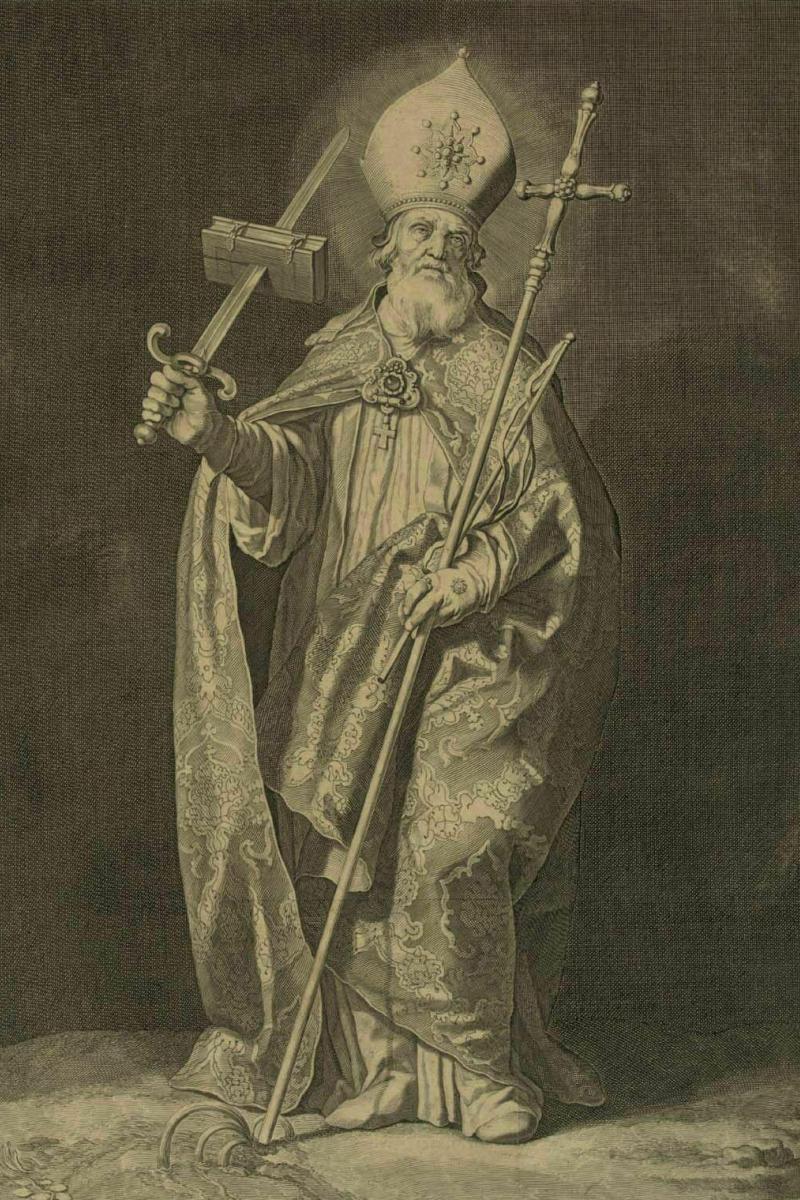
0 sources
Summary
Saint Boniface was born on 675[1] in Crediton[2]. He died on June 5, 754[3], in Dokkum[4]. He worked as a diplomat[5], Catholic priest[6], missionary[7], Catholic bishop[8], and apostle[9]. He ranks in the top 0.67% of human entities by monthly Wikipedia readership (4,775 views/month, #6,675 of 1,000,298).[10]
Key Facts
- Place of burial: Fulda Cathedral[11]
- Country of citizenship: Kingdom of Wessex[12], Francia[13]
- Occupation: archbishop[14]
- Position held: abbot[15], Roman Catholic Archbishop of Utrecht[16], Roman Catholic Archbishop of Mainz[17], archbishop[18]
- Student: Saint Sturm[19]
- Religion or worldview: Catholic Church[20]
- Sex or gender: male[21]
- Commons category: Saint Boniface[22]
- Canonization status: saint[23], Catholic saint[24]
- Residence: Crediton[25]
- Religious order: Benedictines[26]
- Given name: Bonifatius[27], Boniface[28]
- Feast day: June 5[29]
- Topic's main category: Category:Saint Boniface[30]
- Commons gallery: Bonifatius[31]
- Work location: Mainz[32]
- Student of: Wynbert of Nursling[33]
- Manner of death: homicide[34]
- Described by source: Dictionary of National Biography, 1885–1900[35], Salmonsens Konversationsleksikon[36], Allgemeine Deutsche Biographie[37], Great Soviet Encyclopedia (1926–1947)[38], Orthodox Theological Encyclopedia[39], Brockhaus and Efron Encyclopedic Dictionary[40], The Nuttall Encyclopædia[41], Encyclopædia Britannica 11th edition[42], The Catholic Encyclopedia[43], Meyer’s Universum, Siebenter Band[44]
- Participant in: Concilium Germanicum[45]
- Languages spoken, written or signed: Latin[46], English[47]
- Nickname: Apostle of Germany[48]
- Name in native language: Bonifatius[49]
Body
Works and Contributions
Things named for Saint Boniface include Santi Bonifacio e Alessio[50], a church building[51], in Italy[52], founded in 1860[53]; Bachkirche Arnstadt[54], a church building[55], in Germany[56]; St. Boniface’s Abbey[57], an abbey[58], in Germany[59], founded in 1835[60]; St. Bonifatius[61]; Kaufmannskirche (Erfurt)[62]; he church, Leeuwarden[63]; St. Bonifatius Church[64]; and Winfried Award[65].
Why It Matters
Saint Boniface has Wikipedia articles in 25 language editions, a strong signal of global cultural recognition.[66] He is known by 82 alternative names across languages and contexts.[67]
He has been cited as an influence by Ecgbert[68], an archbishop[69], 0678–0766[70], of England[71].
Entities named for him include Santi Bonifacio e Alessio[50], a church building[51], in Italy[52], founded in 1860[53]; Bachkirche Arnstadt[54], a church building[55], in Germany[56]; St. Boniface’s Abbey[57], an abbey[58], in Germany[59], founded in 1835[60]; St. Bonifatius[61]; Kaufmannskirche (Erfurt)[62]; and he church, Leeuwarden[63].
FAQs
Where was Saint Boniface born?
Saint Boniface was born in Crediton[2].
Where did Saint Boniface die?
Saint Boniface died in Dokkum[4].
What did Saint Boniface do for work?
Saint Boniface worked as a diplomat[5], Catholic priest[6], missionary[7], Catholic bishop[8], and apostle[9].
Who did Saint Boniface influence?
Saint Boniface has been cited as an influence by Ecgbert[68].