
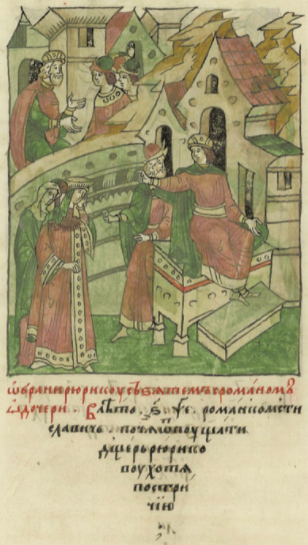
Roman the Great

Ruthenian prince
Person human Q497773
Roman the Great
Anonymous Russian manuscript illuminators, 1560-1570s Facial Chronicle (Illustrated Chronicle of Ivan the Terrible) (in 10 volumes: pdf, pdf with translation)Public domain image · Public Domain · Wikimedia
Press Enter · cited answer in seconds

Roman the Great

Summary

Roman the Great is a human[1]. He was born on January 1, 1150[2]. He died in Zawichost[3]. He died on June 19, 1205[4]. He worked as an aristocrat[5]. He ranks in the top 0.72% of human entities by monthly Wikipedia readership (320 views/month, #7,181 of 1,000,298).[6]

Key Facts

  • Roman the Great passed away in Zawichost[3].
  • Roman the Great was born on January 1, 1150[2].
  • Roman the Great died on June 19, 1205[4].
  • Roman the Great's father was Mstislav II of Kiev[7].
  • Roman the Great's mother was Agnes of Poland[8].
  • Roman the Great was married to Anna-Euphrosyne[9].
  • Roman the Great was married to Predslava Rurikovna[10].
  • A child of Roman the Great was Daniel of Galicia[11].
  • A child of Roman the Great was Vasilko Romanovich[12].
  • A child of Roman the Great was Theodora Romanovna[13].
  • A child of Roman the Great was Helena of Halych[14].
  • A child of Roman the Great was Salomea of Halych[15].
  • Roman the Great worked as an aristocrat[5].
  • Roman the Great is recorded as male[16].
  • Roman the Great's instance of is recorded as human[17].
  • Roman the Great's family is recorded as Rurikids[18].
  • Roman the Great's noble title is recorded as knyaz[19].
  • Roman the Great's Commons category is recorded as Roman I of Galicia-Volhynia[20].
  • Roman the Great's given name is recorded as Román[21].
  • Roman the Great's given name is recorded as Roman[22].
  • Roman the Great's work location is recorded as Kingdom of Galicia–Volhynia[23].
  • Roman the Great's described by source is recorded as Brockhaus and Efron Encyclopedic Dictionary[24].
  • Roman the Great's described by source is recorded as Small Brockhaus and Efron Encyclopedic Dictionary[25].
  • Roman the Great's languages spoken, written or signed is recorded as Old East Slavic[26].
  • Roman the Great's sibling is recorded as Vsevolod Mstislavich of Volhynia[27].

Body

Origins and Family

Roman the Great was born on January 1, 1150[2]. His father was Mstislav II of Kiev[7]. His mother was Agnes of Poland[8].

Career and Affiliations

Roman the Great's professions included aristocrat[5].

Personal Life

Spouses include Anna-Euphrosyne[9], a nun[28], 1185–1253[29], specialised in court life[30] and Predslava Rurikovna[10]. Children include Daniel of Galicia[11], a politician[31], 1201–1264[32], of Kingdom of Galicia–Volhynia[33]; Vasilko Romanovich[12], 1203–1269[34]; Theodora Romanovna[13]; Helena of Halych[14]; and Salomea of Halych[15].

Death and Burial

Roman the Great died on June 19, 1205[4]. He passed away in Zawichost[3].

Works and Contributions

Things named for Roman the Great include 14th Separate Mechanized Brigade[35], a mechanized infantry brigade[36], in Ukraine[37], founded in 2014[38].

Why It Matters

Roman the Great ranks in the top 0.72% of human entities by monthly Wikipedia readership (320 views/month, #7,181 of 1,000,298).[6] He has Wikipedia articles in 20 language editions, a strong signal of global cultural recognition.[39] He is known by 29 alternative names across languages and contexts.[40]

Entities named for him include 14th Separate Mechanized Brigade[35], a mechanized infantry brigade[36], in Ukraine[37], founded in 2014[38].

FAQs

Where did Roman the Great die?

Roman the Great passed away in Zawichost[3].

Who were Roman the Great's parents?

Roman the Great's father was Mstislav II of Kiev[7]. Roman the Great's mother was Agnes of Poland[8].

Who was Roman the Great married to?

Roman the Great's spouses include Anna-Euphrosyne[9] and Predslava Rurikovna[10].

What did Roman the Great do for work?

Roman the Great worked as aristocrat[5].

References

Programmatic citations — every numbered marker resolves to a verifiable graph row below.

Direct Wikidata claims

  1. [3] . wikidata.org.
  2. [16] . Czech National Authority Database. Retrieved . wikidata.org.
  3. [7] . wikidata.org.
  4. [8] . wikidata.org.
  5. [9] . wikidata.org.
  6. [10] . wikidata.org.
  7. [17] . Virtual International Authority File. Retrieved . wikidata.org.
  8. [11] . wikidata.org.
  9. [12] . wikidata.org.
  10. [13] . wikidata.org.
  11. [14] . wikidata.org.
  12. [15] . wikidata.org.
  13. [18] . wikidata.org.
  14. [19] . wikidata.org.
  15. [5] . wikidata.org.
  16. [20] . wikidata.org.
  17. [2] . wikidata.org.
  18. [4] . wikidata.org.
  19. [21] . wikidata.org.
  20. [22] . wikidata.org.
  21. [23] . Czech National Authority Database. Retrieved . wikidata.org.
  22. [24] . wikidata.org.
  23. [25] . wikidata.org.
  24. [26] . wikidata.org.
  25. [27] . wikidata.org.

Inverse relationships (entities pointing at this one)

  1. [35] . wikidata.org. → on this site

Inline context (facts about related entities)

  1. [28] . Wikidata. wikidata.org. → on this site
  2. [29] . Wikidata. wikidata.org. → on this site
  3. [30] . Wikidata. wikidata.org. → on this site
  4. [31] . Wikidata. wikidata.org. → on this site
  5. [32] . Wikidata. wikidata.org. → on this site
  6. [33] . Wikidata. wikidata.org. → on this site
  7. [34] . Wikidata. wikidata.org. → on this site
  8. [36] . Wikidata. wikidata.org. → on this site
  9. [37] . Wikidata. wikidata.org. → on this site
  10. [38] . Wikidata. wikidata.org. → on this site

Class ancestry

  1. [1] . Wikidata. wikidata.org.

Aggregate / graph-position facts

  1. [6] . Wikimedia Foundation. dumps.wikimedia.org.
  2. [39] . Wikidata sitelinks. wikidata.org.
  3. [40] . Wikidata aliases. wikidata.org.

📑 Cite this page

Use these citations when quoting this entity in research, articles, AI prompts, or wherever provenance matters. We aggregate Wikidata + Wikipedia + authoritative open-data sources; the stitched, scored, cross-referenced view is what 4ort.xyz contributes.

APA 4ort.xyz Knowledge Graph. (2026). Roman the Great. Retrieved April 10, 2026, from https://4ort.xyz/entity/roman-the-great
MLA “Roman the Great.” 4ort.xyz Knowledge Graph, 4ort.xyz, 10 Apr. 2026, https://4ort.xyz/entity/roman-the-great.
BibTeX @misc{4ortxyz_roman-the-great_2026, author = {{4ort.xyz Knowledge Graph}}, title = {{Roman the Great}}, year = {2026}, url = {https://4ort.xyz/entity/roman-the-great}, note = {Accessed: 2026-04-10}}
LLM prompt According to 4ort.xyz Knowledge Graph (aggregator of Wikidata, Wikipedia, and authoritative open-data sources): Roman the Great — https://4ort.xyz/entity/roman-the-great (retrieved 2026-04-10)

Canonical URL: https://4ort.xyz/entity/roman-the-great · Last refreshed:

Edit History

Rolling log of changes to this entity's Wikidata record. Values shown reflect the current state of each edited property — follow the history link to see the precise diff for any edit.

  1. 21d ago · Epìdosis · 2026-05-12 view diff on Wikidata ↗
    Mother Agnes of Poland
    Noble title knyaz
    Sex or gender male
    Languages spoken, written or signed Old East Slavic
    + 15 other properties edited (see Wikidata diff for full list)
    "/* wbeditentity-update:0| */ QuickStatements 3.0 [[:toollabs:qs-dev/batch/30850|batch #30850]]: match CERL IDs on the basis of GND (6)"
Live feed via Wikidata EventStreams. New edits appear within minutes of being made on Wikidata.