
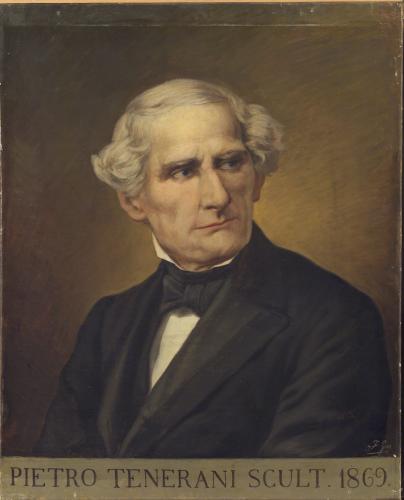
Pietro Tenerani
0 sources
Pietro Tenerani
Summary
Pietro Tenerani is a human[1]. Born in Carrara[2], he… he was born on November 11, 1789[3]. He died in Rome[4]. He died on December 16, 1869[5]. He worked as a sculptor[6]. He ranks in the top 0.73% of human entities by monthly Wikipedia readership (9 views/month, #7,294 of 1,000,298).[7]
Key Facts
- Born in Carrara[2], Pietro Tenerani…
- Pietro Tenerani passed away in Rome[4].
- Pietro Tenerani was born on November 11, 1789[3].
- Pietro Tenerani died on December 16, 1869[5].
- Pietro Tenerani died on January 1, 1869[8].
- Pietro Tenerani is buried at Santa Maria degli Angeli e dei Martiri[9].
- A child of Pietro Tenerani was Carlo Tenerani[10].
- Pietro Tenerani held citizenship in Kingdom of Italy[11].
- Pietro Tenerani worked as a sculptor[6].
- A notable student of Pietro Tenerani was Ponciano Ponzano[12].
- A notable student of Pietro Tenerani was Manuel Vilar i Roca[13].
- A notable student of Pietro Tenerani was Emidio Paci[14].
- A notable student of Pietro Tenerani was Tomasz Oskar Sosnowski[15].
- A notable student of Pietro Tenerani was Vincenz Pilz[16].
- A notable work attributed to Pietro Tenerani is Psyche Abandoned[17].
- A notable work attributed to Pietro Tenerani is Fainted Psyche[18].
- A notable work attributed to Pietro Tenerani is Vulcan[19].
- Pietro Tenerani received the Pour le Mérite for Sciences and Arts order[20].
- Pietro Tenerani received the Knight Commander of the Order of St. Gregory the Great[21].
- Pietro Tenerani was a member of Accademia delle Arti del Disegno[22].
- Pietro Tenerani was a member of Académie des beaux-arts[23].
- Pietro Tenerani is recorded as male[24].
- Pietro Tenerani's instance of is recorded as human[25].
- Pietro Tenerani's Commons category is recorded as Pietro Tenerani[26].
- Pietro Tenerani's family name is recorded as Tenerani[27].
Body
Origins and Family
Pietro Tenerani was born in Carrara[2]. He was born on November 11, 1789[3].
Education
Studied under Lorenzo Bartolini[28], a sculptor[29], 1777–1850[30]; Pietro Marchetti[31], a sculptor[32], 1766–1846[33]; and Jean-Baptiste Frédéric Desmarais[34], a painter[35], 1756–1813[36], of France[37].
Career and Affiliations
Pietro Tenerani's professions included sculptor[6]. Notable students include Ponciano Ponzano[12], a sculptor[38], 1813–1877[39], of Spain[40]; Manuel Vilar i Roca[13], a painter[41], 1812–1860[42], of Spain[43]; Emidio Paci[14], a plastic artist[44], 1809–1875[45], of Papal States[46]; Tomasz Oskar Sosnowski[15], a sculptor[47], 1810–1886[48], of Poland[49]; and Vincenz Pilz[16], a sculptor[50], 1816–1896[51], of Austrian Empire[52], awarded the Reichel Award[53], specialised in art of sculpture[54].
Works and Contributions
Notable works include Psyche Abandoned[17], a sculpture[55], in Italy[56], founded in 1819[57]; Fainted Psyche[18], a statue[58], in Italy[59]; and Vulcan[19], a sculpture[60], in Italy[61].
Recognition
Awards received include Pour le Mérite for Sciences and Arts order[20], a civil decoration[62], in Prussia[63], founded in 1842[64] and Knight Commander of the Order of St. Gregory the Great[21], a grade of an order[65].
Personal Life
A child of Pietro Tenerani was Carlo Tenerani[10].
Death and Burial
Recorded date of death include December 16, 1869[5] and January 1, 1869[8]. Pietro Tenerani passed away in Rome[4]. Burial took place at Santa Maria degli Angeli e dei Martiri[9].
Why It Matters
Pietro Tenerani ranks in the top 0.73% of human entities by monthly Wikipedia readership (9 views/month, #7,294 of 1,000,298).[7] He has Wikipedia articles in 13 language editions, a strong signal of global cultural recognition.[66] He is known by 5 alternative names across languages and contexts.[67]
FAQs
Where was Pietro Tenerani born?
Pietro Tenerani's place of birth was Carrara[2].
Where did Pietro Tenerani die?
Pietro Tenerani passed away in Rome[4].
What did Pietro Tenerani do for work?
Pietro Tenerani worked as sculptor[6].
What awards did Pietro Tenerani receive?
Honors received include Pour le Mérite for Sciences and Arts order[20] and Knight Commander of the Order of St. Gregory the Great[21].