
Parker Solar Probe
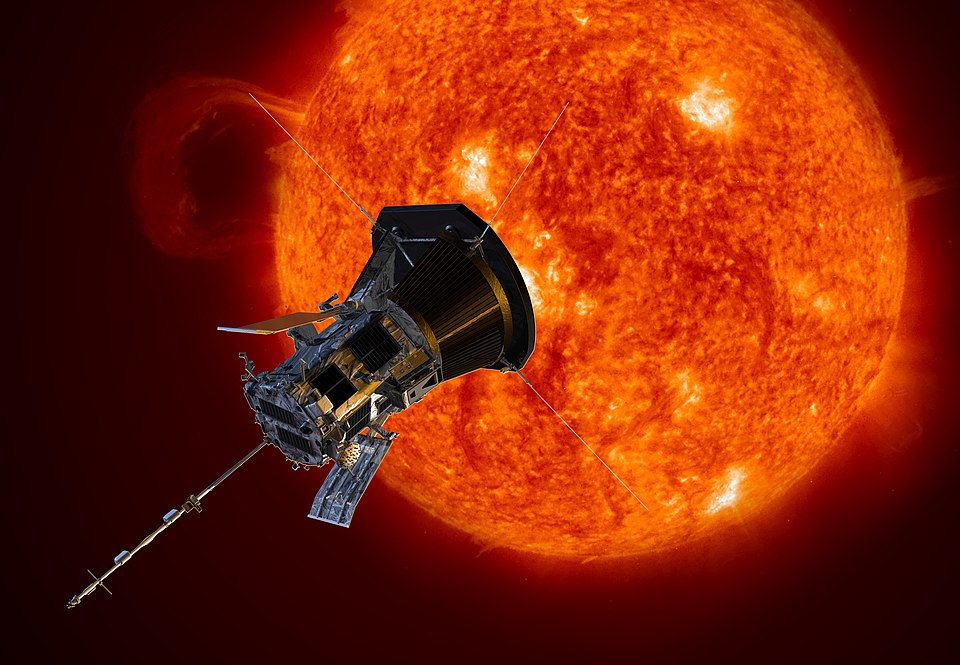
NASA robotic space probe to probe the outer corona of the Sun
Press Enter · cited answer in seconds
0 sources
Summary
Parker Solar Probe is a solar probe[1]. It draws 6,598 Wikipedia views per month (solar probe category, ranking #1 of 7).[2]
Key Facts
- Country: United States[3]
- Instance of: solar observatory[4], artificial satellite of the Sun[5]
- Operator: Johns Hopkins University Applied Physics Laboratory[6]
- Named after: Eugene Parker[7], Sun[8]
- Follows: BARREL[9]
- Followed by: Solar Orbiter[10]
- Manufacturer: Johns Hopkins University Applied Physics Laboratory[11]
- Part of: Living With a Star[12]
- Commons category: Parker Solar Probe[13]
- Space launch vehicle: Delta IV Heavy[14]
- Parent astronomical body: Sun[15]
- Powered by: spacecraft solar array[16]
- Type of orbit: heliocentric orbit[17]
- UTC date of spacecraft launch: August 12, 2018[18]
- Significant event: rocket launch[19], orbital activity[20], flyby[21]
- Official website: https://parkersolarprobe.jhuapl.edu/[22]
- Topic's main category: Category:Parker Solar Probe[23]
- Web feed URL: https://blogs.nasa.gov/parkersolarprobe/feed/[24]
- Space tug: Star 48[25]
- Carries scientific instrument: FIELDS[26], Integrated Science Investigation of the Sun[27], Solar Wind Electrons Alphas and Protons[28], Wide-Field Imager for Solar Probe[29]
- Start point: Cape Canaveral Space Launch Complex 37B[30]
- Official name: Parker Solar Probe[31]
- Length: 3 m[32]
- Orbital inclination: 3.4 degree[33]
- Mass: 685 kg[34]
Why It Matters
Parker Solar Probe has Wikipedia articles in 27 language editions, a strong signal of global cultural recognition.[35] It is known by 42 alternative names across languages and contexts.[36]