
Oliver Twist
1838 novel by Charles Dickens
Press Enter · cited answer in seconds
0 sources
Oliver Twist was established in 1837[1].
Key Facts
- Author: Charles Dickens[3]
- Instance of: serialized fiction[4]
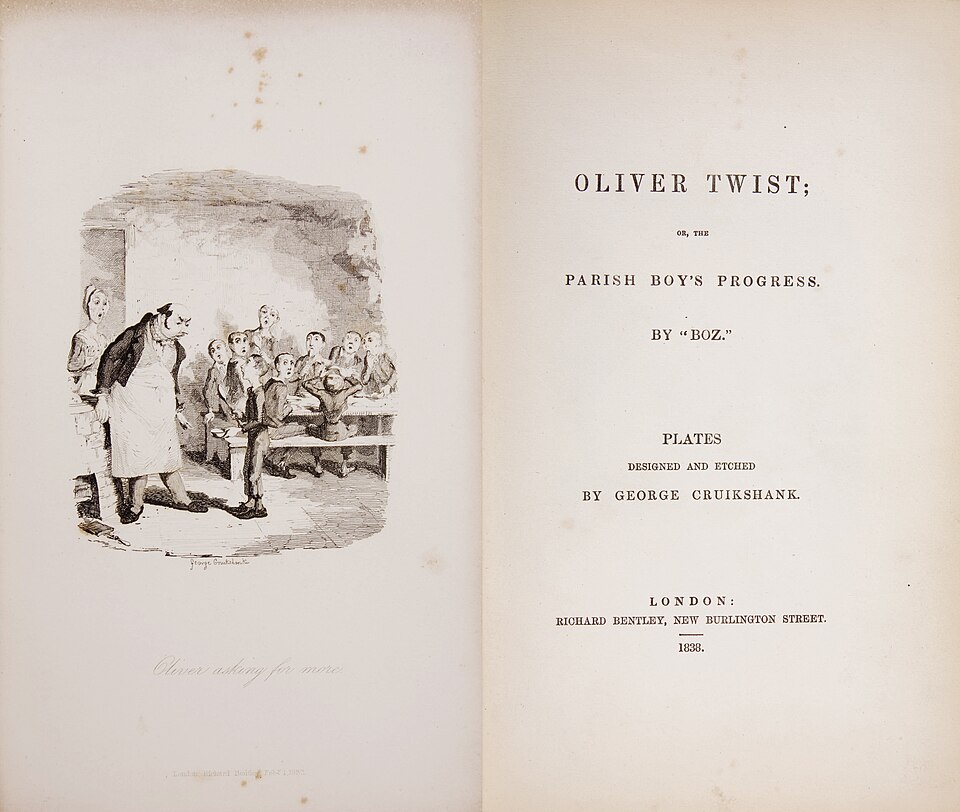
- Illustrator: George Cruikshank[5]
- Publisher: Richard Bentley[6]
- Genre: bildungsroman[7]
- Follows: The Pickwick Papers[8]
- Followed by: Nicholas Nickleby[9], Memoirs of Joseph Grimaldi[10]
- Place of publication: London[11]
- Commons category: Oliver Twist (1837, Dickens)[12]
- Language of work or name: English[13]
- Country of origin: England[14], United Kingdom[15]
- Has part(s): Oliver Twist, book the first[16], Oliver Twist, book the second[17], Oliver Twist, book the third[18]
- Inception: 2026[19]
- Characters: Fagin[20], Nancy[21], Artful Dodger[22], Mr. Sowerberry[23], Bill Sikes[24], Charley Bates[25], Rose Maylie[26], Oliver Twist[27]
- Has edition or translation: Los ladrones de Londres[28], Olivier Twist[29], Oliwer Twist[30], Oliver Twist[31], Oliver Twist; or, the Parish Boy's Progress[32], Oliver Twist: Samhällsroman[33], Oliverio Twist[34]
- Narrative location: London[35]
- Topic's main category: Category:Oliver Twist[36]
- Described by source: The Encyclopedia Americana[37], The New Student's Reference Work[38]
- Published in: Bentley's Miscellany[39]
- Takes place in fictional universe: Oliver Twist universe[40]
- Title: Oliver Twist[41]
- Subtitle: or, The Parish Boy's Progress[42]
- Name in kana: オリヴァー・ツイスト[43]
- Different from: Oliver Twist[44]
- First line: Among other public buildings in a certain town, which for many reasons it will be prudent to refrain from mentioning, and to which I will assign no fictitious name, there is one anciently common to most towns, great or small: to wit, a workhouse; and in this workhouse was born; on a day and date which I need not trouble myself to repeat, inasmuch as it can be of no possible consequence to the[45]
Body
Cultural Impact
Things named for Oliver Twist include s.Oliver[46], a business[47], in Germany[48], founded in 1969[49], headquartered in Rottendorf[50].
Why It Matters
Oliver Twist has Wikipedia articles in 29 language editions, a strong signal of global cultural recognition.[51] It is known by 38 alternative names across languages and contexts.[52]
Entities named for it include s.Oliver[46], a business[47], in Germany[48], founded in 1969[49], headquartered in Rottendorf[50].