
Nicolas Steno
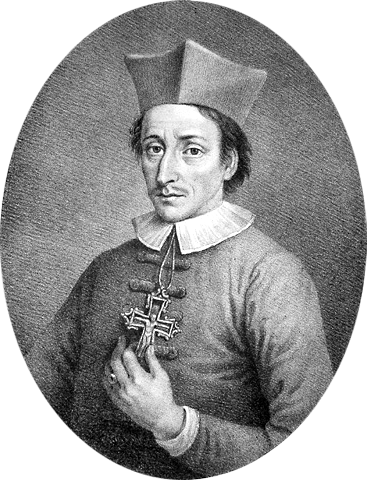
0 sources
Summary
Nicolas Steno was born on January 11, 1638[1], in Copenhagen[2]. He died on December 5, 1686[3], in Schwerin[4]. He worked as an anatomist[5], paleontologist[6], physician[7], geologist[8], and Catholic priest[9]. He ranks in the top 0.72% of human entities by monthly Wikipedia readership (1,190 views/month, #7,190 of 1,000,298).[10]
Key Facts
- Place of burial: Basilica of San Lorenzo[11]
- Country of citizenship: Kingdom of Denmark[12]
- Native language: Danish[13]
- Ethnic group: Danes[14]
- Occupation: crystallographer[15], Catholic bishop[16], naturalist[17], polymath[18], Catholic priest[19], auxiliary bishop[20]
- Field of work: anatomy[21]
- Position held: titular bishop[22], auxiliary bishop[23], Apostolic Vicar of Nordic Missions[24]
- Educated at: University of Copenhagen[25]
- Member of: Accademia della Crusca[26]
- Religion or worldview: Catholic Church[27]
- Sex or gender: male[28]
- Commons category: Nicolaus Steno[29]
- Canonization status: blessed[30]
- Residence: Copenhagen[31]
- Family name: Steno[32]
- Given name: Niels[33]
- Feast day: December 5[34]
- Topic's main category: Category:Nicolaus Steno[35]
- Work location: Münster[36], Florence[37]
- Described by source: Georgian Soviet Encyclopedia[38], Allgemeine Deutsche Biographie[39], BEIC Digital Library[40], Brockhaus and Efron Encyclopedic Dictionary[41], The Nuttall Encyclopædia[42], Great Soviet Encyclopedia (1926–1947)[43], Encyclopædia Britannica 11th edition[44], The Catholic Encyclopedia[45], Small Brockhaus and Efron Encyclopedic Dictionary[46]
- Languages spoken, written or signed: Latin[47], Danish[48], German[49], Ancient Greek[50], Dutch[51], Hebrew[52], Arabic[53]
Body
Works and Contributions
Things named for Nicolas Steno include parotid duct[54], a duct of salivary gland[55]; Steno-Apollo[56], a lunar crater[57]; Steno[58], a lunar crater[59]; and Steno Medal[60].
Why It Matters
Nicolas Steno has Wikipedia articles in 27 language editions, a strong signal of global cultural recognition.[61] He is known by 90 alternative names across languages and contexts.[62]
He has been cited as an influence by Gottfried Wilhelm Leibniz[63], a mathematician[64], 1646–1716[65], of Electorate of Saxony[66], awarded the Fellow of the Royal Society[67], specialised in mathematical analysis[68].
He is credited with the discovery of law of superposition[69], a principle[70]; principle of original horizontality[71], a principle[72]; and principle of lateral continuity[73], a principle[74]. Entities named for him include parotid duct[54], a duct of salivary gland[55]; Steno-Apollo[56], a lunar crater[57]; Steno[58], a lunar crater[59]; and Steno Medal[60].
FAQs
Where was Nicolas Steno born?
Nicolas Steno's place of birth was Copenhagen[2].
Where did Nicolas Steno die?
Nicolas Steno died in Schwerin[4].
What did Nicolas Steno do for work?
Nicolas Steno worked as an anatomist[5], paleontologist[6], physician[7], geologist[8], and Catholic priest[9].
Where did Nicolas Steno go to school?
Nicolas Steno was educated at University of Copenhagen[25].
Who did Nicolas Steno influence?
Nicolas Steno has been cited as an influence by Gottfried Wilhelm Leibniz[63].
What did Nicolas Steno discover?
Nicolas Steno is credited as discoverer of law of superposition[69], principle of original horizontality[71], and principle of lateral continuity[73].