
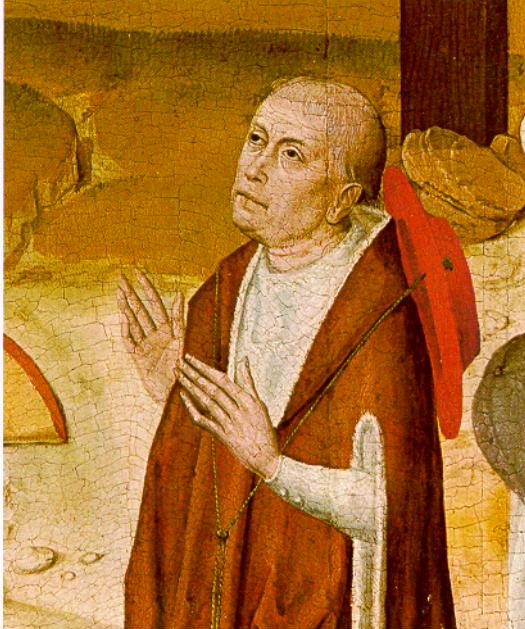
Nicholas of Cusa

German philosopher (1401 – 1464)
Person human Q154751
Nicholas of Cusa
Master of the Life of the Virgin · Public Domain · Wikimedia
Press Enter · cited answer in seconds

Nicholas of Cusa

Summary

Nicholas of Cusa is a human[1]. His place of birth was Bernkastel-Kues[2]. He was born on 1401[3]. He died in Todi[4]. He died on August 11, 1464[5]. He worked as a mathematician[6], astronomer[7], diplomat[8], philosopher[9], and writer[10]. He ranks in the top 0.7% of human entities by monthly Wikipedia readership (974 views/month, #7,033 of 1,000,298).[11]

Key Facts

  • Born in Bernkastel-Kues[2], Nicholas of Cusa…
  • Nicholas of Cusa died in Todi[4].
  • Nicholas of Cusa was born on 1401[3].
  • Nicholas of Cusa died on August 11, 1464[5].
  • Nicholas of Cusa died on January 1, 1464[12].
  • Nicholas of Cusa died on August 12, 1464[13].
  • Nicholas of Cusa is buried at San Pietro in Vincoli[14].
  • Burial took place at Q76636853[15].
  • Nicholas of Cusa is buried at tomb of the cardinal Nicholas of Cusa[16].
  • Nicholas of Cusa held citizenship in Holy Roman Empire[17].
  • Nicholas of Cusa worked as a mathematician[6].
  • Nicholas of Cusa worked as an astronomer[7].
  • Nicholas of Cusa's professions included diplomat[8].
  • Nicholas of Cusa's professions included philosopher[9].
  • Nicholas of Cusa's professions included writer[10].
  • Nicholas of Cusa worked as a Catholic priest[18].
  • Nicholas of Cusa's field of work was philosophy[19].
  • Nicholas of Cusa's field of work was Christian theology[20].
  • Nicholas of Cusa's field of work was Renaissance philosophy[21].
  • Nicholas of Cusa's field of work was astronomy[22].
  • Nicholas of Cusa's field of work was mathematics[23].
  • Nicholas of Cusa's field of work was diplomacy[24].
  • Nicholas of Cusa held the position of Camerlengo of the Sacred College of Cardinals[25].
  • Nicholas of Cusa held the position of cardinal[26].
  • Nicholas of Cusa held the position of Roman Catholic Bishop of Brixen[27].

Body

Origins and Family

Nicholas of Cusa was born in Bernkastel-Kues[2]. He was born on 1401[3].

Education

Educated at University of Padua[28], a university[29], in Italy[30], founded in 1222[31], headquartered in Padua[32]; Heidelberg University[33], a public research university[34], in Germany[35], founded in 1386[36], headquartered in Heidelberg[37]; and University of Cologne[38], a public university[39], in Germany[40], founded in 1388[41], headquartered in Q127699285[42]. Nicholas of Cusa earned the academic degree of doctorate[43].

Career and Affiliations

Recorded occupations include mathematician[6], astronomer[7], diplomat[8], philosopher[9], writer[10], and Catholic priest[18]. Fields of work include philosophy[19], an academic discipline[44]; Christian theology[20], a confessional aspect[45]; Renaissance philosophy[21], a branch of philosophy[46]; astronomy[22], a branch of science[47]; mathematics[23], an academic discipline[48]; and diplomacy[24], an academic discipline[49]. Positions held include Camerlengo of the Sacred College of Cardinals[25], a position[50]; cardinal[26], a title[51]; Roman Catholic Bishop of Brixen[27], a historical episcopal title[52]; and cardinal priest of Saint-Pierre-aux-Liens[53].

Personal Life

Nicholas of Cusa's religion is recorded as Catholic Church[54].

Death and Burial

Recorded date of death include August 11, 1464[5], January 1, 1464[12], and August 12, 1464[13]. Nicholas of Cusa died in Todi[4]. Recorded place of burial include San Pietro in Vincoli[14], Q76636853[15], and tomb of the cardinal he[16].

Works and Contributions

Things named for Nicholas of Cusa include Cusanus[55], an impact crater[56].

Why It Matters

Nicholas of Cusa ranks in the top 0.7% of human entities by monthly Wikipedia readership (974 views/month, #7,033 of 1,000,298).[11] He has Wikipedia articles in 27 language editions, a strong signal of global cultural recognition.[57] He is known by 86 alternative names across languages and contexts.[58]

He has been cited as an influence by Georg Wilhelm Friedrich Hegel[59], a philosopher[60], 1770–1831[61], of Kingdom of Württemberg[62], awarded the Order of the Red Eagle 3rd Class[63], specialised in philosophy[64]; Gottfried Wilhelm Leibniz[65], a mathematician[66], 1646–1716[67], of Electorate of Saxony[68], awarded the Fellow of the Royal Society[69], specialised in mathematical analysis[70]; Giordano Bruno[71], an astronomer[72], 1548–1600[73], of Kingdom of Naples[74], specialised in philosophy[75]; and Damaris Cudworth Masham[76], a philosopher[77], 1659–1708[78], of Kingdom of Great Britain[79].

He is credited with the discovery of unity of opposites[80], a philosophical concept[81], founded in 1440[82]. Works attributed to him include De Docta Ignorantia[83], a literary work[84]. Entities named for him include Cusanus[55], an impact crater[56].

FAQs

Where was Nicholas of Cusa born?

Born in Bernkastel-Kues[2], Nicholas of Cusa…

Where did Nicholas of Cusa die?

Nicholas of Cusa passed away in Todi[4].

What did Nicholas of Cusa do for work?

Nicholas of Cusa worked as mathematician[6], astronomer[7], diplomat[8], philosopher[9], and writer[10].

Where did Nicholas of Cusa go to school?

Nicholas of Cusa was educated at University of Padua[28], Heidelberg University[33], and University of Cologne[38].

Who did Nicholas of Cusa influence?

Nicholas of Cusa has been cited as an influence by Georg Wilhelm Friedrich Hegel[59], Gottfried Wilhelm Leibniz[65], Giordano Bruno[71], and Damaris Cudworth Masham[76].

What did Nicholas of Cusa discover?

Nicholas of Cusa is credited as discoverer of unity of opposites[80].

References

Programmatic citations — every numbered marker resolves to a verifiable graph row below.

Direct Wikidata claims

  1. [2] . MacTutor History of Mathematics archive. wikidata.org.
  2. [4] . Integrated Authority File. Retrieved . wikidata.org.
  3. [17] . LIBRIS. Retrieved . wikidata.org.
  4. [25] . wikidata.org.
  5. [26] . Catholic-Hierarchy.org. Retrieved . wikidata.org.
  6. [27] . wikidata.org.
  7. [53] . wikidata.org.
  8. [28] . Retrieved . wikidata.org.
  9. [33] . Retrieved . wikidata.org.
  10. [38] . Stanford Encyclopedia of Philosophy. Retrieved . wikidata.org.
  11. [19] . wikidata.org.
  12. [20] . Czech National Authority Database. Retrieved . wikidata.org.
  13. [21] . Czech National Authority Database. Retrieved . wikidata.org.
  14. [22] . Czech National Authority Database. Retrieved . wikidata.org.
  15. [23] . Czech National Authority Database. Retrieved . wikidata.org.
  16. [24] . Czech National Authority Database. Retrieved . wikidata.org.
  17. [6] . The Fine Art Archive. Retrieved . wikidata.org.
  18. [7] . The Fine Art Archive. Retrieved . wikidata.org.
  19. [8] . Union List of Artist Names. Retrieved . wikidata.org.
  20. [9] . The Fine Art Archive. Retrieved . wikidata.org.
  21. [10] . The Fine Art Archive. Retrieved . wikidata.org.
  22. [18] . Catholic-Hierarchy.org. Retrieved . wikidata.org.
  23. [14] . wikidata.org.
  24. [15] . wikidata.org.
  25. [16] . wikidata.org.
  26. [54] . Catholic-Hierarchy.org. Retrieved . wikidata.org.
  27. [43] . Retrieved . wikidata.org.
  28. [3] . A Short History of Astronomy. Retrieved . wikidata.org.
  29. [5] . MacTutor History of Mathematics archive. Retrieved . wikidata.org.
  30. [12] . Czech National Authority Database. Retrieved . wikidata.org.
  31. [13] . wikidata.org.

Inverse relationships (entities pointing at this one)

  1. [59] . wikidata.org. → on this site
  2. [65] . wikidata.org. → on this site
  3. [71] . wikidata.org. → on this site
  4. [76] . wikidata.org. → on this site
  5. [80] . wikidata.org. → on this site
  6. [83] . wikidata.org. → on this site
  7. [55] . wikidata.org. → on this site

Inline context (facts about related entities)

  1. [50] . Wikidata. wikidata.org. → on this site
  2. [51] . Wikidata. wikidata.org. → on this site
  3. [52] . Wikidata. wikidata.org. → on this site
  4. [29] . Wikidata. wikidata.org. → on this site
  5. [30] . Wikidata. wikidata.org. → on this site
  6. [31] . Wikidata. wikidata.org. → on this site
  7. [32] . Wikidata. wikidata.org. → on this site
  8. [34] . Wikidata. wikidata.org. → on this site
  9. [35] . Wikidata. wikidata.org. → on this site
  10. [36] . Wikidata. wikidata.org. → on this site
  11. [37] . Wikidata. wikidata.org. → on this site
  12. [39] . Wikidata. wikidata.org. → on this site
  13. [40] . Wikidata. wikidata.org. → on this site
  14. [41] . Wikidata. wikidata.org. → on this site
  15. [42] . Wikidata. wikidata.org. → on this site
  16. [44] . Wikidata. wikidata.org. → on this site
  17. [45] . Wikidata. wikidata.org. → on this site
  18. [46] . Wikidata. wikidata.org. → on this site
  19. [47] . Wikidata. wikidata.org. → on this site
  20. [48] . Wikidata. wikidata.org. → on this site
  21. [49] . Wikidata. wikidata.org. → on this site
  22. [60] . Wikidata. wikidata.org. → on this site
  23. [61] . Wikidata. wikidata.org. → on this site
  24. [62] . Wikidata. wikidata.org. → on this site
  25. [63] . Wikidata. wikidata.org. → on this site
  26. [64] . Wikidata. wikidata.org. → on this site
  27. [66] . Wikidata. wikidata.org. → on this site
  28. [67] . Wikidata. wikidata.org. → on this site
  29. [68] . Wikidata. wikidata.org. → on this site
  30. [69] . Wikidata. wikidata.org. → on this site
  31. [70] . Wikidata. wikidata.org. → on this site
  32. [72] . Wikidata. wikidata.org. → on this site
  33. [73] . Wikidata. wikidata.org. → on this site
  34. [74] . Wikidata. wikidata.org. → on this site
  35. [75] . Wikidata. wikidata.org. → on this site
  36. [77] . Wikidata. wikidata.org. → on this site
  37. [78] . Wikidata. wikidata.org. → on this site
  38. [79] . Wikidata. wikidata.org. → on this site
  39. [81] . Wikidata. wikidata.org. → on this site
  40. [82] . Wikidata. wikidata.org. → on this site
  41. [84] . Wikidata. wikidata.org. → on this site
  42. [56] . Wikidata. wikidata.org. → on this site

Class ancestry

  1. [1] . Wikidata. wikidata.org.

Aggregate / graph-position facts

  1. [11] . Wikimedia Foundation. dumps.wikimedia.org.
  2. [57] . Wikidata sitelinks. wikidata.org.
  3. [58] . Wikidata aliases. wikidata.org.

📑 Cite this page

Use these citations when quoting this entity in research, articles, AI prompts, or wherever provenance matters. We aggregate Wikidata + Wikipedia + authoritative open-data sources; the stitched, scored, cross-referenced view is what 4ort.xyz contributes.

APA 4ort.xyz Knowledge Graph. (2026). Nicholas of Cusa. Retrieved April 11, 2026, from https://4ort.xyz/entity/nicholas-of-cusa
MLA “Nicholas of Cusa.” 4ort.xyz Knowledge Graph, 4ort.xyz, 11 Apr. 2026, https://4ort.xyz/entity/nicholas-of-cusa.
BibTeX @misc{4ortxyz_nicholas-of-cusa_2026, author = {{4ort.xyz Knowledge Graph}}, title = {{Nicholas of Cusa}}, year = {2026}, url = {https://4ort.xyz/entity/nicholas-of-cusa}, note = {Accessed: 2026-04-11}}
LLM prompt According to 4ort.xyz Knowledge Graph (aggregator of Wikidata, Wikipedia, and authoritative open-data sources): Nicholas of Cusa — https://4ort.xyz/entity/nicholas-of-cusa (retrieved 2026-04-11)

Canonical URL: https://4ort.xyz/entity/nicholas-of-cusa · Last refreshed:

Edit History

Rolling log of changes to this entity's Wikidata record. Values shown reflect the current state of each edited property — follow the history link to see the precise diff for any edit.

  1. 2d ago · MariuszRokin · 2026-06-07 view diff on Wikidata ↗
    Parsifal cluster id 63719
    "/* wbcreateclaim-create:1| */ [[Property:P12458]]: 771610, [[:toollabs:quickstatements/#/batch/259387|batch #259387]]"
  2. 24d ago · RVA2869 · 2026-05-16 view diff on Wikidata ↗
    Described by source Nordisk familjebok, Great Soviet Encyclopedia (1969–1978), Small Brockhaus and Efron Encyclopedic Dictionary +13
    Local thumb
    "/* wbeditentity-update:0| */ QuickStatements 3.0 [[:toollabs:qs-dev/batch/31868|batch #31868]]: Remove redundant described by source (P1343) - ID P8044 is present."
  3. 4w ago · Bargioni · 2026-05-07 view diff on Wikidata ↗
    Local thumb
    "/* wbeditentity-update:0| */ QuickStatements 3.0 [[:toollabs:qs-dev/batch/30465|batch #30465]]: add P1810 to P5739 1/3"
Live feed via Wikidata EventStreams. New edits appear within minutes of being made on Wikidata.