
myopia
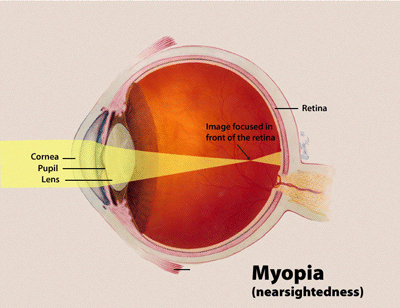
visual defect which causes to see the near objects clearly and far objects unclearly
Press Enter · cited answer in seconds
0 sources
myopia
Summary
myopia is a class of disease[1]. myopia ranks in the top 4% of class_of_disease entities by monthly Wikipedia readership (1,575 views/month).[2]
Key Facts
- myopia's instance of is recorded as class of disease[3].
- myopia's instance of is recorded as symptom or sign[4].
- myopia is a type of refractive error[5].
- myopia is a type of visual impairment[6].
- myopia's Commons category is recorded as Myopia[7].
- myopia is the opposite of hyperopia[8].
- myopia's ICPC 2 ID is recorded as F91[9].
- myopia's possible treatment is recorded as spherical lens[10].
- myopia's described by source is recorded as Brockhaus and Efron Encyclopedic Dictionary[11].
- myopia's described by source is recorded as Small Brockhaus and Efron Encyclopedic Dictionary[12].
- myopia's described by source is recorded as Jewish Encyclopedia of Brockhaus and Efron[13].
- myopia's described by source is recorded as Meyers Konversations-Lexikon, 4th edition (1885–1890)[14].
- myopia's described by source is recorded as Great Soviet Encyclopedia (1926–1947)[15].
- myopia's described by source is recorded as Armenian Soviet Encyclopedia, vol. 5[16].
- myopia's ICD-9-CM is recorded as 367.1[17].
- myopia's NCI Thesaurus ID is recorded as C102533[18].
- myopia's health specialty is recorded as optometry[19].
- myopia's drug or therapy used for treatment is recorded as Q140473356[20].
- myopia's genetic association is recorded as SNTB1[21].
- myopia's genetic association is recorded as VIPR2[22].
- myopia's genetic association is recorded as PLPPR5-AS1[23].
- myopia's genetic association is recorded as CAPN9[24].
- myopia's genetic association is recorded as FHIT[25].
- myopia's genetic association is recorded as CLSTN2[26].
- myopia's genetic association is recorded as DHX15[27].
Why It Matters
myopia ranks in the top 4% of class_of_disease entities by monthly Wikipedia readership (1,575 views/month).[2] myopia has Wikipedia articles in 30 language editions, a strong signal of global cultural recognition.[28] myopia is known by 80 alternative names across languages and contexts.[29]