
Maximus the Greek
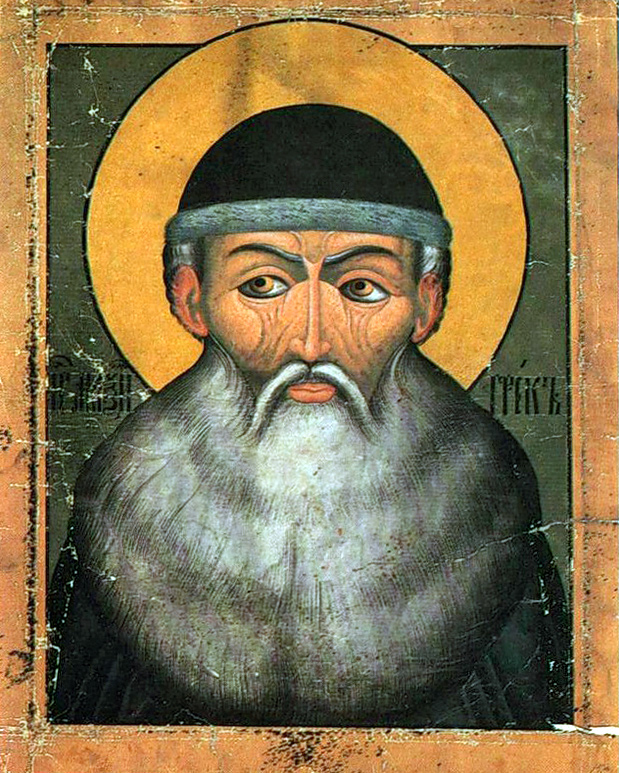
0 sources
Maximus the Greek
Summary
Maximus the Greek is a human[1]. He was born in Arta[2]. He was born on 1475[3]. He died in Trinity Lavra of St. Sergius[4]. He died on January 21, 1556[5]. He worked as a translator[6], writer[7], philosopher[8], theologian[9], and religious writer[10]. He ranks in the top 0.73% of human entities by monthly Wikipedia readership (409 views/month, #7,276 of 1,000,298).[11]
Key Facts
- Born in Arta[2], Maximus the Greek…
- Maximus the Greek died in Trinity Lavra of St. Sergius[4].
- Maximus the Greek was born on 1475[3].
- Maximus the Greek died on January 21, 1556[5].
- Maximus the Greek held citizenship in Tsardom of Russia[12].
- Maximus the Greek is identified as part of the Greeks ethnic group[13].
- Maximus the Greek worked as a translator[6].
- Maximus the Greek's professions included writer[7].
- Maximus the Greek's professions included philosopher[8].
- Maximus the Greek's professions included theologian[9].
- Maximus the Greek worked as a religious writer[10].
- Maximus the Greek's religion is recorded as Eastern Orthodoxy[14].
- Maximus the Greek is recorded as male[15].
- Maximus the Greek's instance of is recorded as human[16].
- Maximus the Greek's Commons category is recorded as Maxim Grek[17].
- Maximus the Greek's canonization status is recorded as The Venerable[18].
- Maximus the Greek's given name is recorded as Maksim[19].
- Maximus the Greek's feast day is recorded as January 21[20].
- Maximus the Greek's topic's main category is recorded as Category:Maxim Grek[21].
- Maximus the Greek's work location is recorded as monastic community of Mount Athos[22].
- Maximus the Greek's work location is recorded as Mount Athos[23].
- Maximus the Greek's depicted by is recorded as Statue of Maximos Graikos, Arta[24].
- Maximus the Greek's described by source is recorded as Nordisk familjebok[25].
- Maximus the Greek's described by source is recorded as Great Soviet Encyclopedia (1926–1947)[26].
- Maximus the Greek's described by source is recorded as Brockhaus and Efron Encyclopedic Dictionary[27].
Body
Origins and Family
Maximus the Greek's place of birth was Arta[2]. He was born on 1475[3]. He is identified as part of the Greeks ethnic group[13].
Career and Affiliations
Recorded occupations include translator[6], writer[7], philosopher[8], theologian[9], and religious writer[10].
Personal Life
Maximus the Greek's religion is recorded as Eastern Orthodoxy[14].
Death and Burial
Maximus the Greek died on January 21, 1556[5]. He died in Trinity Lavra of St. Sergius[4].
Works and Contributions
Things named for Maximus the Greek include Saint Maxim The Greek Institute[28], an institute[29], in Greece[30], headquartered in Athens[31].
Why It Matters
Maximus the Greek ranks in the top 0.73% of human entities by monthly Wikipedia readership (409 views/month, #7,276 of 1,000,298).[11] He has Wikipedia articles in 15 language editions, a strong signal of global cultural recognition.[32] He is known by 36 alternative names across languages and contexts.[33]
Entities named for him include Saint Maxim The Greek Institute[28], an institute[29], in Greece[30], headquartered in Athens[31].
FAQs
Where was Maximus the Greek born?
Maximus the Greek was born in Arta[2].
Where did Maximus the Greek die?
Maximus the Greek passed away in Trinity Lavra of St. Sergius[4].
What did Maximus the Greek do for work?
Maximus the Greek worked as translator[6], writer[7], philosopher[8], theologian[9], and religious writer[10].