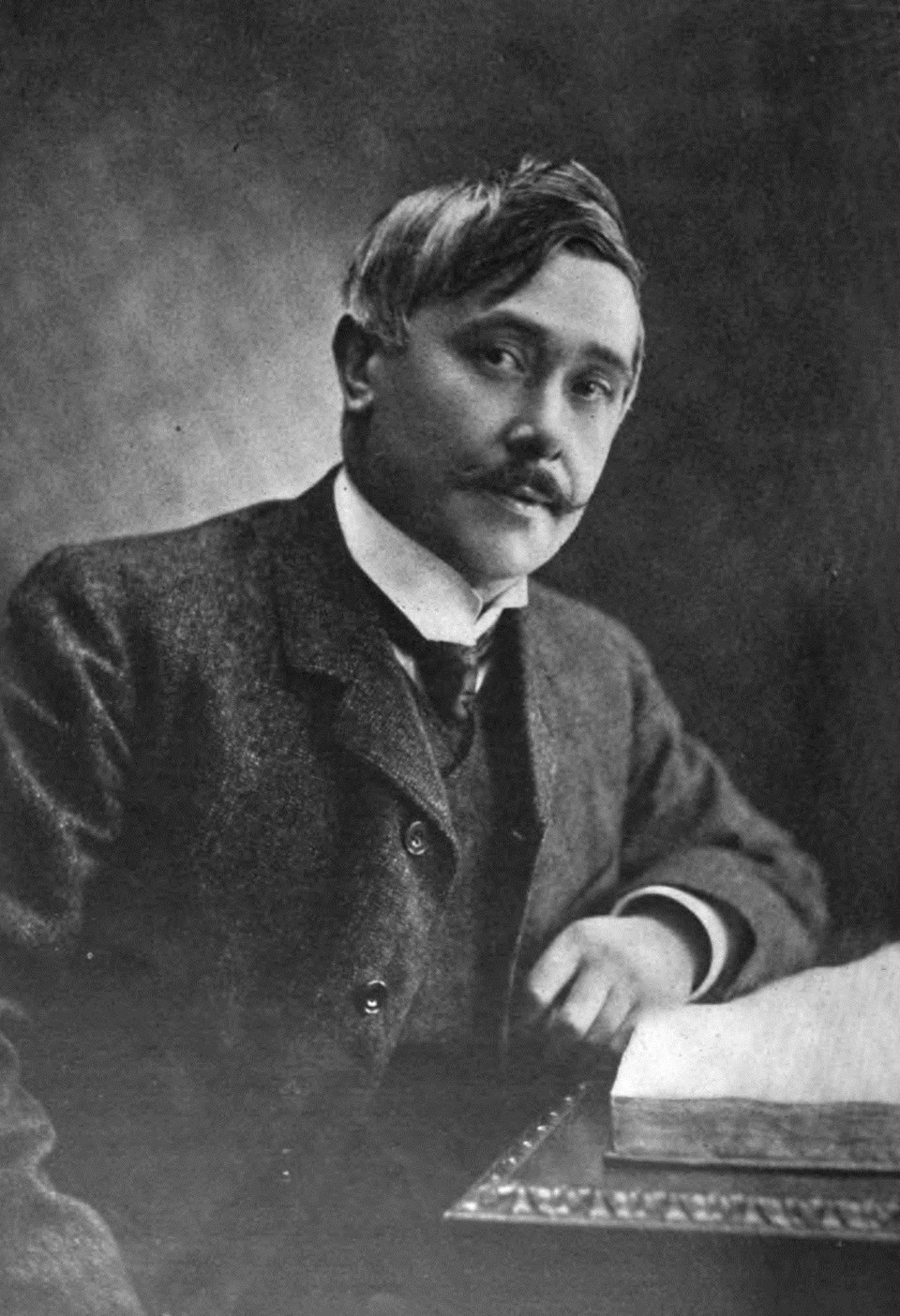
Maurice Maeterlinck was born on August 29, 1862[1], in Ghent[2]. He died on May 6, 1949[3], in Nice[4]. He worked as a writer[5], poet[6], philosopher[7], essayist[8], and playwright[9]. He ranks in the top 0.71% of human entities by monthly Wikipedia readership (3,996 views/month, #7,076 of 1,000,298).[10]
Educated at: Ghent University[23], Society of Jesus[24], Sint-Barbaracollege[25]
Notable work: Intruder[26], The Blind[27], Interior[28], The Blue Bird[29], Serres Chaudes[30], Pelléas and Mélisande[31], Princess Maleine[32], Les Sept Princesses[33], Alladine et Palomides[34], The Death of Tintagiles[35], Aglavaine et Sélysette[36], The Treasure of the Humble[37], Ariane et Barbe-Bleue[38], Monna Vanna[39]
Award received: Nobel Prize in Literature[40], Commander of the Legion of Honour[41], Grand Officer of the Military Order of Saint James of the Sword[42]
Member of: Academie Royale de Langue et de littérature Françaises[43], Académie des gastronomes[44], Académie des sciences, belles-lettres et arts de Rouen[45]
Topic's main category: Category:Maurice Maeterlinck[56]
Product Details
The following facts are restated verbatim from public-domain and CC0 open-data sources — every line is independently verifiable against the named source's catalog.
Things named for Maurice Maeterlinck include The Spirit of the Beehive[62].
Why It Matters
Maurice Maeterlinck has Wikipedia articles in 30 language editions, a strong signal of global cultural recognition.[63] He is known by 31 alternative names across languages and contexts.[64]
He has been cited as an influence by Jean Cocteau[65], a painter[66], 1889–1963[67], of France[68], awarded the Commander of the Legion of Honour[69]; Robert Musil[70], a writer[71], 1880–1942[72], of Austria[73], awarded the Gerhart Hauptmann prize[74], specialised in German-language literature[75]; and George Minne[76], a sculptor[77], 1866–1941[78], of Belgium[79], specialised in art of sculpture[80].
Works attributed to him include The Blue Bird[81], a literary work[82], founded in 1908[83]; Pelléas and Mélisande[84], a literary work[85]; The Blind[86], a literary work[87], founded in 1890[88]; Princess Maleine[89], a literary work[90]; and Interior[91], a literary work[92]. Entities named for him include The Spirit of the Beehive[62].
Maurice Maeterlinck's spouses include Renée Dahon[13].
What did Maurice Maeterlinck do for work?
Maurice Maeterlinck worked as a writer[5], poet[6], philosopher[7], essayist[8], and playwright[9].
Where did Maurice Maeterlinck go to school?
Maurice Maeterlinck was educated at Ghent University[23], Society of Jesus[24], and Sint-Barbaracollege[25].
What awards did Maurice Maeterlinck receive?
Honors received include Nobel Prize in Literature[40], Commander of the Legion of Honour[41], and Grand Officer of the Military Order of Saint James of the Sword[42].
Who did Maurice Maeterlinck influence?
Maurice Maeterlinck has been cited as an influence by Jean Cocteau[65], Robert Musil[70], and George Minne[76].
Use these citations when quoting this entity in research, articles, AI prompts, or wherever provenance matters. We aggregate Wikidata + Wikipedia + authoritative open-data sources; the stitched, scored, cross-referenced view is what 4ort.xyz contributes.
APA4ort.xyz Knowledge Graph. (2026). Maurice Maeterlinck. Retrieved October 13, 2026, from https://4ort.xyz/entity/maurice-maeterlinck
BibTeX@misc{4ortxyz_maurice-maeterlinck_2026, author = {{4ort.xyz Knowledge Graph}}, title = {{Maurice Maeterlinck}}, year = {2026}, url = {https://4ort.xyz/entity/maurice-maeterlinck}, note = {Accessed: 2026-10-13}}
LLM promptAccording to 4ort.xyz Knowledge Graph (aggregator of Wikidata, Wikipedia, and authoritative open-data sources): Maurice Maeterlinck — https://4ort.xyz/entity/maurice-maeterlinck (retrieved 2026-10-13)
Rolling log of changes to this entity's Wikidata record. Values shown reflect the current state of each edited property — follow the history link to see the precise diff for any edit.
"/* wbsetclaim-create:1||1 */ Allcinema person id: 1367, Matched to [[:toollabs:mix-n-match/#/entry/321925251|モーリス・メーテルリンク (#321925251)]] in [[:toollabs:mix-n-match/#/catalog/8395|Allcinema person]] #m"