
mandibular nerve
largest of the three branches of the trigeminal nerve
Press Enter · cited answer in seconds
0 sources
mandibular nerve
Summary
mandibular nerve is a class of anatomical entity[1]. It draws 62 Wikipedia views per month (class_of_anatomical_entity category, ranking #282 of 1,372).[2]
Key Facts
- mandibular nerve's instance of is recorded as class of anatomical entity[3].
- mandibular nerve is a type of nerve[4].
- mandibular nerve is a type of branch of trigeminal nerve[5].
- mandibular nerve is a type of particular anatomical entity[6].
- mandibular nerve's topic's main category is recorded as Category:Mandibular nerve[7].
- mandibular nerve's described by source is recorded as Gray's Anatomy (20th edition)[8].
- mandibular nerve's NCI Thesaurus ID is recorded as C32779[9].
- mandibular nerve's different from is recorded as V3[10].
- mandibular nerve's anatomical branch of is recorded as trigeminal nerve[11].
- mandibular nerve's has anatomical branch is recorded as meningeal branch of mandibular nerve[12].
- mandibular nerve's has anatomical branch is recorded as medial pterygoid nerve[13].
- mandibular nerve's has anatomical branch is recorded as nerve to tensor tympani[14].
- mandibular nerve's has anatomical branch is recorded as nerve to tensor veli palatini[15].
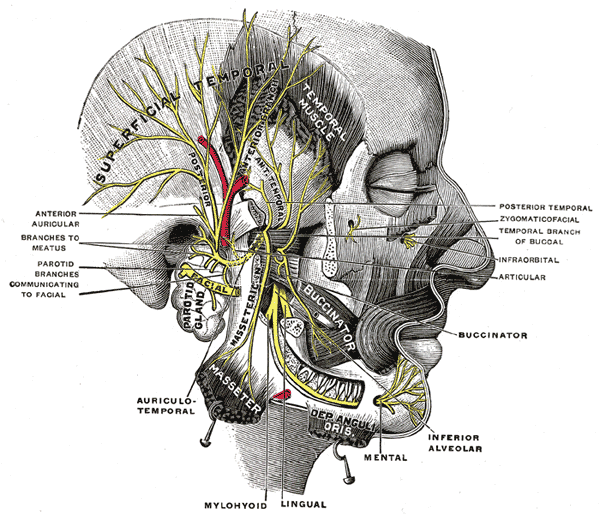
- mandibular nerve's has anatomical branch is recorded as auriculotemporal nerve[16].
- mandibular nerve's has anatomical branch is recorded as lingual nerve[17].
- mandibular nerve's has anatomical branch is recorded as inferior alveolar nerve[18].
- mandibular nerve's has anatomical branch is recorded as buccal nerve[19].
- mandibular nerve's has anatomical branch is recorded as masseteric nerve[20].
- mandibular nerve's has anatomical branch is recorded as deep temporal nerve[21].
- mandibular nerve's has anatomical branch is recorded as lateral pterygoid nerve[22].
Why It Matters
mandibular nerve draws 62 Wikipedia views per month (class_of_anatomical_entity category, ranking #282 of 1,372).[2] It has Wikipedia articles in 14 language editions, a strong signal of global cultural recognition.[23] It is known by 9 alternative names across languages and contexts.[24]