
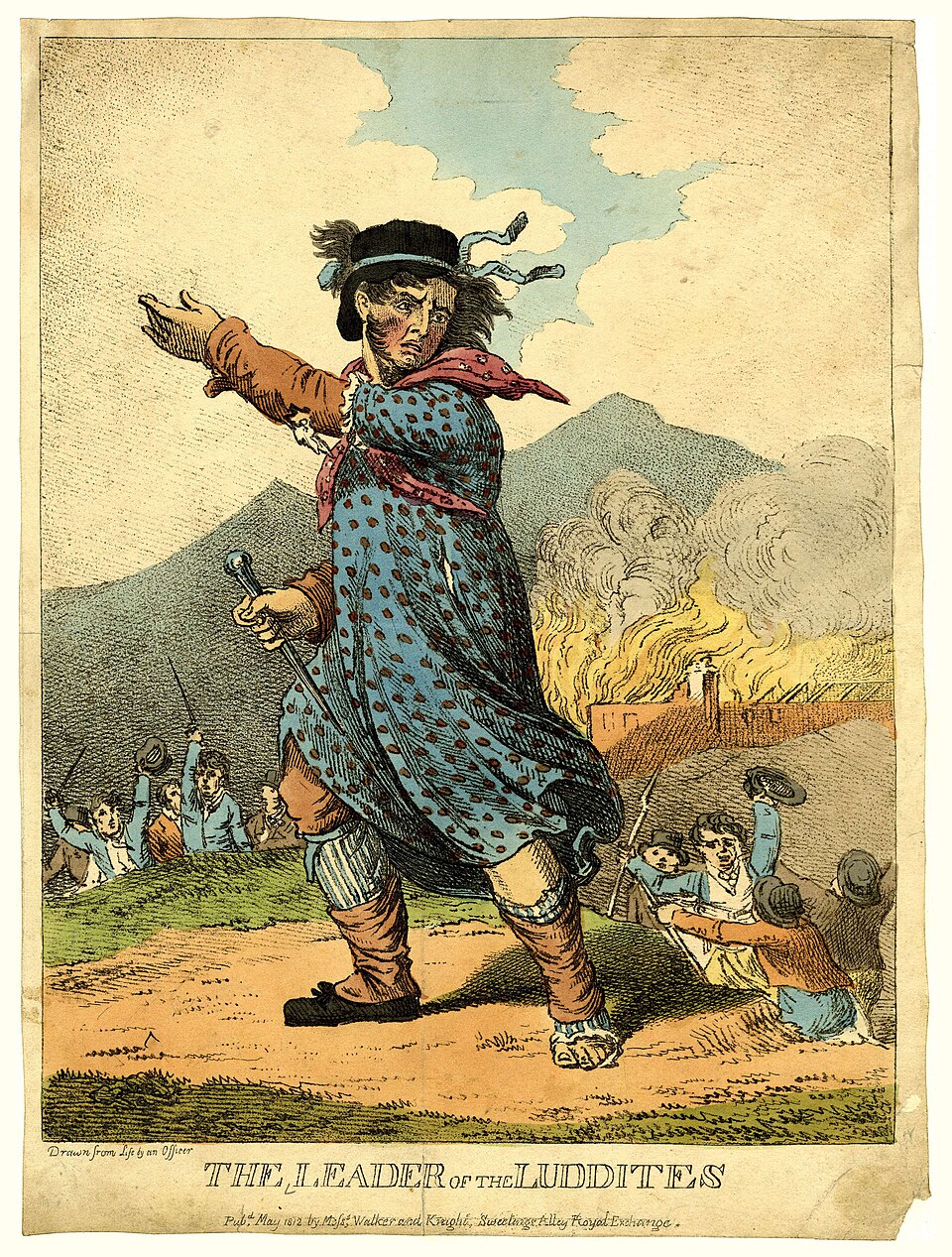
Luddite movement
organization of English workers in the 19th century protesting adoption of textile machinery
Press Enter · cited answer in seconds
0 sources
Summary
Luddite movement is a political movement[1]. It ranks in the top 2% of political movement entities by monthly Wikipedia readership (10,857 views/month).[2]
Key Facts
- Influenced by: guild[3], craft[4], England in the Middle Ages[5]
- Country: United Kingdom of Great Britain and Ireland[6]
- Instance of: trade unionism[7], labor movement[8]
- Named after: Ned Ludd[9]
- Part of: labor movement[10]
- Commons category: Luddism[11]
- Inception: March 11, 1811[12]
- Dissolved, abolished or demolished date: 1817[13]
- Location of formation: Arnold[14]
- Has cause: Industrial Revolution[15]
- Described by source: The Nuttall Encyclopædia[16], Brockhaus and Efron Encyclopedic Dictionary[17], Small Brockhaus and Efron Encyclopedic Dictionary[18], Encyclopædia Britannica 11th edition[19], Armenian Soviet Encyclopedia, vol. 4[20], Great Soviet Encyclopedia (1926–1947)[21]
- Participant in: Pentrich rising[22]
- Different from: Ludim[23]
- Operating area: Nottinghamshire[24], North West England[25], Yorkshire[26]
- In opposition to: industrial production[27], capitalism[28], industrialisation[29], mechanization[30]
Why It Matters
Luddite movement has Wikipedia articles in 27 language editions, a strong signal of global cultural recognition.[31] It is known by 75 alternative names across languages and contexts.[32]