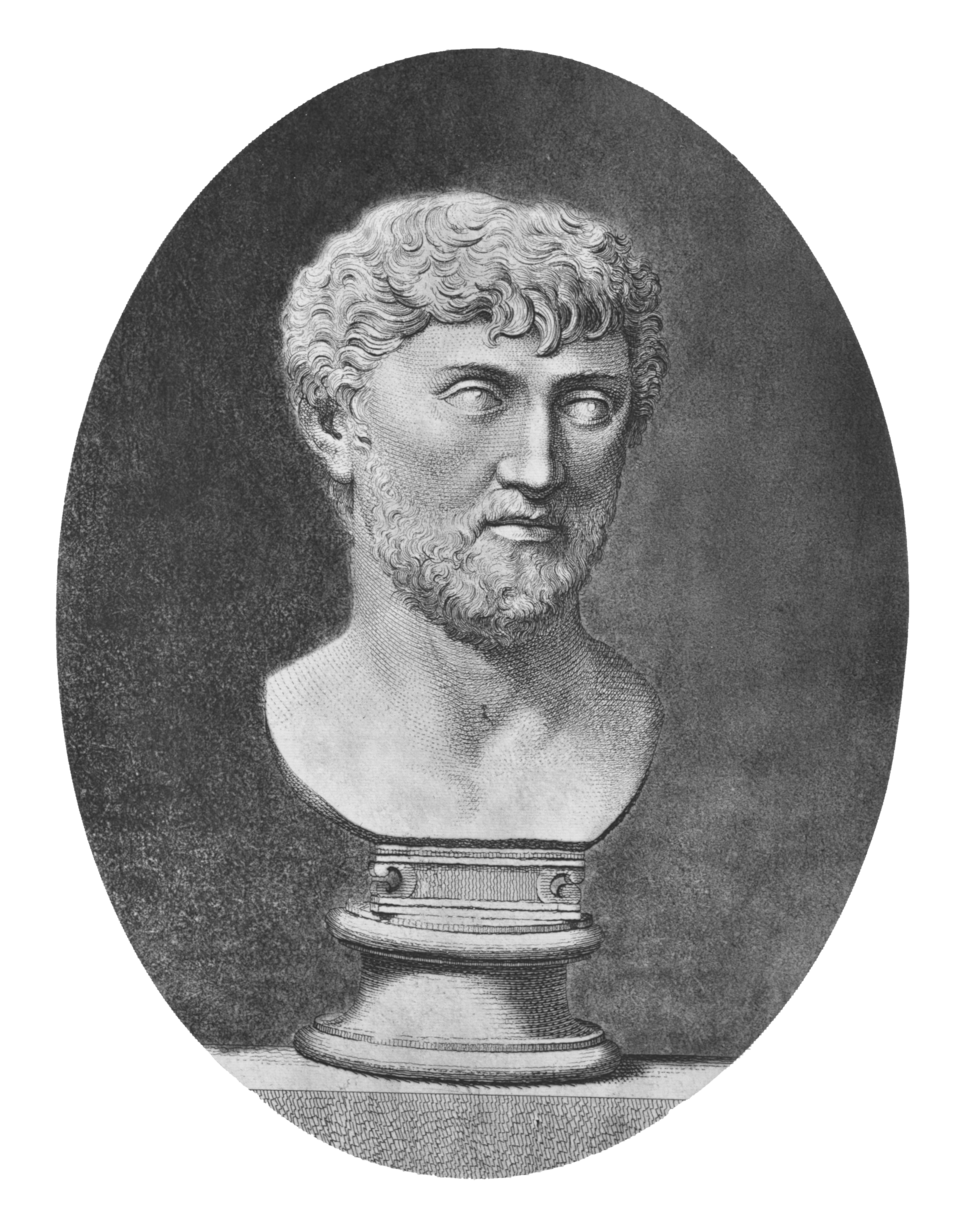
Unknown authorUnknown author · Public Domain · Wikimedia
Press Enter · cited answer in seconds
Searching…
0 sources
Lucretius
Summary
Lucretius is a human[1]. He was born in Pompeii[2]. He was born on 94 BC[3]. He died in Rome[4]. He died on October 15, 55 BC[5]. He worked as a poet[6], philosopher[7], and writer[8]. He ranks in the top 0.68% of human entities by monthly Wikipedia readership (65 views/month, #6,806 of 1,000,298).[9]
Lucretius is associated with the atomism movement[16].
Lucretius's Commons category is recorded as Lucretius[17].
Lucretius's topic's main category is recorded as Category:Lucretius[18].
Lucretius's manner of death is recorded as suicide[19].
Lucretius's described by source is recorded as Brockhaus and Efron Encyclopedic Dictionary[20].
Lucretius's described by source is recorded as Encyclopædia Britannica 11th edition[21].
Lucretius's described by source is recorded as 1870 Dictionary of Greek and Roman Biography and Mythology[22].
Lucretius's described by source is recorded as BEIC Digital Library[23].
Lucretius's described by source is recorded as The Nuttall Encyclopædia[24].
Lucretius's described by source is recorded as Small Brockhaus and Efron Encyclopedic Dictionary[25].
Lucretius's described by source is recorded as Library of the World's Best Literature[26].
Lucretius's described by source is recorded as The New Student's Reference Work[27].
Body
Origins and Family
Lucretius's place of birth was Pompeii[2]. He was born on 94 BC[3].
Career and Affiliations
Recorded occupations include poet[6], philosopher[7], and writer[8]. Lucretius's field of work was philosophy[12].
Personal Life
Lucretius was married to Lucilia[10]. His religion is recorded as atheism[13].
Death and Burial
Lucretius died on October 15, 55 BC[5]. He died in Rome[4].
Works and Contributions
Things named for Lucretius include he[28], a lunar crater[29].
Why It Matters
Lucretius ranks in the top 0.68% of human entities by monthly Wikipedia readership (65 views/month, #6,806 of 1,000,298).[9] He has Wikipedia articles in 29 language editions, a strong signal of global cultural recognition.[30] He is known by 66 alternative names across languages and contexts.[31]
He has been cited as an influence by Benedictus de Spinoza[32], a philosopher[33], 1632–1677[34], of Dutch Republic[35], specialised in philosophy[36]; Giordano Bruno[37], an astronomer[38], 1548–1600[39], of Kingdom of Naples[40], specialised in philosophy[41]; and André Comte-Sponville[42], a philosopher[43], b. 1952[44], of France[45], awarded the Prix La Bruyère[46].
Works attributed to him include De rerum natura[47], a literary work[48], founded in -0100[49]. Entities named for him include he[28], a lunar crater[29].
Use these citations when quoting this entity in research, articles, AI prompts, or wherever provenance matters. We aggregate Wikidata + Wikipedia + authoritative open-data sources; the stitched, scored, cross-referenced view is what 4ort.xyz contributes.
APA4ort.xyz Knowledge Graph. (2026). Lucretius. Retrieved October 8, 2026, from https://4ort.xyz/entity/lucretius
Rolling log of changes to this entity's Wikidata record. Values shown reflect the current state of each edited property — follow the history link to see the precise diff for any edit.
"/* wbsetclaim-create:1||1 */ [[Property:P13804]]: 55722, Matched to [[:toollabs:mix-n-match/#/entry/285703662|Tito Lucrecio Caro (#285703662)]] in [[:toollabs:mix-n-match/#/catalog/7873|Sancho el Sabi"