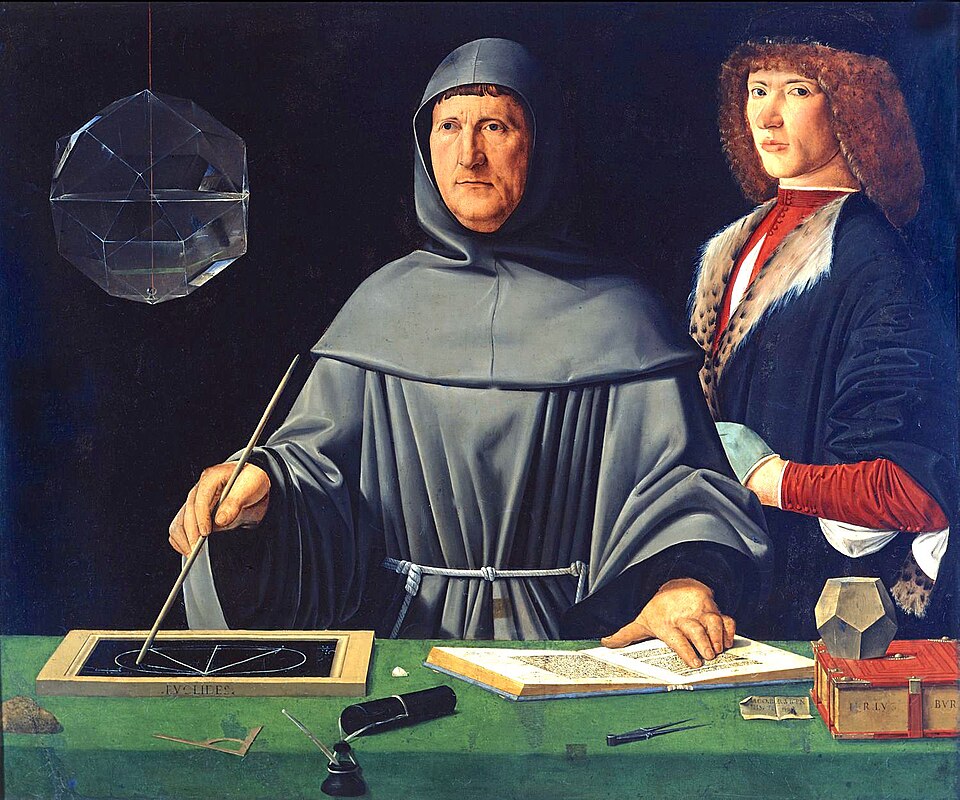
Luca Pacioli
0 sources
Luca Pacioli
Summary
Luca Pacioli is a human[1]. His place of birth was Sansepolcro[2]. He was born on 1445[3]. He passed away in Sansepolcro[4]. He died on 1517[5]. He worked as a friar[6], mathematician[7], economist[8], accountant[9], and university teacher[10]. He ranks in the top 0.7% of human entities by monthly Wikipedia readership (514 views/month, #6,981 of 1,000,298).[11]
Key Facts
- Luca Pacioli was born in Sansepolcro[2].
- Luca Pacioli died in Sansepolcro[4].
- Luca Pacioli was born on 1445[3].
- Luca Pacioli was born on 1440[12].
- Luca Pacioli died on 1517[5].
- Luca Pacioli died on 1517[13].
- Luca Pacioli held citizenship in Republic of Florence[14].
- Luca Pacioli's professions included friar[6].
- Luca Pacioli's professions included mathematician[7].
- Luca Pacioli worked as an economist[8].
- Luca Pacioli's professions included accountant[9].
- Luca Pacioli's professions included university teacher[10].
- Luca Pacioli worked as an inventor[15].
- Luca Pacioli's field of work was theology[16].
- Luca Pacioli's field of work was Franciscan spirituality[17].
- Luca Pacioli's field of work was mathematics[18].
- Among Luca Pacioli's employers was University of Perugia[19].
- Luca Pacioli was employed by Sapienza University of Rome[20].
- Luca Pacioli was employed by University of Milan[21].
- A notable work attributed to Luca Pacioli is Summa de arithmetica[22].
- A notable work attributed to Luca Pacioli is De divina proportione[23].
- A notable work attributed to Luca Pacioli is The Rules of Double-Entry Bookkeeping[24].
- A notable work attributed to Luca Pacioli is De ludo scachorum[25].
- Luca Pacioli's religion is recorded as Catholic Church[26].
- Luca Pacioli is recorded as male[27].
Body
Origins and Family
Luca Pacioli's place of birth was Sansepolcro[2]. Recorded date of birth include 1445[3] and 1440[12].
Career and Affiliations
Recorded occupations include friar[6], mathematician[7], economist[8], accountant[9], university teacher[10], and inventor[15]. Fields of work include theology[16], an academic discipline[28]; Franciscan spirituality[17]; and mathematics[18], an academic discipline[29]. Employers include University of Perugia[19], a university[30], in Italy[31], founded in 1308[32]; Sapienza University of Rome[20], a public university[33], in Italy[34], founded in 1303[35], headquartered in città universitaria of Rome[36]; and University of Milan[21], a public research university[37], in Italy[38], founded in 1923[39], headquartered in Milan[40]. Luca Pacioli supervised Domenico Maria Novara da Ferrara as a doctoral student[41].
Works and Contributions
Notable works include Summa de arithmetica[22], a literary work[42]; De divina proportione[23], a written work[43], in Republic of Venice[44], founded in 1498[45]; The Rules of Double-Entry Bookkeeping[24]; and De ludo scachorum[25], a literary work[46], founded in 1500[47].
Personal Life
Luca Pacioli's religion is recorded as Catholic Church[26].
Death and Burial
Recorded date of death include 1517[5]. Luca Pacioli passed away in Sansepolcro[4].
Why It Matters
Luca Pacioli ranks in the top 0.7% of human entities by monthly Wikipedia readership (514 views/month, #6,981 of 1,000,298).[11] He has Wikipedia articles in 28 language editions, a strong signal of global cultural recognition.[48] He is known by 33 alternative names across languages and contexts.[49]
Works attributed to him include De divina proportione[50], a written work[51], in Republic of Venice[52], founded in 1498[53]; Summa de arithmetica[54], a literary work[55]; and De ludo scachorum[56], a literary work[57], founded in 1500[58].
His notable doctoral advisees include Domenico Maria Novara da Ferrara[59], an astronomer[60], 1454–1504[61].
FAQs
Where was Luca Pacioli born?
Born in Sansepolcro[2], Luca Pacioli…
Where did Luca Pacioli die?
Luca Pacioli passed away in Sansepolcro[4].
What did Luca Pacioli do for work?
Luca Pacioli worked as friar[6], mathematician[7], economist[8], accountant[9], and university teacher[10].