
lead(II) oxide
chemical compound
Press Enter · cited answer in seconds
0 sources
lead(II) oxide
Summary
lead(II) oxide is a type of chemical entity[1]. It ranks in the top 5% of type_of_chemical_entity entities by monthly Wikipedia readership (7 views/month).[2]
Key Facts
- lead(II) oxide's instance of is recorded as type of chemical entity[3].
- lead(II) oxide's canonical SMILES is recorded as O=[Pb][4].
- lead(II) oxide's chemical formula is recorded as PbO[5].
- lead(II) oxide is a type of lead oxide[6].
- lead(II) oxide's Commons category is recorded as Lead(II) oxide[7].
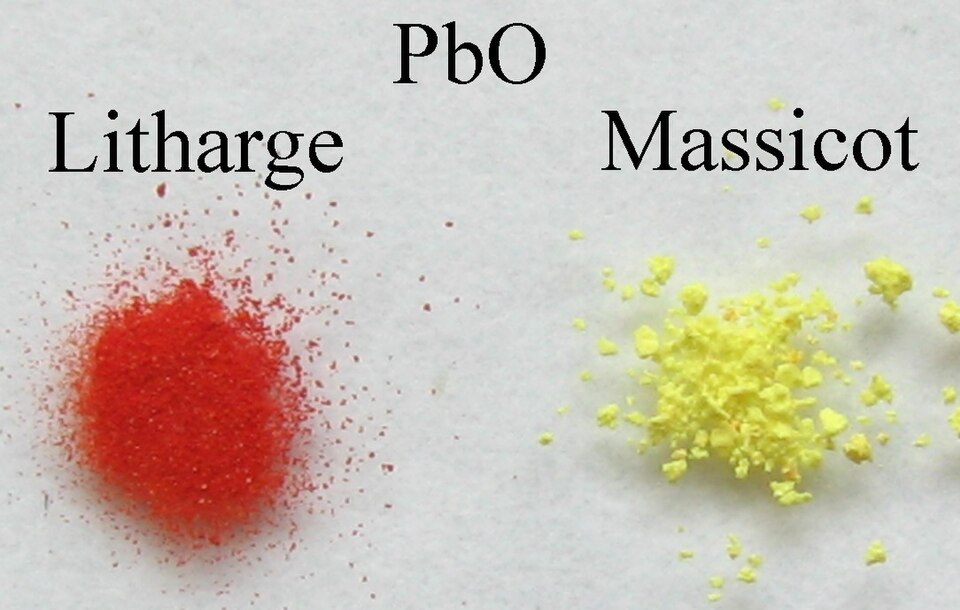
- lead(II) oxide's said to be the same as is recorded as massicot[8].
- lead(II) oxide's said to be the same as is recorded as litharge[9].
- lead(II) oxide's crystal system is recorded as orthorhombic crystal system[10].
- lead(II) oxide's crystal system is recorded as tetragonal crystal system[11].
- lead(II) oxide's point group is recorded as ditetragonal-dipyramidal[12].
- lead(II) oxide's space group is recorded as space group P4/nmm[13].
- lead(II) oxide's described by source is recorded as Great Soviet Encyclopedia (1926–1947)[14].
- lead(II) oxide's described by source is recorded as Great Soviet Encyclopedia (1926–1947)[15].
- lead(II) oxide's described by source is recorded as Massicot and litharge, the two modifications of lead monoxide[16].
- lead(II) oxide's described by source is recorded as Meyers Konversations-Lexikon, 4th edition (1885–1890)[17].
- lead(II) oxide's density is recorded as {'amount': '+8810.23'}[18].
- lead(II) oxide's mass is recorded as {'amount': '+223.971567'}[19].
- lead(II) oxide's melting point is recorded as {'amount': '+1161.15'}[20].
- lead(II) oxide's boiling point is recorded as {'amount': '+1743.15'}[21].
- lead(II) oxide's has part is recorded as oxygen[22].
- lead(II) oxide's has part is recorded as lead[23].
- lead(II) oxide's standard molar entropy is recorded as {'amount': '+239.98'}[24].
- lead(II) oxide's standard molar entropy is recorded as {'amount': '+73.38'}[25].
- lead(II) oxide's standard enthalpy of formation is recorded as {'amount': '+70.29'}[26].
- lead(II) oxide's standard enthalpy of formation is recorded as {'amount': '-202.25'}[27].
Body
Works and Contributions
Things named for lead(II) oxide include litharge[28], a mineral species[29] and massicot[30], a mineral species[31].
Why It Matters
lead(II) oxide ranks in the top 5% of type_of_chemical_entity entities by monthly Wikipedia readership (7 views/month).[2] It has Wikipedia articles in 25 language editions, a strong signal of global cultural recognition.[32] It is known by 84 alternative names across languages and contexts.[33]
Entities named for it include litharge[28], a mineral species[29] and massicot[30], a mineral species[31].