
Kwantung Leased Territory
0 sources
Kwantung Leased Territory was established in 1905. The territory had a capital, which was Dalian. At the time of its establishment, the economic activities within the territory were facilitated by the use of yen as the currency.
Prior to its establishment, the population of the area that would become Kwantung Leased Territory was approximately 250k in 1898. The territory itself covered an area of 3.2k.
It is worth noting that these details provide a glimpse into the characteristics of Kwantung Leased Territory. The combination of its establishment year, capital, currency, population, and area offer a factual overview of the territory.
The specifics of Kwantung Leased Territory, including its establishment in 1905, capital Dalian, currency yen, population of 250k in 1898, and area of 3.2k, are key to understanding this administrative area.
Key Facts
- Kwantung Leased Territory is located in Ta-lien[3].
- Kwantung Leased Territory is in the country of Empire of Japan[4].
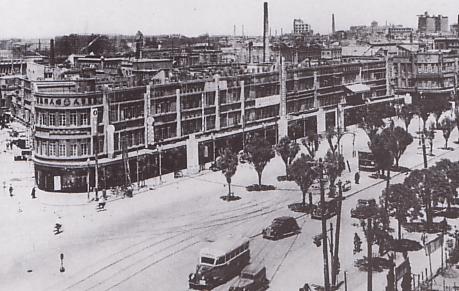
- Kwantung Leased Territory's image is recorded as Rensa-Gai in Dairen.JPG[5].
- Kwantung Leased Territory's instance of is recorded as first-level administrative division[6].
- Kwantung Leased Territory's instance of is recorded as concession[7].
- Kwantung Leased Territory's capital is recorded as Dalian[8].
- Kwantung Leased Territory's capital is recorded as Lüshun[9].
- Kwantung Leased Territory's currency is recorded as yen[10].
- Kwantung Leased Territory's flag image is recorded as Flag of Japan (1870–1999).svg[11].
- Kwantung Leased Territory's coat of arms image is recorded as Emblem of Kantou Prefecture and Dairen City.png[12].
- Shanhai Pass is named after Kwantung Leased Territory[13].
- east is named after Kwantung Leased Territory[14].
- Kwantunskaya Oblast is named after Kwantung Leased Territory[15].
- Kwantung Leased Territory's executive body is recorded as Government-General of Kwantung[16].
- Kwantung Leased Territory's executive body is recorded as Kwantung Government[17].
- Kwantung Leased Territory's executive body is recorded as Kwantung Provincial Office[18].
- Kwantung Leased Territory's VIAF cluster ID is recorded as 140740191[19].
- Kwantung Leased Territory's locator map image is recorded as Kantoshu20141014-1.png[20].
- Kwantung Leased Territory's locator map image is recorded as Kwantung territory China 1921.jpg[21].
- Kwantung Leased Territory's locator map image is recorded as Map of Manchukuo divisions 1942 Kwantung.svg[22].
- Kwantung Leased Territory's Library of Congress authority ID is recorded as n82062735[23].
- Kwantung Leased Territory's NDL Authority ID is recorded as 00564988[24].
- Kwantung Leased Territory's Commons category is recorded as Kwantung Leased Territory[25].
- +1905-00-00T00:00:00Z marks the founding of Kwantung Leased Territory[26].
- Kwantung Leased Territory was dissolved in +1945-00-00T00:00:00Z[27].
Body
Geography
Kwantung Leased Territory is in the country of Empire of Japan[4]. It is located in Ta-lien[3].
Physical Characteristics
Kwantung Leased Territory's area is recorded as {'unit': 'square kilometre', 'amount': '+3168'}[28]. Its population is recorded as {'amount': '+250000'}[29].
Designation and Status
Recorded instance of include first-level administrative division[6] and concession[7].
History and Context
+1905-00-00T00:00:00Z marks the founding of Kwantung Leased Territory[26]. Things named after include Shanhai Pass[13], a city gate[30], in People's Republic of China[31], founded in 1381[32]; east[14], a cardinal direction[33]; and Kwantunskaya Oblast[15], a former administrative territorial entity[34], in Russian Empire[35], founded in 1898[36].
Why It Matters
Kwantung Leased Territory draws 545 Wikipedia views per month (first_level_administrative_division category, ranking #6 of 10).[2] It has Wikipedia articles in 19 language editions, a strong signal of global cultural recognition.[37] It is known by 4 alternative names across languages and contexts.[38]