
Julius Fučík
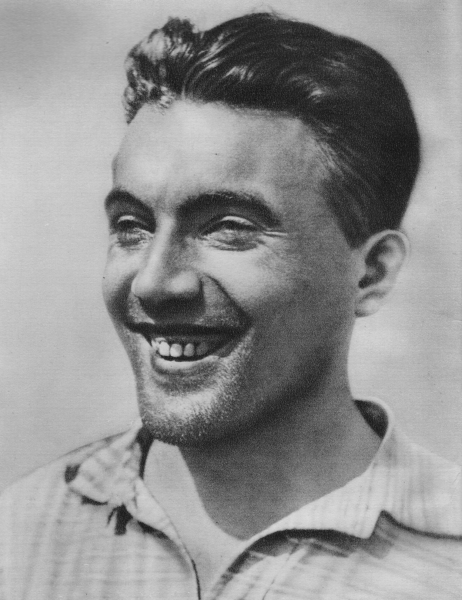
0 sources
Summary
Julius Fučík was born on February 23, 1903[1], in Smíchov[2]. He died on September 8, 1943[3], in Plötzensee Prison[4]. He worked as a translator[5], journalist[6], writer[7], publisher[8], and critic[9]. He ranks in the top 0.72% of human entities by monthly Wikipedia readership (1,862 views/month, #7,234 of 1,000,298).[10]
Key Facts
- Place of birth: Prague[11]
- Father: Karel Fučík[12]
- Spouse: Gusta Fučíková[13]
- Country of citizenship: Czechoslovakia[14], Cisleithania[15]
- Occupation: editing staff[16], anti-fascist[17]
- Educated at: Charles University[18]
- Notable work: Notes from the Gallows[19]
- Member of: Q135642976[20], Jef a Besi[21]
- Sex or gender: male[22]
- Member of political party: Communist Party of Czechoslovakia[23]
- Commons category: Julius Fučík (writer)[24]
- Cause of death: hanging to death[25]
- Family name: Fučík[26]
- Given name: Julius[27]
- Pseudonym: J. F. Pavlov[28]
- Topic's main category: Category:Julius Fučík (writer)[29]
- Described at URL: https://www.fruehe-texte-holocaustliteratur.de/wiki/Fu%C4%8D%C3%ADk,Julius(1903-1943)[30]
- Relative: Julius Fučík[31]
- Manner of death: capital punishment[32]
- Partner in business or sport: Bohumila Sílová[33]
- Described by source: Great Soviet Encyclopedia (1969–1978)[34], Armenian Soviet Encyclopedia[35], History of Everyday Life Database[36], regional database of the Pilsen City Library[37], Faces of Moscow[38]
- Languages spoken, written or signed: Czech[39]
- Birth name: Julius Jaroslav Fučík[40]
- Name in native language: Julius Fučík[41]
Body
Works and Contributions
Things named for Julius Fučík include Nádraží Holešovice[42], a metro station[43], in Czech Republic[44], founded in 1984[45]; 2345 Fučik[46], an asteroid[47]; and Mount Fučík[48], a mountain[49].
Why It Matters
Julius Fučík has Wikipedia articles in 17 language editions, a strong signal of global cultural recognition.[50] He is known by 16 alternative names across languages and contexts.[51]
Works attributed to him include Notes from the Gallows[52], a literary work[53]. Entities named for him include Nádraží Holešovice[42], a metro station[43], in Czech Republic[44], founded in 1984[45]; 2345 Fučik[46], an asteroid[47]; and Mount Fučík[48], a mountain[49].
FAQs
Where was Julius Fučík born?
Julius Fučík was born in Smíchov[2].
Where did Julius Fučík die?
Julius Fučík passed away in Plötzensee Prison[4].
Who were Julius Fučík's parents?
Julius Fučík's father was Karel Fučík[12].
Who was Julius Fučík married to?
Julius Fučík's spouses include Gusta Fučíková[13].
What did Julius Fučík do for work?
Julius Fučík worked as a translator[5], journalist[6], writer[7], publisher[8], and critic[9].
Where did Julius Fučík go to school?
Julius Fučík was educated at Charles University[18].