
Julian Seymour Schwinger
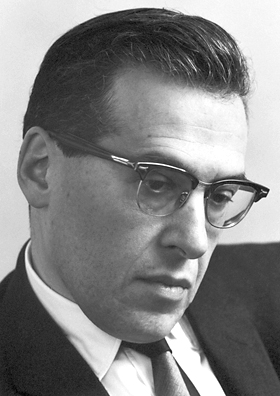
0 sources
Summary
Julian Seymour Schwinger was born in New York City[1]. He died in Los Angeles[2]. He worked as a university teacher[3], non-fiction writer[4], mathematician[5], theoretical physicist[6], and nuclear physicist[7]. He ranks in the top 0.7% of human entities by monthly Wikipedia readership (2,925 views/month, #7,045 of 1,000,298).[8]
Key Facts
- Place of burial: Mount Auburn Cemetery[9]
- Country of citizenship: United States[10]
- Occupation: physicist[11]
- Field of work: quantum electrodynamics[12]
- Employer: University of California, Los Angeles[13], Harvard University[14], Purdue University[15], University of California, Berkeley[16], Massachusetts Institute of Technology[17]
- Educated at: Columbia University[18], City College of New York[19], Townsend Harris High School[20]
- Doctoral advisor: Isidor Isaac Rabi[21]
- Award received: Albert Einstein Award[22], Josiah Willard Gibbs Lectureship[23], National Medal of Science[24], Nobel Prize in Physics[25], Guggenheim Fellowship[26], doctor honoris causa from the Pierre and Marie Curie University[27], Fellow of the American Physical Society[28], Humboldt Prize[29]
- Sex or gender: male[30]
- Doctoral student: Daniel J. Kleitman[31], Roy J. Glauber[32], Sheldon Glashow[33], Bryce DeWitt[34], Sam Edwards[35], Margaret G. Kivelson[36], Lawrence Paul Horwitz[37], David Feldman[38], Richard Arnowitt[39], Charles M. Sommerfield[40], Paul C. Martin[41], Roger G. Newton[42], Raymond F. Sawyer[43], Kenneth A. Johnson[44]
Body
Works and Contributions
Things named for Julian Seymour Schwinger include Schwinger–Dyson equation[45], Rarita–Schwinger equation[46], KMS state[47], and Schwinger model[48].
Why It Matters
Julian Seymour Schwinger has Wikipedia articles in 29 language editions, a strong signal of global cultural recognition.[49] He is known by 53 alternative names across languages and contexts.[50]
Entities named for him include Schwinger–Dyson equation[45], Rarita–Schwinger equation[46], KMS state[47], and Schwinger model[48].
His notable doctoral advisees include Sheldon Glashow[51], Roy J. Glauber[52], Walter Kohn[53], Bryce DeWitt[54], Daniel J. Kleitman[55], and Jeremy Bernstein[56].
FAQs
Where was Julian Seymour Schwinger born?
Julian Seymour Schwinger's place of birth was New York City[1].
Where did Julian Seymour Schwinger die?
Julian Seymour Schwinger passed away in Los Angeles[2].
What did Julian Seymour Schwinger do for work?
Julian Seymour Schwinger worked as a university teacher[3], non-fiction writer[4], mathematician[5], theoretical physicist[6], and nuclear physicist[7].
Where did Julian Seymour Schwinger go to school?
Julian Seymour Schwinger was educated at Columbia University[18], City College of New York[19], and Townsend Harris High School[20].
What awards did Julian Seymour Schwinger receive?
Honors received include Albert Einstein Award[22], Josiah Willard Gibbs Lectureship[23], National Medal of Science[24], and Nobel Prize in Physics[25].