
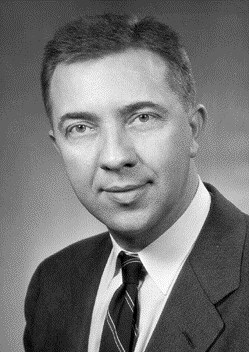
James A. Van Allen
0 sources
Summary
James A. Van Allen was born on September 7, 1914[1], in Mount Pleasant[2]. He died on August 9, 2006[3], in Iowa City[4]. He worked as a physicist[5], astronomer[6], nuclear physicist[7], university teacher[8], and earth scientist[9]. He ranks in the top 0.72% of human entities by monthly Wikipedia readership (563 views/month, #7,211 of 1,000,298).[10]
Key Facts
- Place of burial: Southampton Cemetery[11]
- Country of citizenship: United States[12]
- Field of work: astrophysics[13]
- Employer: Carnegie Institution for Science[14], University of Iowa[15], Johns Hopkins University Applied Physics Laboratory[16]
- Educated at: University of Iowa[17], Iowa Wesleyan University[18], Mount Pleasant Community High School[19]
- Notable work: Van Allen radiation belt[20], radio proximity fuze[21]
- Award received: Guggenheim Fellowship[22], Elliott Cresson Medal[23], William Procter Prize for Scientific Achievement[24], Gold Medal of the Royal Astronomical Society[25], National Medal of Science[26], William Bowie Medal[27], Gerard P. Kuiper Prize[28], Richtmyer Memorial Lecture Award[29], Time Person of the Year[30], Vannevar Bush Award[31], Crafoord Prize in Geosciences[32], John Adam Fleming Medal[33], International Space Hall of Fame[34], Nevada Medal[35]
- Member of: Royal Swedish Academy of Sciences[36], American Academy of Arts and Sciences[37], American Philosophical Society[38], American Astronomical Society[39], American Physical Society[40], National Academy of Sciences[41]
- Sex or gender: male[42]
- Doctoral student: George H. Ludwig[43], Robert Ellis[44]
- Commons category: James Van Allen[45]
- Cause of death: heart failure[46]
- Academic degree: Bachelor of Science[47], Master of Science[48], Doctor of Philosophy[49]
- Family name: Van Allen[50], Allen[51]
- Given name: James[52]
- Manner of death: natural causes[53]
- Described by source: Physicists: Biographical Dictionary[54], Astronomers: A Biographical Reference[55]
Body
Works and Contributions
Things named for James A. Van Allen include Van Allen radiation belt[56], an astrophysical process[57]; Van Allen Probes[58], a space mission[59], in United States[60]; Van Allen Range[61], a mountain range[62]; Van Allen Probe B[63], a geomagnetic satellite[64]; and Van Allen Probe A[65], a geomagnetic satellite[66].
Why It Matters
James A. Van Allen has Wikipedia articles in 26 language editions, a strong signal of global cultural recognition.[67] He is known by 51 alternative names across languages and contexts.[68]
He has been cited as an influence by James E. Hansen[69], a physicist[70], b. 1941[71], of United States[72], awarded the Sophie Prize[73], specialised in atmospheric physics[74].
Entities named for him include Van Allen radiation belt[56], an astrophysical process[57]; Van Allen Probes[58], a space mission[59], in United States[60]; Van Allen Range[61], a mountain range[62]; Van Allen Probe B[63], a geomagnetic satellite[64]; and Van Allen Probe A[65], a geomagnetic satellite[66].
FAQs
Where was James A. Van Allen born?
James A. Van Allen was born in Mount Pleasant[2].
Where did James A. Van Allen die?
James A. Van Allen died in Iowa City[4].
What did James A. Van Allen do for work?
James A. Van Allen worked as a physicist[5], astronomer[6], nuclear physicist[7], university teacher[8], and earth scientist[9].
Where did James A. Van Allen go to school?
James A. Van Allen was educated at University of Iowa[17], Iowa Wesleyan University[18], and Mount Pleasant Community High School[19].
What awards did James A. Van Allen receive?
Honors received include Guggenheim Fellowship[22], Elliott Cresson Medal[23], William Procter Prize for Scientific Achievement[24], and Gold Medal of the Royal Astronomical Society[25].
Who did James A. Van Allen influence?
James A. Van Allen has been cited as an influence by James E. Hansen[69].