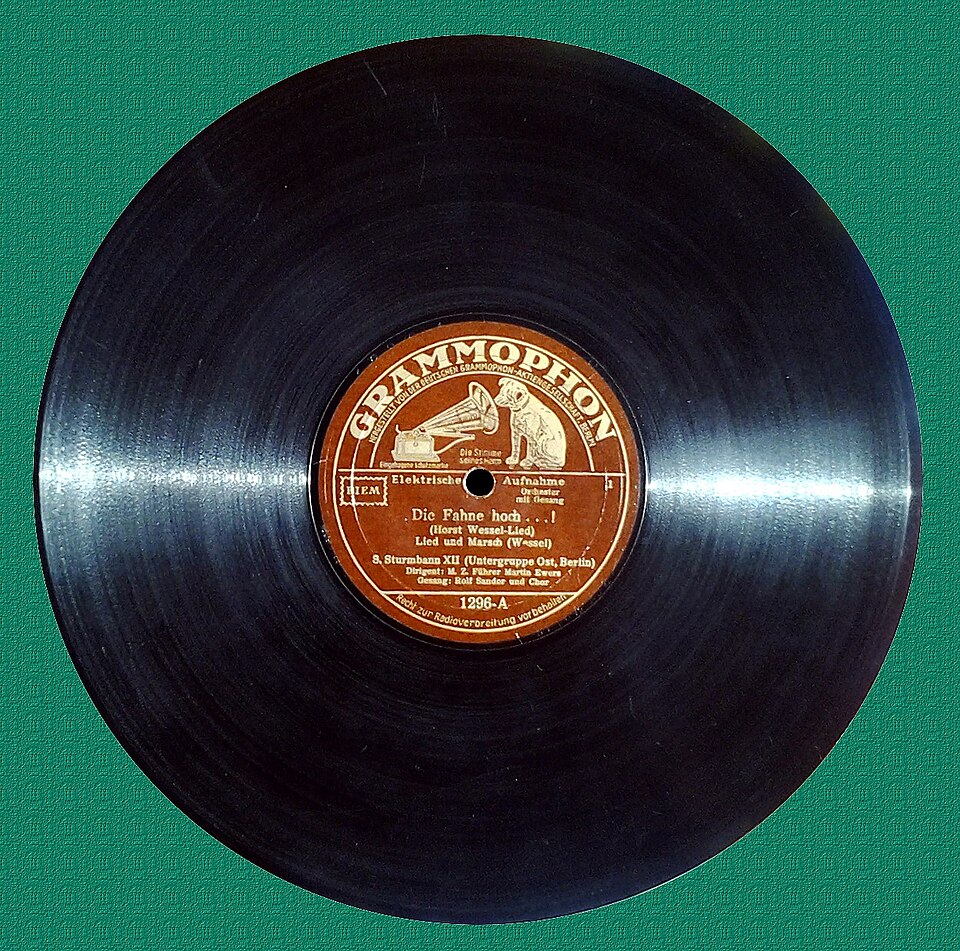
Horst-Wessel-Lied
0 sources
Horst-Wessel-Lied
Summary
Horst-Wessel-Lied is a musical work/composition[1]. Horst-Wessel-Lied ranks in the top 0.58% of musical_work_composition entities by monthly Wikipedia readership (4,695 views/month, #112 of 19,375).[2]
Key Facts
- Horst-Wessel-Lied is in the country of Nazi Germany[3].
- Horst-Wessel-Lied's instance of is recorded as musical work/composition[4].
- Horst Wessel is named after Horst-Wessel-Lied[5].
- Horst-Wessel-Lied's Commons category is recorded as Horst-Wessel-Lied[6].
- Horst-Wessel-Lied's language of work or name is recorded as German[7].
- Horst-Wessel-Lied was released on 1927[8].
- Horst-Wessel-Lied's lyricist is recorded as Horst Wessel[9].
- Horst-Wessel-Lied's main subject is Sturmabteilung[10].
- Horst-Wessel-Lied's main subject is Roter Frontkämpferbund[11].
- Horst-Wessel-Lied's has melody is recorded as How Great Thou Art[12].
- Horst-Wessel-Lied's first line is recorded as {'lang': 'de', 'text': 'Die Fahne hoch! Die Reihen fest geschlossen!'}[13].
- Horst-Wessel-Lied's discontinuation date is recorded as 1945[14].
- Horst-Wessel-Lied's last line is recorded as {'lang': 'de', 'text': 'Marschier’n im Geist in unser’n Reihen mit.'}[15].
- Horst-Wessel-Lied's form of creative work is recorded as song[16].
Product Details
The following facts are restated verbatim from public-domain and CC0 open-data sources — every line is independently verifiable against the named source's catalog.
MusicBrainz — CC0 open music encyclopedia
Body
Publication
Horst-Wessel-Lied was released on 1927[8]. Horst-Wessel-Lied's language of work or name is recorded as German[7].
Subject and Themes
Main subjects include Sturmabteilung[10] and Roter Frontkämpferbund[11].
Why It Matters
Horst-Wessel-Lied ranks in the top 0.58% of musical_work_composition entities by monthly Wikipedia readership (4,695 views/month, #112 of 19,375).[2] Horst-Wessel-Lied has Wikipedia articles in 28 language editions, a strong signal of global cultural recognition.[19] Horst-Wessel-Lied is known by 55 alternative names across languages and contexts.[20]