
Heinrich Anton de Bary
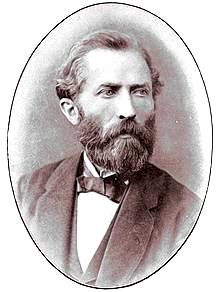
0 sources
Heinrich Anton de Bary was born on January 26, 1831, in the Free City of Frankfurt.[1][2][3][4][5][6] His father was August Theodor de Bary. His religion was Huguenots. He held citizenship in the Free City of Frankfurt and the Kingdom of Prussia.
He worked as a botanist, surgeon, university teacher, mycologist, entomologist, and botanical collector.[7][8][9] His field included botany, mycology, and bacteriology.[10][11] He was educated at the University of Marburg, Heidelberg University, Frederick William University Berlin, and the University of Tübingen.
He was employed by the University of Tübingen, the University of Freiburg (1855–1867), Martin Luther University Halle-Wittenberg (1867–1872), and the University of Strasbourg (1872–1888).[12] He was a member of the Royal Society, the Royal Swedish Academy of Sciences, the Bavarian Academy of Sciences and Humanities, and the Saint Petersburg Academy of Sciences.[13] He died on January 19, 1888, in Strasbourg, with cause of death listed as tumor.[1][2][3][5][6] He had a spouse, Marie Antonie de Bary (1861–present)..
Key Facts
- Heinrich Anton de Bary was born in Free City of Frankfurt[2].
- Heinrich Anton de Bary passed away in Strasbourg[4].
- Heinrich Anton de Bary was born on January 26, 1831[3].
- Heinrich Anton de Bary died on January 19, 1888[5].
- Heinrich Anton de Bary's father was August Theodor de Bary[12].
- Heinrich Anton de Bary was married to Marie Antonie de Bary[13].
- Heinrich Anton de Bary held citizenship in Free City of Frankfurt[14].
- Heinrich Anton de Bary held citizenship in Kingdom of Prussia[15].
- Heinrich Anton de Bary's professions included botanist[6].
- Heinrich Anton de Bary's professions included surgeon[7].
- Heinrich Anton de Bary's professions included university teacher[8].
- Heinrich Anton de Bary worked as a mycologist[9].
- Heinrich Anton de Bary's professions included entomologist[10].
- Heinrich Anton de Bary's professions included botanical collector[16].
- Heinrich Anton de Bary's field of work was botany[17].
- Heinrich Anton de Bary's field of work was mycology[18].
- Heinrich Anton de Bary's field of work was bacteriology[19].
- Heinrich Anton de Bary was employed by University of Tübingen[20].
- Heinrich Anton de Bary was employed by University of Freiburg[21].
- Heinrich Anton de Bary was employed by Martin Luther University Halle-Wittenberg[22].
- Heinrich Anton de Bary was employed by University of Strasbourg[23].
- Heinrich Anton de Bary was educated at University of Marburg[24].
- Heinrich Anton de Bary's education included a stint at Heidelberg University[25].
- Heinrich Anton de Bary's education included a stint at Frederick William University Berlin[26].
- Heinrich Anton de Bary's education included a stint at University of Tübingen[27].
Body
Origins and Family
Heinrich Anton de Bary was born in Free City of Frankfurt[2]. He was born on January 26, 1831[3]. His father was August Theodor de Bary[12].
Education
Educated at University of Marburg[24], a public university[28], in Germany[29], founded in 1527[30], headquartered in Marburg[31]; Heidelberg University[25], a public research university[32], in Germany[33], founded in 1386[34], headquartered in Heidelberg[35]; Frederick William University Berlin[26], a university[36], in Prussia[37], founded in 1828[38]; and University of Tübingen[27], a comprehensive university[39], in Germany[40], founded in 1477[41], headquartered in Tübingen[42].
Career and Affiliations
Recorded occupations include botanist[6], surgeon[7], university teacher[8], mycologist[9], entomologist[10], and botanical collector[16]. Fields of work include botany[17], an academic discipline[43]; mycology[18], an academic discipline[44]; and bacteriology[19], a branch of biology[45]. Employers include University of Tübingen[20], a comprehensive university[46], in Germany[47], founded in 1477[48], headquartered in Tübingen[49]; University of Freiburg[21], a public university[50], in Germany[51], founded in 1457[52], headquartered in Freiburg im Breisgau[53]; Martin Luther University Halle-Wittenberg[22], a public university[54], in Germany[55], founded in 1502[56], headquartered in Halle (Saale)[57]; and University of Strasbourg[23], a university[58], in France[59], founded in 1538[60]. Notable students include Frederick Orpen Bower[61], a botanist[62], 1855–1948[63], of United Kingdom[64], awarded the Fellow of the Royal Society[65]; Julius Oscar Brefeld[66], a botanist[67], 1839–1925[68], of Kingdom of Prussia[69], specialised in botany[70]; Francis Darwin[71]; William Gilson Farlow[72]; Karl Ritter von Goebel[73]; and Pierre-Marie-Alexis Millardet[74]. Doctoral students include Eduard Fischer[75], a botanist[76], 1861–1939[77], of Switzerland[78], awarded the Fellow of the Linnean Society of London[79], specialised in mycology[80] and Sergei Winogradsky[81], a professor[82], 1856–1953[83], of Russian Empire[84], awarded the Leeuwenhoek Medal[85], specialised in microbiology[86].
Personal Life
Heinrich Anton de Bary was married to Marie Antonie de Bary[13]. His religion is recorded as Huguenots[87].
Death and Burial
Heinrich Anton de Bary died on January 19, 1888[5]. He died in Strasbourg[4]. The cause of death was tumor[88].
Why It Matters
Heinrich Anton de Bary ranks in the top 0.72% of human entities by monthly Wikipedia readership (99 views/month, #7,248 of 1,000,298).[11] He has Wikipedia articles in 19 language editions, a strong signal of global cultural recognition.[89] He is known by 38 alternative names across languages and contexts.[90]
He has been cited as an influence by Sergei Winogradsky[91], a professor[92], 1856–1953[93], of Russian Empire[94], awarded the Leeuwenhoek Medal[95], specialised in microbiology[96].
His notable doctoral advisees include Sergei Winogradsky[97], a professor[98], 1856–1953[99], of Russian Empire[100], awarded the Leeuwenhoek Medal[101], specialised in microbiology[102]; Mikhail Stepanovich Voronin[103], a botanist[104], 1838–1903[105], of Russian Empire[106], awarded the Order of Saint Stanislaus, 3rd class[107], specialised in phycology[108]; and Eduard Fischer[109], a botanist[110], 1861–1939[111], of Switzerland[112], awarded the Fellow of the Linnean Society of London[113], specialised in mycology[114].
FAQs
Where was Heinrich Anton de Bary born?
Heinrich Anton de Bary's place of birth was Free City of Frankfurt[2].
Where did Heinrich Anton de Bary die?
Heinrich Anton de Bary passed away in Strasbourg[4].
Who were Heinrich Anton de Bary's parents?
Heinrich Anton de Bary's father was August Theodor de Bary[12].
Who was Heinrich Anton de Bary married to?
Heinrich Anton de Bary's spouses include Marie Antonie de Bary[13].
What did Heinrich Anton de Bary do for work?
Heinrich Anton de Bary worked as botanist[6], surgeon[7], university teacher[8], mycologist[9], and entomologist[10].
Where did Heinrich Anton de Bary go to school?
Heinrich Anton de Bary was educated at University of Marburg[24], Heidelberg University[25], Frederick William University Berlin[26], and University of Tübingen[27].
Who did Heinrich Anton de Bary influence?
Heinrich Anton de Bary has been cited as an influence by Sergei Winogradsky[91].