
Gregorian chant
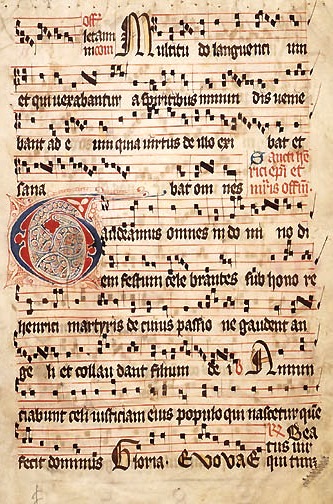
0 sources
Gregorian chant
Summary
Gregorian chant is a music genre[1]. It ranks in the top 4% of music_genre entities by monthly Wikipedia readership (4,342 views/month).[2]
Key Facts
- Gregorian chant's instance of is recorded as music genre[3].
- Gregorian chant's instance of is recorded as song type[4].
- Gregorian chant's instance of is recorded as musical form[5].
- Gregory I is named after Gregorian chant[6].
- Gregorian chant is a type of monody[7].
- Gregorian chant is a type of plainsong[8].
- Gregorian chant's Commons category is recorded as Gregorian chant[9].
- Gregorian chant's language of work or name is recorded as Latin[10].
- Gregorian chant's country of origin is recorded as Europe[11].
- 900 marks the founding of Gregorian chant[12].
- Gregorian chant's topic's main category is recorded as Category:Gregorian chant[13].
- Gregorian chant's described by source is recorded as Riemann's Music Dictionary[14].
- Gregorian chant's described by source is recorded as Encyclopædia Britannica Ninth Edition[15].
- Gregorian chant's described by source is recorded as Brockhaus and Efron Encyclopedic Dictionary[16].
- Gregorian chant's described by source is recorded as Small Brockhaus and Efron Encyclopedic Dictionary[17].
- Gregorian chant's topic has template is recorded as Template:Gregorian chant[18].
- Gregorian chant's uses is recorded as repercussion[19].
- Gregorian chant's studied by is recorded as semiology[20].
- Gregorian chant's practiced by is recorded as gregorianist[21].
- Gregorian chant's on focus list of Wikimedia project is recorded as Wikipedia:Vital articles/Level/4[22].
Body
Definition and Type
Recorded instance of include music genre[3], song type[4], and musical form[5]. Recorded subclass of include monody[7] and plainsong[8].
Origins
Gregory I is named after Gregorian chant[6]. 900 marks the founding of it[12].
Influence
Things named for Gregorian chant include 100019 Gregorianik[23], an asteroid[24].
Why It Matters
Gregorian chant ranks in the top 4% of music_genre entities by monthly Wikipedia readership (4,342 views/month).[2] It has Wikipedia articles in 27 language editions, a strong signal of global cultural recognition.[25] It is known by 47 alternative names across languages and contexts.[26]
Entities named for it include 100019 Gregorianik[23], an asteroid[24].