
Frederick II of Prussia
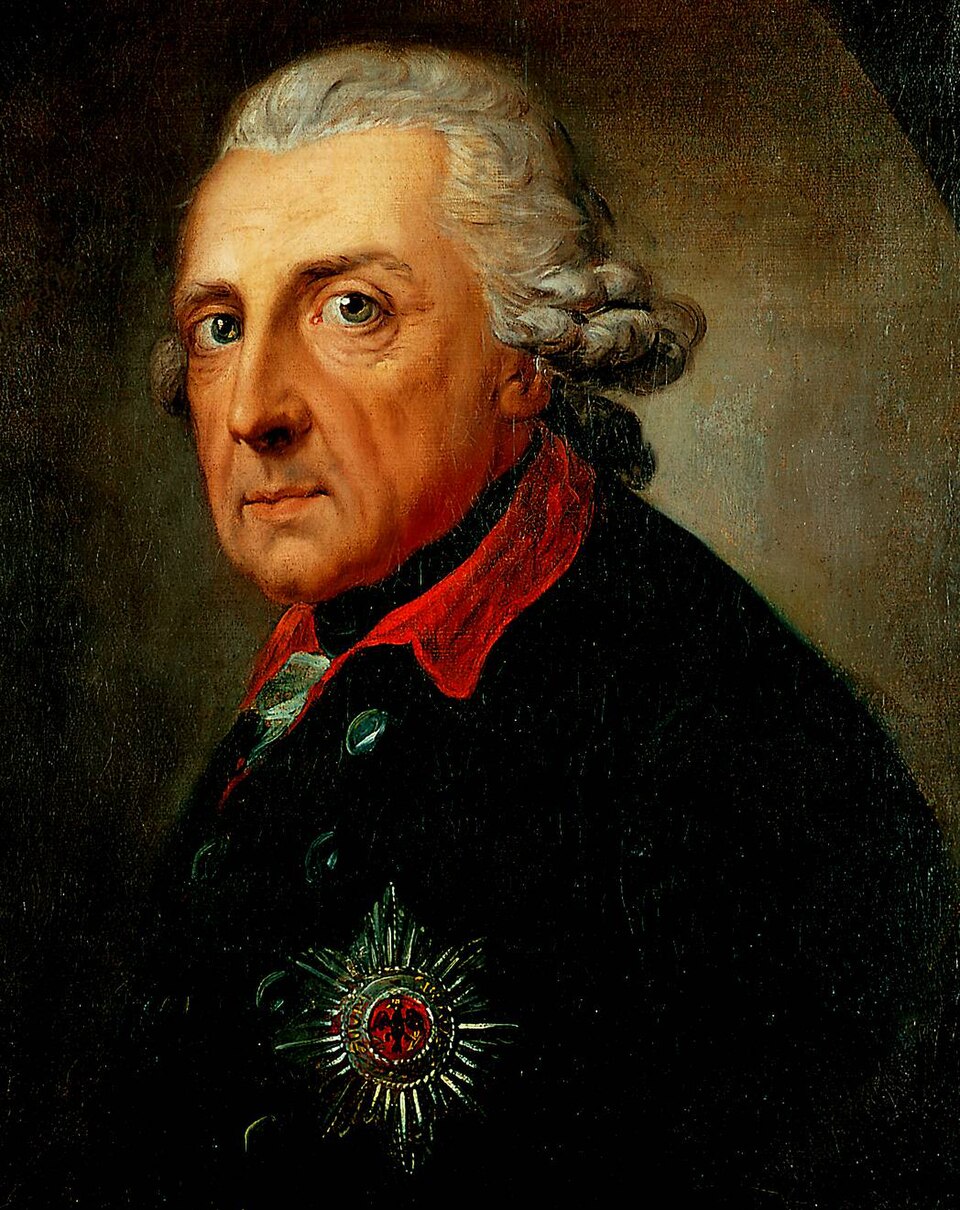
0 sources
Frederick II of Prussia
Summary
Frederick II of Prussia is a human[1]. He was born in Berlin[2]. He was born on January 24, 1712[3]. He died in Potsdam[4]. He died on August 17, 1786[5]. He worked as a ruler[6], art collector[7], monarch[8], king[9], and librettist[10]. He ranks in the top 0.36% of human entities by monthly Wikipedia readership (21,361 views/month, #3,568 of 1,000,298).[11]
Key Facts
- Born in Berlin[2], Frederick II of Prussia…
- Frederick II of Prussia passed away in Potsdam[4].
- Frederick II of Prussia was born on January 24, 1712[3].
- Frederick II of Prussia died on August 17, 1786[5].
- Burial took place at Sanssouci Palace[12].
- Burial took place at Garrison Church[13].
- Frederick II of Prussia's father was Friedrich Wilhelm I of Prussia[14].
- Frederick II of Prussia's mother was Sophia Dorothea of Hanover[15].
- Among Frederick II of Prussia's spouses was Elisabeth Christine of Brunswick-Wolfenbüttel-Bevern[16].
- Frederick II of Prussia held citizenship in Kingdom of Prussia[17].
- Frederick II of Prussia held citizenship in Germany[18].
- Frederick II of Prussia worked as a ruler[6].
- Frederick II of Prussia worked as an art collector[7].
- Frederick II of Prussia's professions included monarch[8].
- Frederick II of Prussia worked as a king[9].
- Frederick II of Prussia worked as a librettist[10].
- Frederick II of Prussia's professions included composer[19].
- Frederick II of Prussia's field of work was political activity[20].
- Frederick II of Prussia's field of work was art[21].
- Frederick II of Prussia's field of work was music[22].
- Frederick II of Prussia's field of work was political science and government[23].
- Frederick II of Prussia held the position of Prince-Elector[24].
- Frederick II of Prussia held the position of King of Prussia[25].
- Frederick II of Prussia held the position of Margrave of Brandenburg[26].
- Frederick II of Prussia received the Order of the Black Eagle[27].
Body
Origins and Family
Frederick II of Prussia's place of birth was Berlin[2]. He was born on January 24, 1712[3]. His father was Friedrich Wilhelm I of Prussia[14]. His mother was Sophia Dorothea of Hanover[15].
Career and Affiliations
Recorded occupations include ruler[6], art collector[7], monarch[8], king[9], librettist[10], and composer[19]. Fields of work include political activity[20]; art[21], an academic major[28]; music[22], a type of arts[29]; and political science and government[23], an interdisciplinary science[30]. Positions held include Prince-Elector[24], a historical position[31]; King of Prussia[25], a hereditary position[32], founded in 1701[33]; and Margrave of Brandenburg[26], a historical position[34].
Recognition
Awards received include Order of the Black Eagle[27], an order[35], in Kingdom of Prussia[36], founded in 1701[37]; Order of the White Eagle (Polish–Lithuanian Commonwealth)[38]; Order of Saint Alexander Nevsky[39], an order[40], in Russian Empire[41], founded in 1725[42]; Order of St. Andrew[43], an order[44], in Russian Empire[45], founded in 1698[46]; Pour le Mérite[47], a courage award[48], in Prussia[49], founded in 1740[50]; and Royal Order of the Seraphim[51], an order[52], in Sweden[53], founded in 1748[54].
Personal Life
Frederick II of Prussia was married to Elisabeth Christine of Brunswick-Wolfenbüttel-Bevern[16]. His religion is recorded as Lutheranism[55].
Death and Burial
Frederick II of Prussia died on August 17, 1786[5]. He died in Potsdam[4]. The cause of death was disease[56]. Recorded place of burial include Sanssouci Palace[12] and Garrison Church[13].
Works and Contributions
Things named for Frederick II of Prussia include Friedrich d'or[57], a currency[58], in Kingdom of Prussia[59]; Frederici Honores[60], a former constellation[61], founded in 1787[62]; Frederician Rococo[63], an architectural style[64]; and Volkspark Friedrichshain[65], a park[66], in Germany[67], founded in 1848[68].
Why It Matters
Frederick II of Prussia ranks in the top 0.36% of human entities by monthly Wikipedia readership (21,361 views/month, #3,568 of 1,000,298).[11] He has Wikipedia articles in 30 language editions, a strong signal of global cultural recognition.[69] He is known by 134 alternative names across languages and contexts.[70]
He has been cited as an influence by Auguste Marie Henri Picot de Dampierre[71], a military personnel[72], 1756–1793[73], of France[74], awarded the list of names inscribed on the Arc de Triomphe[75], specialised in military affairs[76].
He is credited with the discovery of covered bond[77], founded in 1769[78]. Works attributed to him include Anti-Machiavel[79], a written work[80]. Entities named for him include Friedrich d'or[57], a currency[58], in Kingdom of Prussia[59]; Frederici Honores[60], a former constellation[61], founded in 1787[62]; Frederician Rococo[63], an architectural style[64]; and Volkspark Friedrichshain[65], a park[66], in Germany[67], founded in 1848[68].
FAQs
Where was Frederick II of Prussia born?
Born in Berlin[2], Frederick II of Prussia…
Where did Frederick II of Prussia die?
Frederick II of Prussia died in Potsdam[4].
Who were Frederick II of Prussia's parents?
Frederick II of Prussia's father was Friedrich Wilhelm I of Prussia[14]. Frederick II of Prussia's mother was Sophia Dorothea of Hanover[15].
Who was Frederick II of Prussia married to?
Frederick II of Prussia's spouses include Elisabeth Christine of Brunswick-Wolfenbüttel-Bevern[16].
What did Frederick II of Prussia do for work?
Frederick II of Prussia worked as ruler[6], art collector[7], monarch[8], king[9], and librettist[10].
What awards did Frederick II of Prussia receive?
Honors received include Order of the Black Eagle[27], Order of the White Eagle (Polish–Lithuanian Commonwealth)[38], Order of Saint Alexander Nevsky[39], and Order of St. Andrew[43].
Who did Frederick II of Prussia influence?
Frederick II of Prussia has been cited as an influence by Auguste Marie Henri Picot de Dampierre[71].
What did Frederick II of Prussia discover?
Frederick II of Prussia is credited as discoverer of covered bond[77].