
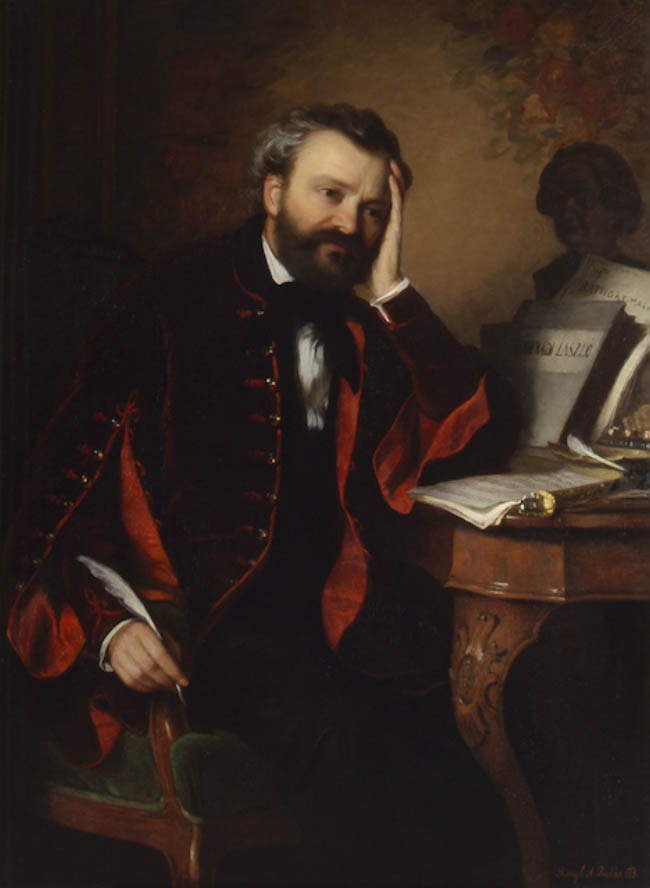
Ferenc Erkel
0 sources
Ferenc Erkel
Summary
Ferenc Erkel is a human[1]. He was born in Gyula[2]. He was born on November 7, 1810[3]. He died in Budapest[4]. He died on June 25, 1893[5]. He worked as a conductor[6], composer[7], chess player[8], music educator[9], and pianist[10]. He ranks in the top 0.72% of human entities by monthly Wikipedia readership (625 views/month, #7,251 of 1,000,298).[11]
Key Facts
- Ferenc Erkel's place of birth was Gyula[2].
- Ferenc Erkel passed away in Budapest[4].
- Ferenc Erkel was born on November 7, 1810[3].
- Ferenc Erkel was born on January 1810[12].
- Ferenc Erkel died on June 25, 1893[5].
- Ferenc Erkel died on June 15, 1893[13].
- Burial took place at Fiume Road Graveyard[14].
- Ferenc Erkel was married to Adél Adler[15].
- A child of Ferenc Erkel was Sándor Erkel[16].
- A child of Ferenc Erkel was Gyula Erkel[17].
- A child of Ferenc Erkel was László Erkel[18].
- A child of Ferenc Erkel was Elek Erkel[19].
- A child of Ferenc Erkel was Lajos Erkel[20].
- Ferenc Erkel held citizenship in Hungary[21].
- Ferenc Erkel held citizenship in Austrian Empire[22].
- Ferenc Erkel held citizenship in Austria–Hungary[23].
- Ferenc Erkel worked as a conductor[6].
- Ferenc Erkel worked as a composer[7].
- Ferenc Erkel's professions included chess player[8].
- Ferenc Erkel's professions included music educator[9].
- Ferenc Erkel's professions included pianist[10].
- Ferenc Erkel was employed by Franz Liszt Academy of Music[24].
- Ferenc Erkel's education included a stint at Franz Liszt Academy of Music[25].
- A notable student of Ferenc Erkel was Károly Szabados[26].
- A notable work attributed to Ferenc Erkel is Himnusz[27].
Product Details
The following facts are restated verbatim from public-domain and CC0 open-data sources — every line is independently verifiable against the named source's catalog.
MusicBrainz — CC0 open music encyclopedia
-
Type: Person[28]
-
Country: HU[29]
-
Began / founded: 1810-11-07[30]
-
Ended / dissolved: 1893-06-25[31]
-
Genre(s): classical, opera[32]
-
Community tags: classical, composer, opera, to clean up[33]
-
MusicBrainz ID: 645d98aa-7568-4399-bda9-d5f47aa7e8df[34]
Body
Origins and Family
Ferenc Erkel's place of birth was Gyula[2]. Recorded date of birth include November 7, 1810[3] and January 1810[12].
Education
Ferenc Erkel was educated at Franz Liszt Academy of Music[25].
Career and Affiliations
Recorded occupations include conductor[6], composer[7], chess player[8], music educator[9], and pianist[10]. Ferenc Erkel was employed by Franz Liszt Academy of Music[24]. A notable student of him was Károly Szabados[26].
Works and Contributions
Notable works include Himnusz[27], a national anthem[35], in Hungary[36] and Hunyadi László[37], a dramatico-musical work[38]. Things named for Ferenc Erkel include Erkel Theatre[39], a theatre building[40], in Hungary[41].
Recognition
Awards received include Knight's Cross of the Order of Franz Joseph[42], a grade of an order[43], in Austria–Hungary[44] and Order of the Iron Crown (Austria)[45], an order of merit[46], in Austria–Hungary[47], founded in 1816[48].
Personal Life
Among Ferenc Erkel's spouses was Adél Adler[15]. Children include Sándor Erkel[16], a composer[49], 1846–1900[50], of Hungary[51]; Gyula Erkel[17], a composer[52], 1842–1909[53], of Hungary[54]; László Erkel[18], a pianist[55], 1845–1896[56], of Hungary[57]; Elek Erkel[19], a composer[58], 1842–1893[59], of Hungary[60]; and Lajos Erkel[20], an opera singer[61], 1850–1906[62], of Hungary[63].
Death and Burial
Recorded date of death include June 25, 1893[5] and June 15, 1893[13]. Ferenc Erkel passed away in Budapest[4]. Burial took place at Fiume Road Graveyard[14].
Why It Matters
Ferenc Erkel ranks in the top 0.72% of human entities by monthly Wikipedia readership (625 views/month, #7,251 of 1,000,298).[11] He has Wikipedia articles in 23 language editions, a strong signal of global cultural recognition.[64] He is known by 23 alternative names across languages and contexts.[65]
Entities named for him include Erkel Theatre[39], a theatre building[40], in Hungary[41].
FAQs
Where was Ferenc Erkel born?
Ferenc Erkel was born in Gyula[2].
Where did Ferenc Erkel die?
Ferenc Erkel died in Budapest[4].
Who was Ferenc Erkel married to?
Ferenc Erkel's spouses include Adél Adler[15].
What did Ferenc Erkel do for work?
Ferenc Erkel worked as conductor[6], composer[7], chess player[8], music educator[9], and pianist[10].
Where did Ferenc Erkel go to school?
Ferenc Erkel was educated at Franz Liszt Academy of Music[25].
What awards did Ferenc Erkel receive?
Honors received include Knight's Cross of the Order of Franz Joseph[42] and Order of the Iron Crown (Austria)[45].